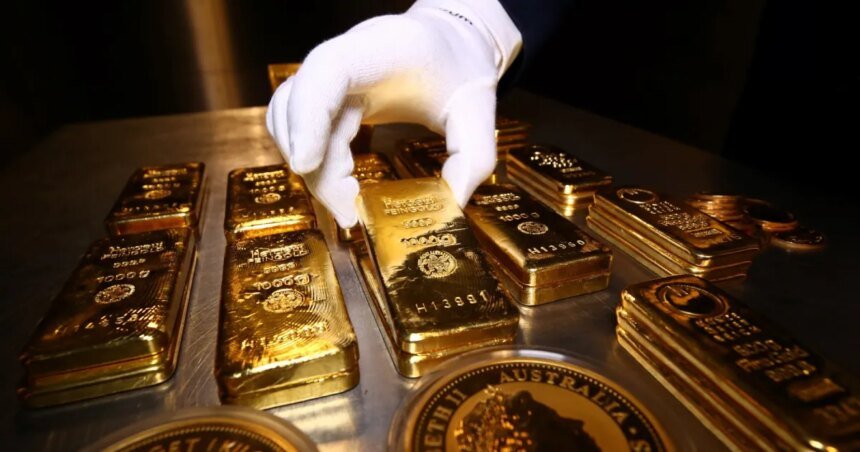
Central banks are heading to increase the weight of gold in their reserves during the next 12 months, with broader expectations of a decline in the relative share of the dollar in global reserves in the coming years, according to the World Gold Council’s survey for the current year.
The survey showed that 89% of the responding central banks expect official global gold reserves to rise within a year, while a record percentage of 45% expect their own gold holdings to increase, compared to 74% who expect the share of the dollar in global reserves to decrease within 5 years.
The expectations come with the increasing possibility of the US Federal Reserve and the European Central Bank raising interest rates during the current year, the shift in risk appetite after the announcement of a framework agreement to end the Iran war, and a deeper trend among central banks, especially in emerging economies, to diversify reserves and reduce concentration in the dollar.

International Monetary Fund data show that the dollar is still the first reserve currency, as its share of global foreign exchange reserves reached 56.77% in the last quarter of 2025, compared to 56.93% in the previous quarter, while the share of “other currencies” not classified separately rose to 6.13%.
Market strategist Ahmed Asiri said, in a comment to Al Jazeera Net, that the continuation of central banks to enhance their holdings of gold and reduce the relative dependence on the dollar “reflects a long-term shift in the management of sovereign assets more than it reflects a decline in the status of the American currency.”
He adds that the dollar is still the world’s first reserve currency, but an increasing number of central banks are seeking to reduce concentration in a single asset after years of economic sanctions and the restructuring of trade and financial alliances.
The survey conducted by the World Gold Council between February 5 and May 19, 2026, with the participation of 76 central banks, which is the highest sample since the survey began 9 years ago, shows that some participants stated that countries may reduce their dollar holdings if their relationship with Washington is affected, while other participants stressed that the liquidity and depth of dollar-denominated assets are still much higher than alternatives.
Gold as a hedging instrument
Among the 34 central banks that plan to increase gold within 12 months, 31 said that the motive is the policy of diversifying reserves, and 23 pointed to the need for gold as a hedging tool against inflation, exposure to the dollar, or market turmoil, while 23 others attributed the decision to the rise in economic risks in reserve currency economies, such as the US fiscal deficit or slow growth in advanced economies, according to the survey.
Asiri links this transformation to a global environment characterized by rising geopolitical tensions, continued inflation risks, and fluctuating interest paths. He says that assets that provide protection from shocks and contribute to diversifying countries’ huge reserve portfolios are gaining greater importance in such an environment, which is the role that attracts monetary policy makers to gold, especially in emerging economies.
Central banks argue that gold’s appeal has factors other than price; 90% of banks that own gold considered the metal’s performance during crises an important or very important factor, and 84% saw its role as a long-term store of value or as a hedge against inflation as a main reason for keeping it, while 83% considered it an effective tool for diversifying portfolios.
85% of banks in emerging and developing economies considered gold a hedge against geopolitical risks, compared to only 56% in advanced economies.
Asiri adds that gold has properties that are difficult to find in other assets. It does not carry credit risks, maintains its value in the long term, and shows strong performance during periods of crises and instability, which is why gold has become a strategic tool for managing long-term sovereign risks, not just a temporary haven when markets are turbulent, according to him.
At its meeting on June 17, 2026, the US Federal Reserve kept the interest range at 3.50% to 3.75%, and the European Central Bank raised the main interest rates by 25 basis points, bringing the deposit interest to 2.25%, the main refinancing interest to 2.40%, and the marginal lending interest to 2.65%, as of June 17, 2026.

Central banks have already taken action
- In China, the People’s Bank of China expanded its gold reserves for the 19th consecutive month in May, adding 320,000 ounces, bringing the total to 74.96 million ounces, or about 2,332 tons, according to data issued by the Chinese Central Bank.
- In Central Europe, the Czech National Bank announced that it had begun purchasing gold at a more active pace since 2023, increasing its holdings from about 12 tons at the end of 2022 to 80.8 tons at the end of May 2026, with a goal of reaching 100 tons by 2028.
- In January 2026, the Polish National Bank approved a plan to increase its gold reserves to 700 tons, placing it among the top 10 holders of gold globally.
Half of the central banks that intend to increase gold, according to the World Gold Council, said that they would finance purchases through local purchase programs in local currency, while 38% said that they would sell existing reserve assets.
The survey also showed that 9% increased domestic storage during the last 12 months, and 10% diversified their offshore storage locations, reflecting greater attention to the risks of acquisition and control of assets.