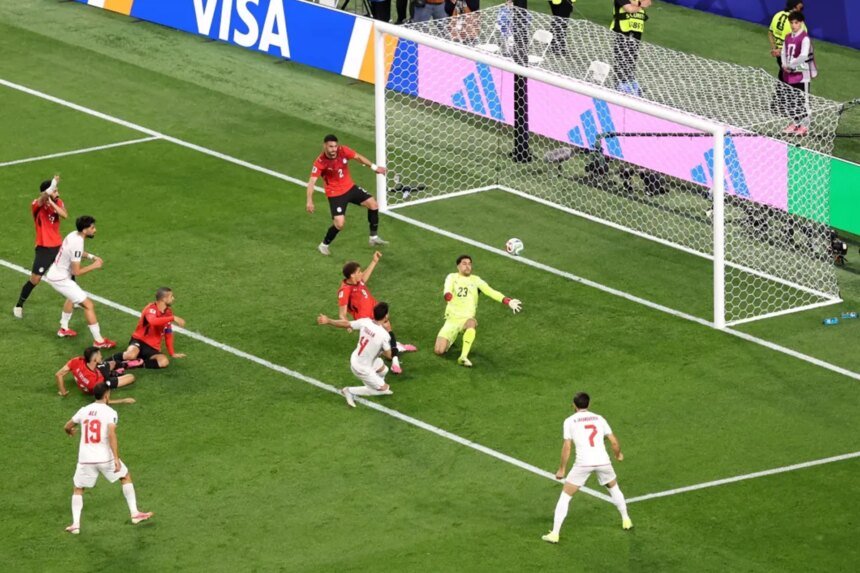
The cancellation of the Iranian national team’s second goal against the Egyptian national team in the 93rd minute of stoppage time, under the pretext of offside after returning to the video assistant referee (VAR) technology, sparked widespread controversy and major questions across social media platforms, at a crucial moment in the confrontation that brought together the two teams in the third and final round of the group stage in the 2026 World Cup.
The shot came in the final minutes, after the Iranian team pressed hard in an attempt to snatch a fatal goal, before the attack ended with a goal that seemed to give Iran a valuable victory and a historic qualification to the knockout rounds, to be reviewed later via video technology.

The stands exploded with joy after Iranian defender Shoja Khalilzadeh succeeded in following a rebound ball inside the penalty area and depositing it into the net, amid chaos that followed a free kick inside the penalty area, before he took off his shirt to celebrate the goal and received a yellow card.
Read also
list of 2 itemsend of list
But the celebrations did not last long, as Polish match referee Simon Marciniak referred to reviewing the shot via Video Assistant Referee (VAR) technology, beginning a state of anticipation and controversy over the legitimacy of the goal.
-
How was offside calculated?
According to the arbitration analysis of the case, according to what was published in sports newspapers, offside is not counted at the moment of the final shot, but rather at the first touch or pass at the beginning of the attack, in accordance with Article (11) of the Laws of the Game, which stipulates that the timing of offside is determined at the moment the passing player touches the ball, and not at the end of the offensive movement.
Replays show that the free kick taken inside the penalty area reshaped the offside line, as a number of Iranian players were in an advanced position at the moment the first ball was passed, before they later interfered in the aerial struggle inside the six-yard area with the Egyptian defense.
Although being in an advanced position is not considered a violation in itself, the law criminalizes this if the player becomes an influential element in the course of the game, whether by competing for the ball or directly influencing the movements of the defenders.
On this basis, the refereeing team considered that the advanced Iranian players actually participated in confusing the defense during the building phase of the attack, which put them in a position of direct influence on the course of the shot, so that the situation was considered offside and the goal was subsequently disallowed.
-
Why was Iran’s goal cancelled?
When Shoja Khalilzadeh seemed to give Iran the winning goal in the fatal moments, it was difficult to understand the reason for the cancellation, especially since the goal came at a crucial time that would have changed the course of the entire group.
The peculiarity of this shot is that it relied on a rare case of applying the offside law, as the Egyptian goalkeeper was ahead of his position, which made the offside calculation based on the position of the penultimate defending player, and not on the goalkeeper as many believe.
But the problem was not at the moment of the final shot, but rather at the beginning of the attack, as the offside rule applies when passing the ball and not at its end. According to this interpretation, the assessment of the attacker’s position goes back to the moment of the first shot on goal.
At that moment, after his teammate Mohamed Ghorbani’s shot bounced off Egypt’s goalkeeper Mostafa Shabir, it became clear through replays that Shojaa Khalilzadeh was in an advanced position compared to the last defenders of the Egyptian national team, with the exception of only one player.
The goalkeeper’s advance from his usual position also increased the complexity of the shot, but it did not change the fact of offside, as a review of the video technology showed that the Iranian player was closer to the goal than most of the defense personnel at the moment the ball was passed.
Accordingly, the situation was resolved by canceling the goal, leaving the tie (1-1) in place, and the Egyptian team decided on its qualification to the round of 32, while the decision for Iran was postponed to the results of the rest of the groups.
-
There was widespread controversy between supporters and opponents of the decision
The decision sparked a wide wave of controversy and questions across social media platforms, especially in light of the sensitivity of its timing and its direct connection to the result of the match and the fate of qualification, as many considered that the moment of decision came at a dramatic time that intensified the interaction and division over the validity of the arbitration decision, while others reopened the debate about the accuracy of applying the Video Assistant Referee (VAR) technology in complex shots inside the penalty area.
On the other hand, the opinions of observers and experts were divided between those who believed that the decision to cancel the goal was correct in accordance with the offside law, and those who considered that the situation did not require decisive intervention from video technology, which deepened the controversy surrounding the shot.
Sports writer and journalist Mohamed Awad wrote on the “X” platform that the referee’s decision was correct, “100% offside,” explaining that the Egyptian national team’s goalkeeper was ahead, which makes the application of the “last defender” rule different, and requires the presence of a second defender between the attacker and the goal according to the law.
He added that many people are accustomed to considering the goalkeeper to be the main reference in the offside line, but his advance in this case changed the arrangement of the defenders, which led to the Iranian player being considered in an offside position the moment the ball was passed.
For his part, Egyptian sports content creator Abdel Rahman Talaat said that offside is calculated from the position of the penultimate opponent, explaining that the absence of the goalkeeper from his traditional position means another defensive player is counted as a reference to the offside line, and therefore the goal is completely illegal, as he put it.
In the same context, former Kuwaiti international referee Mishal Al-Asousi explained that the law does not specify a fixed position for the second defender, but rather depends on the arrangement of the players on the field at the moment of the pass, noting that the goalkeeper’s advance made the center back the last defensive element before the attacker, which led to offside in this case.
On the other hand, sports activists believed that the controversy was due to a widespread misunderstanding of the offside law, stressing that the calculation of the case depends on the position of the “penultimate opponent,” regardless of his position on the field.
Others questioned the decision of the video technology, considering that the shot was subject to exaggerated interpretation, and that the goal could have been scored in light of the confusion in determining the moment of passing and the offside line, while others stressed that the video technology applied the law exactly.
Source: Al Jazeera + Agencies + social media sites