
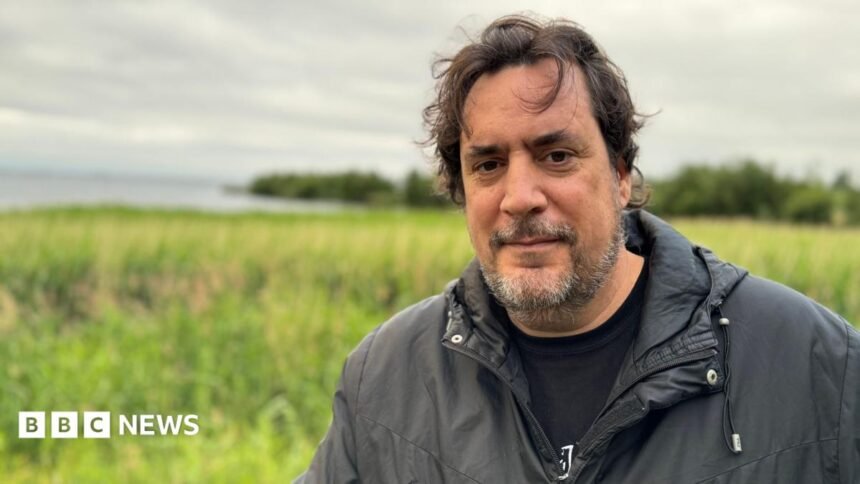

Professor Eduardo Salazar-Ortuño led the battle to grant a legal recognition to the largest Mediterranean saltwater lagoon in Europe
Professor Eduardo Salazar-Ortuño led the battle to grant a legal recognition to the largest Mediterranean saltwater lagoon in Europe
Could recognising Lough Neagh as a legal “person” help restore the largest freshwater lake in these islands?
The former lawyer who secured a Rights of Nature recognition for a Spanish saltwater lagoon believes it could.
Professor Eduardo Salazar-Ortuño led the battle to grant the recognition to Mar Menor in Murcia, Spain, after the ecology of the lagoon collapsed in 2016.
He said it could “transform” the future of Lough Neagh.
The lough has been blighted by potentially toxic blue-green algal blooms since 2023, due to pollution primarily from agriculture and wastewater.
Lawyers, activists, fishermen and policy makers came together in Belfast earlier this month to discuss the possibilities.
What is Rights of Nature?
Rights of Nature (RoN) is a legal approach that bestows personhood on a natural site.
That gives it the right to exist and flourish, to be restored, regenerated and respected.
It also recognises the right of any person or organisation to defend, protect and enforce those rights on behalf of nature.
Without the recognition, the site must depend on indirect protection that comes from human-centred environment law.
The concept has been used in a number of countries to help protect precious sites.
The Republic of Ireland is considering a referendum to add RoN to its constitution.
What happened at Mar Menor?

Mar Menor, on the south-eastern coast of Murcia, had suffered from pollution due to intensive farming of the land around it
Mar Menor, on the south-eastern coast of Murcia, had suffered from pollution due to intensive farming of the land around it
Mar Menor, on the south-eastern coast of Murcia, is the largest Mediterranean saltwater lagoon in Europe.
It plays a significant economic role in the region, through tourism, and small-scale fishing that many families depend on.
The marine ecosystem and its habitats – wetland, seagrass beds and marine prairies – support a range of wildlife.
Like Lough Neagh, it has a number of specific designations intended to protect it.
Despite those protections, just like Lough Neagh, it has suffered from pollution due to intensive farming of the land around it.
That pollution changed the balance of the lagoon.
By 2016, it had triggered a bloom of algae, known as ovas, that depleted the water of oxygen and caused the death of thousands of species.
That is where Salazar-Ortuño comes in.
Bringing the law to the lagoon
As someone who grew up in Murcia and knew the lagoon well, Salazar-Ortuño was shocked by the devastation.
“We lost 85% of the marine prairies, and we saw the fishes on the shore looking for oxygen, and these images were horrible,” he said.
“If you have been as a child in the Mar Menor, you cannot see these images and stay the same person after.”
As an environmental specialist, he looked to the law for an answer.
That came in the form of Rights of Nature (RoN).
Putting Mar Menor first

Salazar-Ortuño began work with the backing of more than 600,000 people in Murcia, who signed a legal petition calling for protection
Salazar-Ortuño began work with the backing of more than 600,000 people in Murcia, who signed a legal petition calling for protection
Salazar-Ortuño began work with the backing of more than 600,000 people in Murcia, who signed a legal petition calling for protection.
“We went to the parliament in order to change the existing anthropocentric law into an ecocentric law,” Salazar-Ortuño said.
“Then we decided to propose our parliament with 600,000 signatures that the Mar Menor needs to have rights and legal personhood.”
A tutorship, or guardianship, was created, which meant that anybody could go to court on the lagoon’s behalf.
“They are represented by many stakeholders around the lagoon – fishermen, farmers, citizens, neighbours, environmental groups.
“The Mar Menor has a tax number, a private account, and then when one citizen or the tutorship asks for restoration against any of the farmers, against any of the polluters of the Mar Menor, the restoration goes directly to the Mar Menor.”
And it has already had an impact.
“There is a big pressure in the environmental ministry – they have invested more than €600 million (£517.5m) by restoring of the Mar Menor,” Salazar-Ortuño said.
“So it’s a big impact after the mobilisation.”
From the lagoon to Lough Neagh

Blue-green algae Lough Neagh, pictured in August last year
Blue-green algae Lough Neagh, pictured in August last year
That success has piqued the interest of lawyers and academics in Northern Ireland, who are trying to find ways to support the restoration of Lough Neagh.
At a recent convention, led by the Climate Justice Group at the Law Society of Northern Ireland, attendees including fishermen, conservationists and policy-makers, heard from Salazar-Ortuño and other experts.
The group’s chair, Simon Chambers, said Lough Neagh was “a glaringly obvious” issue to focus on as a collaborative approach.

Simon Chambers is the chair of the Climate Justice Group at the Law Society of Northern Ireland
Simon Chambers is the chair of the Climate Justice Group at the Law Society of Northern Ireland
“It has to be a solution that’s going to work for everybody, and that’s why we need input from everybody to see what the law can do,” Chambers said.
“But the Mar Menor region acquired a right of nature to be represented in and of itself before courts in Spain and Europe.
“Hopefully that will inspire a future generation of lawyers to bring it forward in this jurisdiction.”
Due to stormier weather this year, large-scale algal blooms have not yet formed on Lough Neagh to the same extent as the previous three summers.
But the algae has been detected in a number of places around the Lough and elsewhere.
‘We are part of the ecosystem’
Salazar-Ortuño has no doubt of the potential benefit of RoN for Lough Neagh.
He believes transforming the law transforms the mind of people to put the ecosystem at the heart of the approach, rather than human development.
“For me, every ecosystem can have benefits from the rights of nature movement, but mostly the endangered ecosystems like Lough Neagh.
He said every one – all citizens in Northern Ireland should understand that we are “part of the ecosystem”.
“You can go in this path, in this way to understand Lough Neagh differently – not only as a fish tank.”
Related topics
https://www.bbc.com/future/article/20231010-mar-menor-saving-europes-largest-saltwater-lagoon
https://www.bbc.co.uk/future/article/20210316-how-the-human-right-to-a-healthy-environment-helps-nature
https://www.bbc.co.uk/travel/article/20200319-the-new-zealand-river-that-became-a-legal-person
Will making India’s holiest river a ‘person’ save it?