Published on 6/25/2026
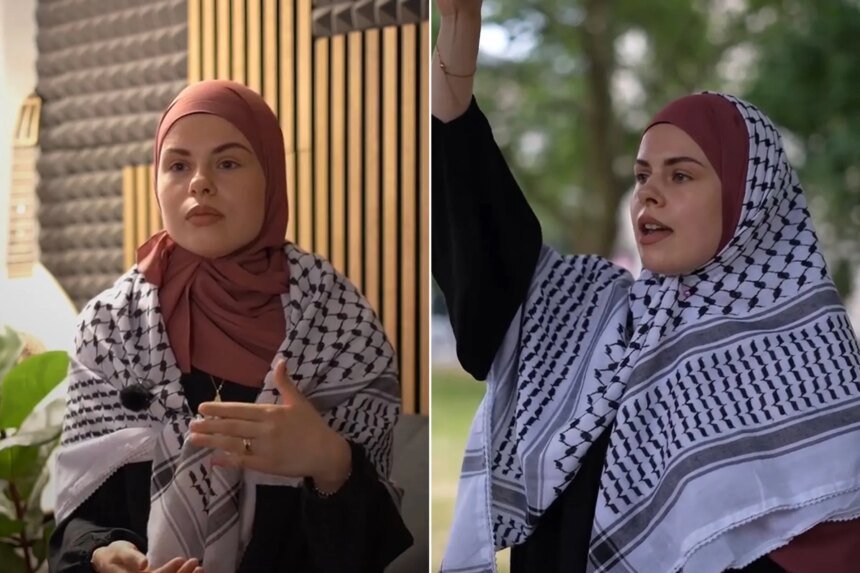
German activist Gaelin Brandenburg, 22 years old, revealed the details of her journey with Islam that began at the age of fourteen, only to face years later another type of exclusion and discrimination, this time because of her hijab and religious identity in her home country.
In her interview with Al Jazeera, the activist – who was born to a French father and a German mother – recalled the first incident she was exposed to after wearing the hijab at the age of eighteen, where a drunk man on the subway was repeating that she did not live freely, before he approached her and spit on her in the presence of her mother. She explained that what frightened her most at that moment was not the attack on her, but rather her fear that her mother would be harmed while she was trying to protect her.
Guillen pointed out that the problem lies in the stereotypical image that many hold about veiled women, as some believe that the veil was imposed on them, while she asserts that her experience is completely different, and that it was a personal decision that she made out of conviction. She cautioned that if people gave themselves the opportunity to get to know a veiled woman, and asked her respectfully about the meaning of the veil or about her view of her religion, many preconceptions would change.
On the other hand, the activist warned that hatred does not stop at street harassment, but rather extends to the digital world, where she constantly receives comments questioning her German identity because of her hijab, in addition to insults and threats, some of which amount to someone wishing she would get into a car accident.
She described these comments as painful, not only because of their cruelty, but because they were made by people belonging to the society in which she was born and lived, stressing that she is a human being before anything, whether she wears the hijab or not.
In the same context, Guillen spoke about her participation in the demonstrations in support of Gaza about 3 years ago, based on her conviction that defending civilians and rejecting war is a humanitarian responsibility.
Based on this conviction, Gehlen joined the voices calling for an end to the war in Gaza and Lebanon, demanding that the German government stop exporting weapons, and urging citizens not to just watch, but rather to participate in the demonstration in rejection of the continuation of the war.
Journey of faith
The activist reviewed the beginning of her acquaintance and attachment to the Islamic religion when she was young, explaining that she lived a difficult childhood during which she felt excluded and was subjected to bullying by some of her German classmates at school.
However, she pointed out that her subsequent move to another school in Berlin changed her outlook on people for the first time, as she found herself for the first time among Muslim classmates who treated her with love and respect.
Regarding the journey of her conversion to Islam, she explained that during her stay in a children’s care home she saw one of the boys fasting during Ramadan, so she began to ask about the meaning of fasting and then about the teachings of Islam, to begin a research journey that ended with her declaring her conversion to Islam when she was fourteen years old, stressing that she never regretted this decision, but rather her certainty in it increased over the years.
Gehlen called on Muslim women to adhere to their faith and not allow hate speech to push them to abandon their beliefs or identity. She also called on German society to replace dialogue with prejudices, stressing that acquaintance and mutual respect are the way to break stereotypes, and that a person must be seen as a human being, before anything else.
In this context, an annual report issued by the “Klem” network concerned with monitoring racial discrimination against Muslims in Germany revealed a noticeable increase in the number of cases of anti-Muslim racism in 2024, in light of a climate dominated by fear, despair, and lack of trust in official institutions.
According to the report, 3,080 cases of anti-Muslim discrimination or violence were documented in 2024, compared to 192 cases in 2023, and it was found that women were targeted in about 70% of the incidents, while the attacks also included children and adults who were subjected to verbal abuse and stereotypical accusations such as “terrorists,” “anti-Semites,” or “stabbers with knives.”
These verbal and physical attacks – according to the report – increased in particular after the outbreak of the Israeli war on the Gaza Strip after the Al-Aqsa flood in October 2023.