

DALLAS. From the sky, down to earth and onward through some variant of normality.
This was a really good bad bet.
WC summer shines again.
Now I thought I’d start with some backhanded compliments and a splash of joyous criticism, but you’ll have to follow me for a while.
For the most part, I don’t think Sweden is making any further good efforts here in Dallas.
Our own passing game consisted mostly of haphazard dribbles, our midfield was often empty and abandoned, our written advantage in set-piece situations disappeared with weak deliveries.
A lot of technical errors, a lot of idiosyncratic decision-making, problems activating our best players and clearest threats.
And yet.
Relatively easy to establish offensive pressure, no huge problems to protect own penalty area, more ball possession, more and better chances.
Overall, I think that a fairly dirty Sweden is better than an extremely well-coordinated and skilled Japan.
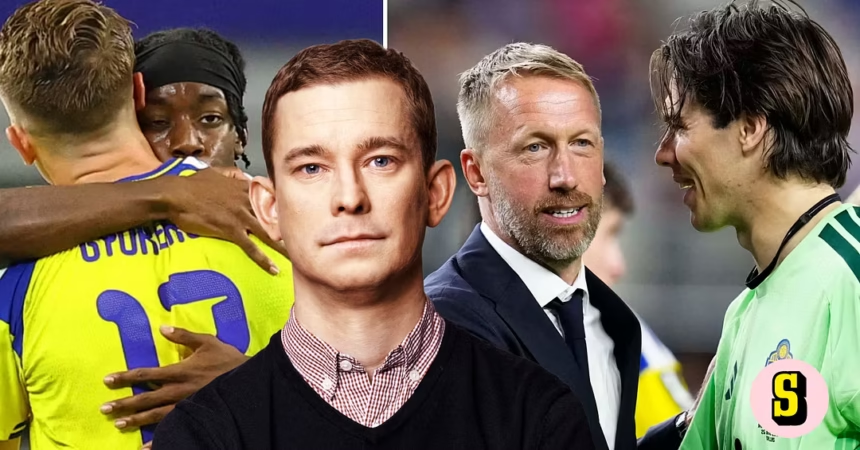
Graham Potter was forced to patch and mend both in and out of the match, and in the end we were there with Gustaf Lagerbielke, Carl Starfelt and Daniel Svensson as a three-back line in the final phase of a decisive World Cup match.
And yet.
Frustratingly overambitious Bergvall
Sweden forced, King Ken Sema tunnelled, we were an Elanga wide side or an Isak header away from winning the match and clinching second place.
Somewhere it shows an inherent capacity and strength, not least because it felt so very dark and grim just half an hour earlier. When the Japanese combination saw their way through and Daizen Maeda slipped in the 1-0 goal, it was as if the life was about to drain from the Swedish WC summer.
On the other side of Holland’s accident in Houston, Graham Potter had changed the starting line-up considerably, but prioritized safety in the match plan itself.
Nothing strange about that.
Sweden was in desperate need of some normality and stability, and until the first commercial break, the risk-minimizing game looked perfectly fine.
Then Isak Hien fell apart, and when Victor Lindelöf was subsequently withdrawn, it was as if the Swedish structure was gradually dissolving before our eyes.
A snortingly overambitious Lucas Bergvall got into the game wrong, rushing into situations and abandoning his position. The half hour leading up to the Japanese goal was by far the worst of the match from a Swedish point of view, and once we found ourselves at a disadvantage it was difficult to see a way out.
Something needed to happen. Something happened.
Anthony Elanga sent home a floater with his weaker left foot, and a caught Zion Susuki in the Japanese goal reacted far too late.
In one way, the goal did not formally change that much, but in another way it caused the entire momentum of the Swedish tournament to swing.
Faith returned to both the field and the stands. Courage grew, spine strengthened in real time. What just now appeared hopelessly difficult and unattainable again seemed perfectly reasonable and possible.
Victory against Japan? Second place in the group? Everything clearly within reach.
Should we have gone for it even harder at the end…? Possibly, but partly we don’t know for sure that we will really face France, partly we actually created bigger and bigger chances the longer the match went on.
Like the most natural thing in the world
Before this, I had called for some normality in the Swedish performance, and what I got was precisely normality rather than any excess of quality.
We did what we had to, and could state that it actually went quite far.
In addition, we uncovered a couple more match winners.
Anthony Elanga will of course not be able to be left out of a World Cup eleven again, and at the back Jacob Widell Zetterström was both reliable and decisive.
A blink of an eye ago, he could no longer play football at all, as two concussions close together forced him into a long and uncertain break in his career.
Now he was sent into a crucial World Cup match, and made it look like the most natural thing in the world. No uncertainty, no trepidation – calm and confidence-inspiring goalkeeping garnished with a couple of top-notch saves.
When this day began, no one could answer with any conviction exactly which national team this Sweden really was.
Now we can at least say that we are a team with Isak, Gyökeres and Elanga at the top, a team with a cat-like base voice teddy bear from Lidingö in goal – a team that will play in the round of 16 in the World Cup.
It may not be something that makes us any further strong medal candidates, but it’s certainly not nothing.