Published on 6/21/2026
Before Mexico’s El Tri and Korea’s Taeguk Warriors met in Guadalajara, the capital of Jalisco, the two countries had woven – through cactus, factories and song – one of the planet’s strangest friendships.
In a car driving through the streets of Monterrey, Yuna Gua noticed that her Mexican friends were singing a song she did not know.
She listened more, and then she realized that they were singing in Korean, her language, not theirs.
The girl who came as a child from South Korea, and in the beginning did not find anything to help her integrate except football, is discovering her culture in the tongues of the people of the country that embraced her.
This small moment sums up a relationship that is difficult to explain by geography. South Korea and Mexico are separated by about 12,000 kilometers, a 15-hour time difference, and a difference in language, cuisine, and history.
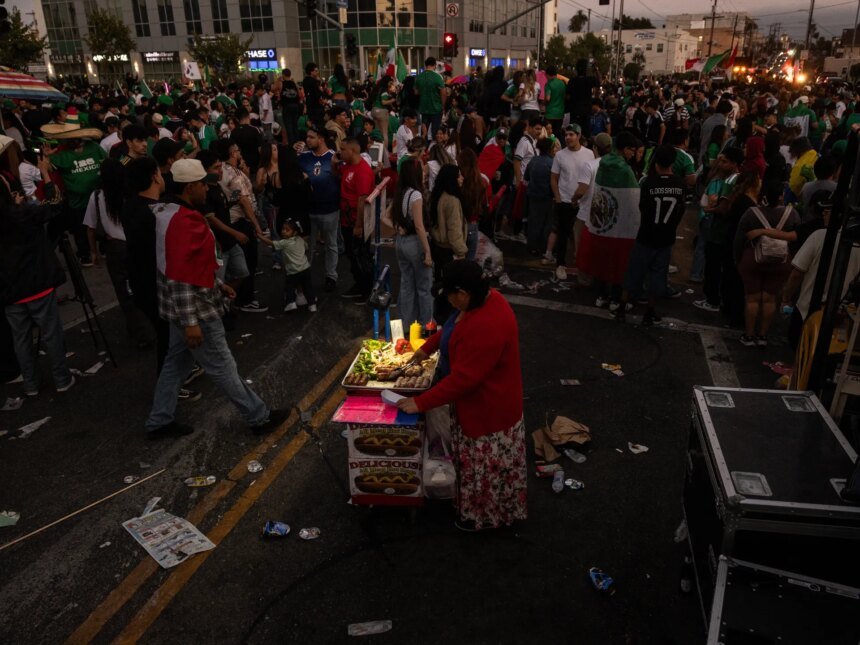
However, the Korean presence in Mexico became entrenched until it became a mass movement, in which Mexican President Claudia Sheinbaum stands on a balcony next to BTS, and Korean World Cup tourists are greeted by chants of “Korean, brother, you are now Mexican.”
When the two teams meet in Guadalajara (Guadalajara) in the group stage, this brotherhood is put to the test on the field.
The portal was a song
This passion was not born suddenly. It formed slowly, layer upon layer. It began with factories, then food came, then songs decided the battle.
Erika Garza, director of the Department of Asian Studies at the Autonomous University of Nuevo Leon, says that K-pop was the “gateway” and that many young people came through it to the Korean language, education and culture.
What Mexico is experiencing is part of a broader phenomenon known as “Hallyu” (the Korean Wave), which is a soft cultural force that has made Korean drama, music and cinema a bridge connecting young people around the world – from the Arab world to Latin America – with South Korean culture, according to a previous Al Jazeera Net report.
Its impact fills downtown Monterey today; Shopkeepers sell life-sized cartoon cut-outs of Stray Kids members and pillows bearing the faces of BTS stars.
In front of a K-pop store, young man Christopher Elzondo (18 years old) stands confused, having been captivated by the rhythm and choreography of Korean music. He is no longer sure which team to support.
A city called “Piscoria”
Behind the cultural gate is an economic door. When the Korean company Kia opened its factory in the town of Pesqueria near Monterrey, thousands of South Koreans flocked with it to the industrial center of Mexico.
The factory began production in 2016 with a capacity of approximately 400,000 cars annually, and the company’s investments in Mexico over a decade exceeded $3 billion.
The influence of the Koreans in the place was not fleeting; The area even gained a nickname that blends its name with the name of Korea – “Piskoria” – with the increasing influx of Korean immigrants since the factory opened.
Yuna Goa’s family was part of that wave. She moved from Korea to Monterrey when she was eight, where her father’s work led them to the other side of the ocean. She came knowing neither Spanish nor Mexican culture, only to find herself years later in the seat of a teacher, not a learner.
Rooted in cactus fields
But the encounter between Koreans and Mexicans is more than a century older than Kia and BTS.
In May 1905, a British freighter called the Ilford docked off the coast of Mexico, carrying more than a thousand Koreans who had left a poor, troubled country in search of the promise of a better life.
The promise was a mirage as they were sold into forced labor on the henequin plantations of Yucatán – an agave plant from which rope fiber is extracted, which was called “green gold” there – and worked long hours in harsh conditions, under deceptive contracts that were soon exposed.
The Koreans worked side by side with the Mayas, learned their language, and married their women; When Japan annexed Korea in 1910, they lost a homeland to return to, so they stayed in Mexico and built new families there.
They introduced themselves as “Ainiking”, a Korean corruption of “Hennekin”, the crop they were destined to harvest.
The strangest thing is that this migration did not arise from any relationship between the two countries. At that time, there was neither an embassy nor an agreement between Korea and Mexico. Rather, their destinies met by chance at the intersection of the empires’ ambitions. The brotherhood that Mexicans chant today, therefore, has roots in century-old soil.
The night Korea saved Mexico
Fate brought their paths together again on the grass; In the 2018 World Cup in Russia, the two countries were in one group, and Mexico seemed on the verge of saying goodbye after losing 3-0 to Sweden. Then South Korea did the impossible, defeating defending champion Germany 2-0 with two goals in time, eliminating the champion and pushing Mexico to the next round. Korea exited the tournament, but emerged a champion in the eyes of the Mexicans.
Hundreds of fans then flocked to the South Korean Embassy in Mexico City, carrying Consul General Han Byung-jin on the shoulders, singing “Cielito Lindo” and “Ode to Joy”, and sharing tequila. And from that night the chant was born, “Korean, bro, now you’re Mexican.”
Friends… for 90 minutes
The story is repeated today, but with reversed roles. The two teams lead their group by three points each before the direct match.
Since the start of the World Cup, a wave of Mexican friendliness has been washing over Yona Goa; The crowd carried her into the air at a celebration in Monterrey, and a woman gave her family a free Mexican meal at a market and wished them well. The love extends to the stars on the field as well. Korean striker Son Heung-min is especially admired by Mexicans, so much so that many fans secretly wish it would end in a draw.
However, the competitive spirit began to creep in. At a Korean restaurant outside Monterey, Kevin Kim, a Korean resident of Texas, sat having lunch with his Mexican business partner, Humberto Osuna, who have been friends for years.
Osuna said they were “very close friends”, then added that all that could change at the first whistle. “Then we will become enemies,” he said, laughing.