
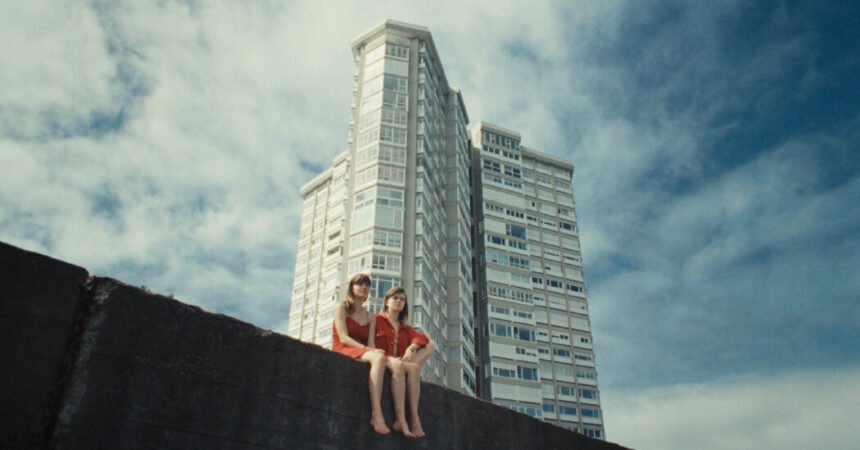
Before heading to film school in Barcelona, Marina (Llúcia Garcia) must first secure the paperwork she needs to receive her scholarship, which includes a document confirming the names of her deceased birth parents. But when she arrives in Vigo, her parents’ coastal hometown, Marina’s already hazy memories of Mom and Dad are further warped by her extended family’s conflicting accounts and evasiveness.
A profound sense of shame lingers around the memory of her parents, who both died of AIDS-related illnesses. It’s a personal matter for the director Carla Simón, who first reckoned with the grief around the same loss in her debut feature “Summer of 1993,” but now extends her autobiographical project to adulthood, as Marina, 18, approaches the same age as her mother was before she died.
“Romería,” the Spanish word for “pilgrimage,” offers wistful, sparkling images of the Galician coastline courtesy of Hélène Louvart, who follows Marina as she travels around the region with her uncle Lois (Tristán Ulloa) and a rowdy pack of cousins she’s meeting for the first time.
The slowly building drama between Marina and her extended family plays with lovely (if somewhat generic) naturalism. But as these tensions subtly reveal the enduring stigma of her parents’ disease — with Marina representing an uncomfortable reminder of that past — a separate, thrilling experiment plays out that eventually dives into spectral fantasy. Woven throughout Marina’s journey is her camcorder footage of her parents’ old stamping grounds accompanied by narration of her mother’s diary entries from the 1980s. Our grasp of time and identity slips during these scenes, turning what could be a conventional memory piece into a bracing resurrection.
Romería
Not rated. In Catalan and Spanish, with subtitles. Running time: 1 hour 54 minutes. In theaters.