Published on 6/23/2026
|
Last update: 14:03 (Mecca time)
Imagine that you woke up one day, pressed the light switch and it did not work, or opened the water tap and turbid water came out of it, then you tried to browse your phone to follow the bus schedule before your travel, and found that the government networks were completely down. In just a few hours, your modern, organized city will turn into chaos.
This “hypothetical” disaster is an accurate depiction of what would happen if the “shadow soldiers” decided to miss work for a single day.
Read also
list of 4 itemsend of list
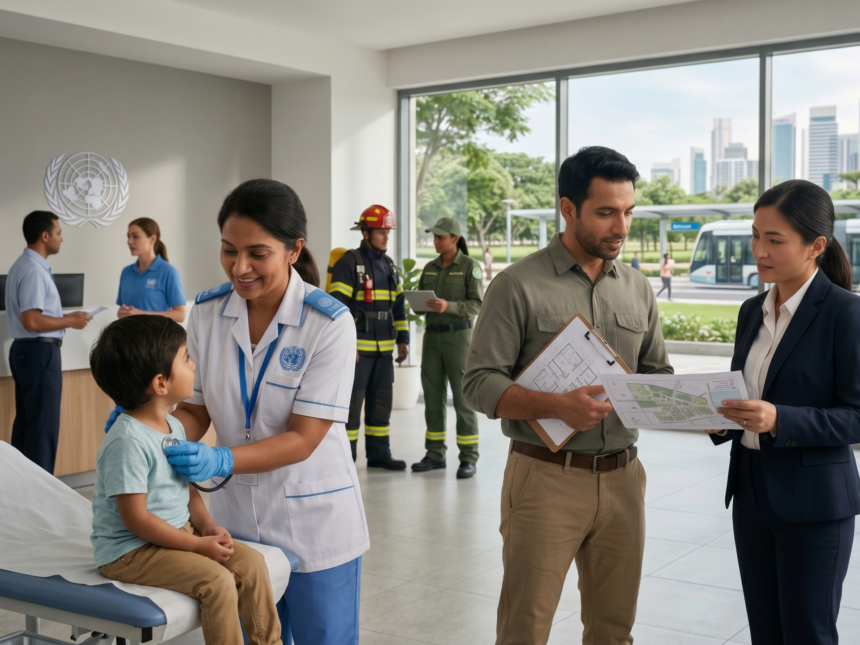
On the occasion of the United Nations Public Service Day, which falls on June 23, and under this year’s theme that focuses on innovation and inclusivity in public institutions, while the spotlight and awards often go toward front-line professions; Behind the scenes work thousands of public servants who selflessly turn the “cogs” of daily life, transforming large, complex cities into safe, livable places without anyone seeing them.
Lifeline engineers… who guarantees the purity of a drop of water?
When we turn on the tap to wash our faces or drink, we rarely think about the journey this water has taken to reach us. Deep inside the government’s treatment and purification plants, chemical technicians and analysts work long hours.
Their role is not limited to operating the pumps, but extends to monitoring water quality and protecting it from biological and chemical pollutants, in a process similar to “national health security.”

According to an investigation published by the ETH Zurich Research Collection platform on essential workers in city infrastructure, water and sanitation network employees work in high-risk environments to ensure that supplies do not stop for a single moment. Their absence simply means the spread of epidemics, and the stopping of entire sectors from work, from hospitals to factories.
Although our daily lives literally depend on what they do, these people remain among the least visible groups in society, and no one notices their presence except when the water is cut off.
Guardians of the skies… eyes fixed in the sky that cannot sleep
At thousands of feet, passenger and cargo planes fly safely across the world’s continents. Behind the dark screens in government airport control towers sit “air traffic controllers” who are responsible for managing thousands of lives suspended in the sky every day.
Working in this sector requires exceptional mental focus, as any simple lapse could lead to an air disaster. These employees manage flight routes, deal with sudden weather disturbances and emergency situations, and devise instant solutions under time pressure, without passengers knowing them or hearing their voices over the radio.

Public services in 2026 are no longer limited to sidewalks and pipes, but rather extend to the digital space. With this shift, a new generation of public servants has emerged: “government cybersecurity analysts.”
These engineers ensure the protection of huge databases that include citizens’ health, financial, and educational records. Every day, they repel hundreds of cyber attacks aimed at disrupting hospital networks, smart traffic systems, or basic digital services.
A study published by BMC PubMed Central on the resilience of critical infrastructure in major cities indicates that government digital systems have become the backbone that prevents the collapse of medical and logistical services in crises.
These technicians face their screens for long hours to protect public security, without carrying a weapon or wearing military uniforms, but nevertheless they stand in a line of defense that is no less sensitive than any front line.

The “gears” of daily life as seen by the United Nations
Literature and reports issued by the United Nations on the occasion of “Public Service Day” confirm that the organization does not view public service employees as mere workers in office or routine jobs, but rather describes them with deeper roles related to human development and stability.
The United Nations vision for these employees can be summarized in 4 main circles:
- The backbone of sustainable development: The United Nations describes them as the primary driver and first responder to achieving the “Sustainable Development Goals.” They are the ones who transform policies and major plans, such as combating poverty and providing education, health care, and clean water, into tangible services that citizens experience daily.
- The first line of defense in crisesIn its recent reports, the United Nations described them as soldiers standing on the front lines to confront global crises, natural disasters, epidemics and climate change, sometimes sacrificing their personal safety to keep communities safe.
- Trust builders between peoples and governments: The United Nations considers the public servant to be “the actual face of the state.” To the extent of his integrity, efficiency, and innovation in providing service, bridges of trust are built or destroyed between the citizen and his governing institutions.
- Pioneers of innovation and inclusivity: The organization goes beyond the stereotypical image of a bureaucrat, to describe contemporary public service employees as “innovators” who lead digital transformation, and find smart and flexible solutions that ensure services reach all segments of society without discrimination or exclusion.
The psychology of “working in the shadows”… the invisible price of success
The greatest irony of these employees’ work is that their success means they disappear from the scene. The more smoothly the public service runs, the less the citizen realizes that there is someone running it.
We rarely remember the morning cleaner, the night power maintenance technician, or the emergency room communications coordinator, except when the service is down or there is a crisis.
This “disappearing pattern” produces difficult psychological and social challenges. Reports from the Chartered Institute of Personnel and Development, which platforms like Herbert Smith Freehills has covered in its “Cities of the Future” series, indicate that critical infrastructure and emergency room workers are experiencing high levels of psychological stress and burnout.
This burnout results from the weight of responsibility, coupled with a lack of societal appreciation, as well as their constant confrontation with housing crises and living pressures in the major cities whose continued functioning they themselves ensure.
Gratitude as a societal duty…the safety valve of civilization
Rehabilitating these employees is not just a symbolic gesture on an international occasion, but rather a societal and moral duty that ensures the continued quality of our lives.
Our perception of the value of work needs to be revised, so that a person’s value is not measured by the extent of his fame or the appearance of his name in the limelight. Public service is the backbone of modern civilization, and the absence of this pillar simply means that cities will collapse and the technology we boast of will turn into meaningless junk.
Appreciating these heroes begins with simple details: a sincere word of thanks to the municipal worker, understanding the pressures that emergency personnel go through, and supporting a public debate that pressures institutions to ensure that they obtain their material rights and psychological care that befits the magnitude of their hidden sacrifices.
On Public Service Day, perhaps the most sincere tribute to them is to remember that they are the “cogs” of the city that work in silence, and that the civilization in which we live cannot continue without many hands that are not seen, but they move everything.