Published on 6/23/2026
In a move that combines science, tourism and heritage, the Royal Commission for AlUla Governorate announced the AlUla Manara Observatory project, which is expected to become one of the largest star observatories in the world and one of the most prominent astronomical tourism attractions in the region.
Al-Ula is located in the northwest of the Kingdom of Saudi Arabia, an area historically associated with ancient trade routes and using the stars to navigate across the desert.
Read also
list of 2 itemsend of list
Today, the sky is back to playing a pivotal role in the future of the region, but this time through an advanced scientific and tourism facility targeting researchers, visitors, and astronomy enthusiasts from around the world.

The project site was chosen more than 70 kilometers north of Al-Ula, between the Hurrat Awirid Reserve and the Al-Gharamil area, because of its very dark skies and exceptionally low light pollution, conditions that make the region one of the best astronomical observation sites in the world.
One of the largest astronomical observatories in the world
The project will include a main telescope with a four-meter diameter mirror, in addition to two other telescopes with a diameter of two meters each, which places it in the category of large observatories in the world.
Its role will not be limited to scientific research only, but will include a visitor center, observation platforms, exhibition halls, interactive exhibitions, and educational facilities aimed at simplifying astronomy and making it an experience available to the public.
The project will be developed in partnership with the Saudi Space Agency, the King Abdulaziz City for Science and Technology, and the American SETI Institute, which specializes in researching extraterrestrial life.

The Royal Commission for AlUla said that it intends to implement new controls for outdoor lighting in the region to reduce light pollution and ensure the continued quality of the night sky, allowing stargazing experiences to be provided throughout the year.
Design inspired by the desert and sky
The project bears the name “Al-Manara,” an Arabic word meaning guide or guiding light, a symbolic reference to its role in exploring the universe.
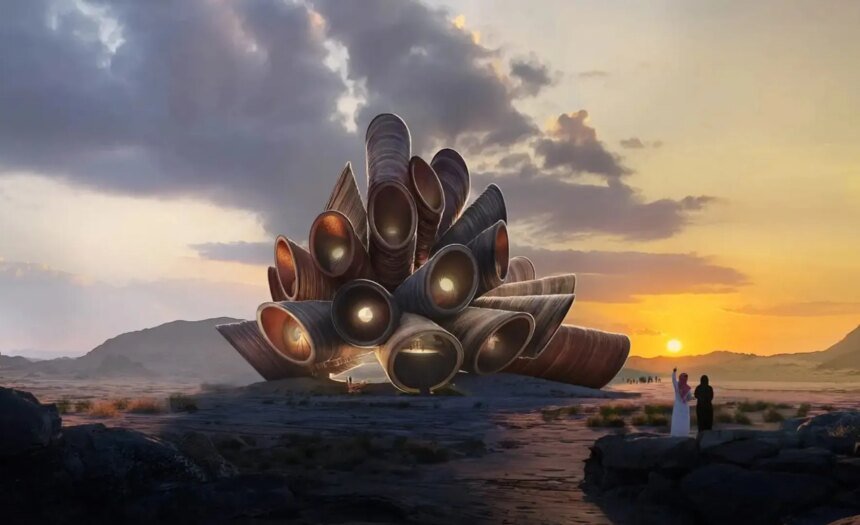
The project was designed by the British office “Heatherwick Studio”, and its architectural idea was inspired by the spiral shapes found in nature and cosmic systems. The design consists of a group of interlocking stone towers and pipes that appear to emerge from the desert terrain itself.
Local sandstone will also be used in construction to harmonize the observatory with the surrounding environment and benefit from its thermal properties in the face of desert temperature fluctuations.

The complex will include a modern planetarium, a research center for scientists, a restaurant, and open observation platforms on the roof, in addition to educational spaces that allow visitors to get closer to scientific work instead of just watching it from afar.
British designer Thomas Heatherwick said: “Space observatories are often located in isolated, technical locations far from the public, but we saw an opportunity to remove these barriers and create a place that allows visitors to enter the world of cosmic wonder.”
A global center for astronomy tourism
The announcement of this project comes at a time when the astronomy tourism sector is witnessing rapid global growth, and Booking.com’s forecasts for the year 2025 indicate that 62% of travelers are interested in visiting destinations with dark skies and stargazing experiences.
The project is part of a broader plan to transform AlUla into one of the most important dark sky destinations in the world. The areas of Al-Manara and Al-Gharamil in 2024, and then Sharaan Park and Wadi Nakhla in 2025, received international classifications as dark sky parks.

The combined area of these areas is more than 6,146 square kilometers, making AlUla ranked third in the world in the category of dark sky parks.
Future plans also include the establishment of astronomy lodges, isolated accommodation facilities, and specialized observation platforms that will allow visitors to spend entire nights under the starry desert sky.
When the sky becomes part of the identity of the place
The Lighthouse Observatory does not represent just a new scientific project, but rather reflects a broader vision linking knowledge, heritage and nature. Among the sand mountains that used to guide caravans in ancient times, modern telescopes will guide human eyes towards distant galaxies and stars that were born millions of years ago.
In a time when technology is accelerating and artificial lights are competing, Al-Ula reminds us that maintaining the darkness of the sky is not a deprivation of light, but rather an opportunity to see the universe as our ancestors saw it, and to keep human curiosity towards the unknown alive and burning. Every discovery begins with a look to the sky, and every civilization advances when it continues to ask the big questions.