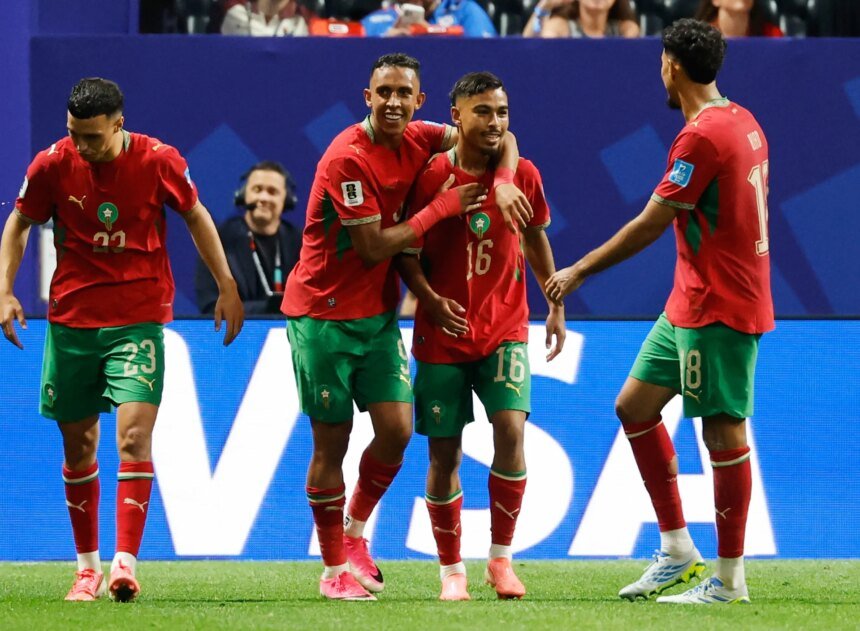
Despite the Moroccan team’s success in imposing its attacking advantage during the confrontation with Haiti and winning 4-2, the match revealed a number of important tactical details that are worth paying attention to, whether with regard to the construction of the game or the defensive balance that the “Atlas Lions” lacked in influential periods of the match.
Different shape
The Moroccan team started the match with the same tactical drawing that it adopted in the matches against Brazil and Scotland, which is 4-2-3-1, which sometimes turns into a clear 4-3-3, but the fundamental difference this time was the absence of Azzedine Ounahi from the starting lineup.
Read also
list of 2 itemsend of list
In the previous two matches, Onahi played the role of a link between the midfield and the attack, benefiting from his great ability to keep the ball and rotate it under pressure, which gave Morocco greater ability to control the pattern of play and manage the different periods of the match.
The absence of Ounahi deprived Morocco of a player capable of calming the pace or accelerating it as needed, and Sofiane Amrabat, despite his great value, does not possess the same characteristics related to rhythm-making and possession control that Ounahi or even the rising talent Ayoub Bouadi enjoys.
As a result, the Moroccan team seemed less able to kill the game during parts of the first half, and left more spaces for the opponent than usual, especially in threatening shots from Haitian players.
The adjustment in the distribution of roles also caused Ismail Sibari to be removed from the areas where he appears at his best.
Saibari prefers to receive the ball while facing the goal, whether through longitudinal passes or through balls that come directly in front of him, as happened in more than one shot during the confrontations between Brazil and Scotland thanks to the great understanding with Brahim Diaz.
However, during the first half, Saibari found himself forced to play in areas farther from the penalty area, which affected his offensive effectiveness and he missed more than one opportunity that needed a player to reach the goal in better positions.
When he finally got the ball in the space he preferred, after a special pass from Achraf Hakimi, he succeeded in exploiting it perfectly and scored the net.
Hakimi.. offensive lung
Once again, Achraf Hakimi proved that he is the most important attacking lung for the Moroccan national team. The right-back not only scored the first equalizing goal, but was the main source of threat to Haiti’s goal throughout the match, taking advantage of his continuous runs and his ability to create numerical superiority in the final third. Hakimi scored, created and provided solutions in more than one situation.
The match confirms once again that Hakimi is not just an attacking full-back, but rather one of the most important keys to creating opportunities within coach Mohamed Wehbe’s system.

Unexpected boldness
The Haiti national team entered the match with a completely different personality than the expected stereotype of one of the weakest teams in the tournament.
The team played with great courage, entered the duels strongly, and did not approach the match with a mentality of complete defense or waiting for Moroccan attacks.
On the contrary, he tried to exploit every available space behind Moroccan lines, and succeeded in creating real problems for the Moroccan defense system.
Leading twice against one of the most prominent teams in the world today reflects the level of boldness with which the Caribbean team played, and at the same time reflects some of the weaknesses that emerged within the Moroccan team.
In the second half, coach Mohamed Wehbe sought to impose control again in the middle of the field, and his players seemed more in control of the course of the match and less in a rush to finish, something he tried to reinforce in the second half by bringing in the duo Ezzedine Ounahi and Yassin Jassim, whose entry to the field was enough to clearly tighten control of the match.

Sofiane Rahimi’s ferocity in the third goal was enough to kill the Haitians’ chances of getting any point, then came the substitute Yassine Jassim’s goal to end everything and write the Moroccan superiority by four to two goals over the Caribbean team.
The problem of binaries
Perhaps the biggest observation about Morocco’s performance during the first half in particular was the lack of intensity and ferocity in individual struggles.
The two goals that the team received were not only the result of numerical superiority or complex tactical sentences, but they also came about due to the lack of seriousness required in dealing with some decisive balls inside danger areas.
The first goal came after a distinctive collective attack from Haiti that ended with a smart attempt from Lenny Joseph, while the second goal came through an exceptional shot from Wilson Isidore, but reaching these positions came as a result of giving the opponent more space and time than it should have.
This raises concern before the qualifying rounds, especially since stronger offensive teams may punish Morocco more if the same defensive problems continue.
Moroccan superiority despite everything
Aside from the unexpected result in the first half, Morocco was the better party in both halves of the match in terms of creating chances and reaching dangerous areas.
The Moroccan national team recorded a possession rate of 69% against Haiti, which is its highest percentage in a single World Cup match.
The team created a large number of opportunities, and repeatedly reached Haiti’s goal, and its main problem was only the final touch and taking advantage of the available opportunities.
Defensively, the picture seemed less reassuring, especially if we take into account the large technical difference between the two teams.
Haiti entered the match with only two goals in its history of participation in the World Cup, but it succeeded in doubling this number during one match against Morocco.
Morocco came out with the required points, and continued to show its offensive strength and diversity of solutions in the final third, but the match also revealed the importance of the presence of players such as Azzedine Ounahi and Ayoub Bouadi in controlling the tempo of the game, and it also reopened the file of defensive solidity and dealing with individual duos.
Although the offensive performance was sufficient to overcome the Haiti test, the upcoming rounds will require a greater degree of defensive discipline from the “Atlas Lions”, because the major teams will not give them the opportunity to compensate for mistakes with the same ease.