Al Jazeera correspondents


Published on 6/23/2026
|
Last update: 6/24/2026 09:51 (Mecca time)
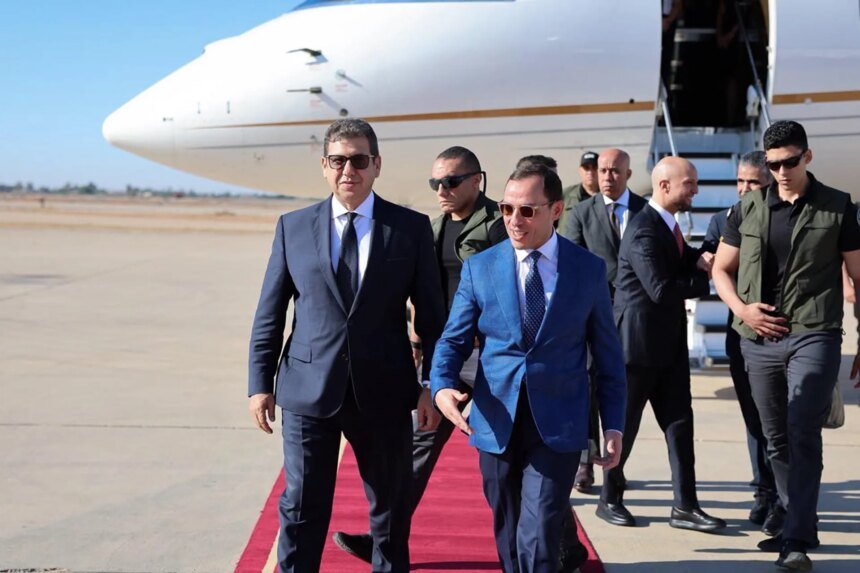
Tripoli/Cairo- The visit of the head of the Egyptian General Intelligence Service, Major General Hassan Rashad, to Tripoli is the first since he assumed his position in October 2024, and it also comes at a time witnessing an accelerating political movement in which the international track intersects with new regional and international initiatives and movements, foremost of which is Egyptian-Turkish coordination on hot issues in the region.
The National Unity Government in Libya said that Hassan Rashad conveyed to Prime Minister Abdel Hamid Al-Dabaiba the greetings of Egyptian President Abdel Fattah Al-Sisi, and the meeting discussed the latest developments in the political situation in Libya. The two sides stressed the importance of continuing coordination and consultation in a way that supports security, stability and unity of the country and enhances efforts to unify national institutions.

(Our government Facebook page)
How is the relationship between the two countries developing?
Relations between Cairo and Tripoli have witnessed a volatile path since the formation of the National Unity Government in 2021. While Egypt was Abdul Hamid Dabaiba’s first foreign destination after his government gained confidence, Cairo at the same time maintained its close relations with the Libyan East camp and its political and military leaders.
Despite periods of political stagnation, economic cooperation between the two sides continued, especially through the participation of Egyptian companies in reconstruction and infrastructure projects, most notably the Third Ring Road project, which the National Unity Government describes as the largest infrastructure project the capital has witnessed in nearly 30 years.
Rashad’s current visit was also preceded by a visit by Major General Khaled Hussein, Deputy Head of the Egyptian General Intelligence Service, to Tripoli in late 2025, in a move that was considered an indication of the resumption of direct political and security coordination between the two parties.
Is there any Egyptian involvement in the current political movement?
In an exclusive interview with Al Jazeera Net, a member of the Libyan House of Representatives, Ali Al-Soul, believed that the timing of the visit cannot be separated from the political movement taking place in Libya, including the American initiative led by the US President’s Advisor for Arab and Middle East Affairs, Massad Boulos, as the number of representatives supporting the American initiative rose to 104, considering that this reflects the growing desire to search for new approaches to ending the institutional division and restructuring the executive authority on consensual foundations.
The available data do not indicate that the visit took place in isolation from Cairo’s understandings with the Libyan East camp, especially since it comes at a time when Cairo has continued its contacts with various Libyan parties over the past months, including meetings between Hassan Rashad and Field Marshal Khalifa Haftar in Benghazi, in parallel with continued communication with the National Unity Government in Tripoli.
A desire to enhance attendance
In an interview with Al Jazeera Net, Libyan political analyst Elias Al-Baroni believes that the visit reflects an Egyptian desire to strengthen its presence within the Libyan scene rather than an announcement of a new mediation initiative.
He points out that Cairo views Libya as a security and strategic issue linked to its national security, pointing out that the visit came in conjunction with an increasing regional movement, including a meeting hosted by Cairo that discussed the Libyan file with the participation of regional officials and US Presidential advisor Massad Boulos, which reflects Egypt’s keenness to remain an influential party in any future political arrangements.
Agree to reduce escalation in the region
On the other hand, a high-ranking Egyptian diplomatic source says that the Libyan crisis was the subject of extensive discussion this week in Cairo, noting that Egyptian Foreign Minister Badr Abdel Ati and his Turkish counterpart Hakan Fidan discussed in a bilateral meeting in Cairo the possibility of employing harmony and successful coordination between Cairo and Ankara in some files of the region.
Regarding the Libyan file, the source confirmed that there is agreement on the importance of Libya to Egypt, and the importance of the stability of Syria to Turkey, As part of joint efforts to reduce escalation.
The Egyptian source revealed that the coming period will witness intense activity at the level of the Libyan crisis, so that foundations will be established on which to build towards the stage of stability and unification of institutions.
Supporting the process of unifying institutions
The Egyptian diplomat explained that the Egyptian approach to the Libyan crisis is based on supporting the unity and sovereignty of Libya away from external interference, and the necessity of the immediate exit of all foreign forces, mercenaries and foreign fighters from Libyan territory in implementation of international decisions, saying that Cairo’s conviction is that any regional movement must start from the basis of a pure Libyan-Libyan solution.
The same source explained that Cairo has recently been playing an active role and is moving on several parallel paths. He added, “Politically, we engage through the mechanism of the immediate neighboring countries between Egypt, Tunisia, and Algeria to unify visions and intensify efforts aimed at bringing the viewpoints closer between all Libyan parties and leaders without exclusion.”
He continued that this comes in parallel with providing full support to the efforts of the UN envoy to Libya, and close coordination to enhance the effectiveness of the UN road map to ensure the implementation of the solution path according to specific time stages.
On the security level, he explained: “Egypt actively supports the process of unifying the military and security institutions and the work of the 5+5 Joint Military Committee. Egypt also adopts an approach that goes beyond the political and security aspects to include strengthening economic interdependence and supporting development programmes, believing that addressing the economic and social dimensions is an essential pillar for creating the appropriate environment for the success of the comprehensive political settlement.”
The diplomatic source explained that Cairo is working hard to hold presidential and parliamentary elections in Libya as soon as possible, stressing that Libya’s security and stability is an inherent extension and an integral part of Egyptian national security.