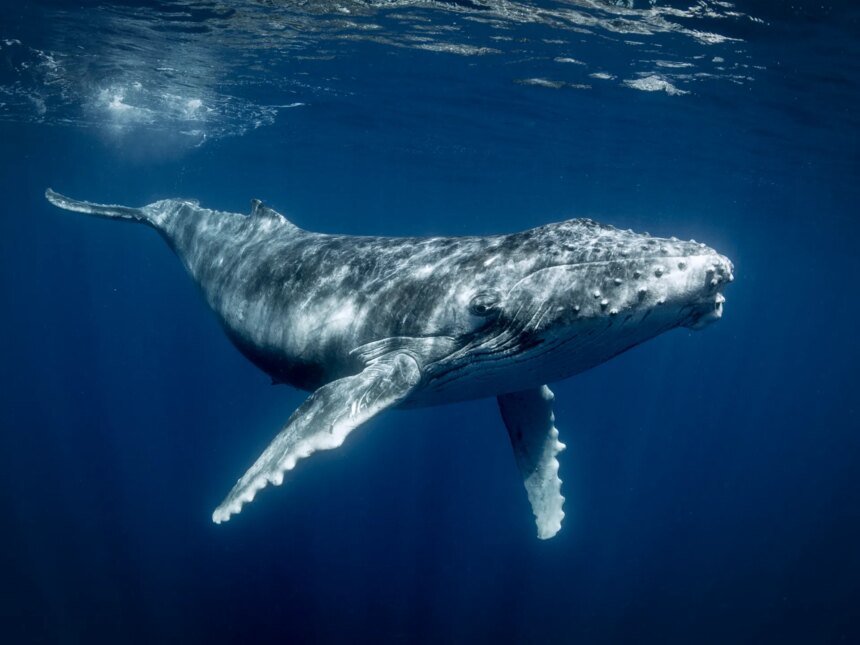
In most of the world’s oceans, humpback whales begin one of the longest journeys in the animal world every year. They leave cold feeding grounds near the poles, travel thousands of kilometers to warmer waters to mate and give birth, and then return again with the change of seasons.
But in the Arabian Sea, the story seems completely different, where a small and rare group of humpback whales lives near the coasts of Oman, Yemen and India, in a way that almost contradicts the known pattern of this species.
Instead of long seasonal migration between the polar and tropical regions, these whales remain almost all year round within the Arabian Sea. The authors of the study published June 19 in the journal Frontiers in Marine Science used satellite trackers to understand the movement of these endangered whales.
The researchers placed 14 tracking devices on 13 whales off the Omani coast between 2014 and 2017, then followed their horizontal paths and diving movements over a total period of 749 days.

Small range of rare whales
The findings are particularly important because Arabian Sea humpback whales are one of the most isolated populations of whales in the world. Previous estimates indicate that their number off the coast of Oman does not exceed about 82 individuals, which makes any information about their presence, feeding, or breeding areas essential for protection efforts, according to the study’s lead author, Andrew Wilson, a marine biologist and founding director of Future Seas Global.
Satellite data showed that most of the whales stayed close to the Omani coast, especially in Masirah Bay and Hallaniyat Bay. According to the study, these areas appear to be the “heart of the home” for these whales. They spend a long time in slow, limited movements within specific ranges, a behavior often associated with feeding, resting, or reproduction.
Wilson said in statements to Al Jazeera Net: “This result confirms that the Arabian Sea humpback whales are not just seasonal visitors to these waters, but rather depend on them to a great extent. Their long stay near Oman indicates that this region provides them with basic needs throughout the year, unlike most other humpback whales that clearly separate feeding areas and breeding areas through long migratory journeys.”
But one whale broke this pattern; He made a long journey from the Gulf of Masirah across the Arabian Sea to the Gulf of Manar near southern India, then returned again to Oman. During this trip, he covered no less than 7,330 kilometers in 103 days.
According to the study, this trip provides the first direct evidence of an Arabian Sea humpback whale crossing between the western and eastern Arabian Sea, which means that the range of movement may be wider than previously thought, even if it remains linked to the Arabian Sea region itself.
Life near the surface… and danger nearby
The study also reveals that these whales use the sea in a more diverse way than previously known. They often move over the shallow continental shelf, but may also move to deeper areas near canyons and sea cliffs.
Diving data indicate that whales spend a long time near the surface; The devices recorded that the largest percentage of time was in the first ten meters of the water column, followed by depths between 10 and 20 metres.
But this information has a worrying aspect, according to the main author of the study, who points out that the frequent presence of whales near the surface makes them more vulnerable to collisions with ships, especially in an area witnessing increased navigational traffic. Its proximity to coastal fishing areas increases the risk of entanglement in nets, a problem whose effects previous studies have shown on the bodies of a large number of these whales.
The study believes that protecting this group cannot be the responsibility of only one country. Its paths extend through the waters of Oman, Yemen, India, and perhaps other regions in the northern Indian Ocean. Therefore, researchers call for regional protection plans that include feeding and breeding areas and corridors through which whales move, while working to reduce the risks of fishing and shipping.
Limited study but important for protection
The researchers explain that the study included a small number of whales, with a predominance of males in the sample. Nine whales were identified as male, compared to only two females and two of undetermined sex. The trackers also had a limited lifespan, leaving important time gaps, especially between June and October, a period that may be crucial for understanding feeding during the monsoon season.
Tracker placements also focused on areas known to have high sightings, which may affect the estimate of the full range of movement of these whales. The data did not provide direct evidence of feeding moments. Rather, researchers inferred behavior from movement and diving patterns, which is a useful method but does not reveal all the details of the whales’ lives at sea.