Published on 6/23/2026
|
Last update: 15:33 (Mecca time)
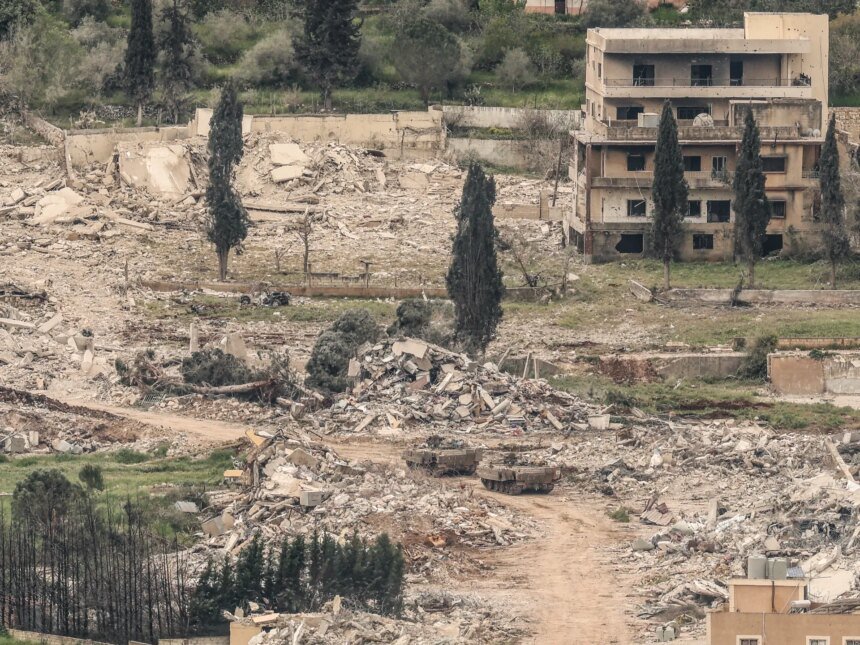
The Lebanese government delegation is preparing to hold the fifth round of direct negotiations with Israel under American sponsorship, amid challenges imposed by the complex field reality and the Israeli side’s insistence on refusing to withdraw from the areas it occupied in southern Lebanon.
The Lebanese delegation is heading with recommendations from Lebanese President Joseph Aoun based on: complete withdrawal of the occupation, deployment of the national army, return of prisoners and displaced persons, and reconstruction.
However, the Israeli insistence on not withdrawing from the regions of southern Lebanon constitutes a dilemma facing these discussions. Israeli Prime Minister Benjamin Netanyahu stated that: “Israel will remain in the safe zone whenever necessary,” which is what the Israeli occupation army calls the “yellow belt” in the southern regions of the Litani River.
The interactive map presented by colleague Abdel Qader Arada shows that Israel has not determined the mechanisms for withdrawal from southern Lebanon, which raises questions related to the Israeli presence in the western and central axes that were the scene of fighting between the occupation army and Hezbollah fighters, as well as questions regarding whether the “experimental areas” will include areas north of the Litani River, specifically in Nabatieh.
In the same context, Israeli Finance Minister Bezalel Smotrich told Israeli Army Radio: “There will be no Israeli withdrawal from Lebanon and Beaufort Castle until Hezbollah is gone.”
This comes at a time when Hezbollah rejects the formulas of “yellow or experimental zones” and freedom of movement of the occupation, demanding a quick timetable for withdrawal.
Experimental areas
In his reading of the field situation, the military and strategic expert, retired Brigadier General Khalil Gemayel, spoke about the details of the deployment of the Lebanese army, Hezbollah fighters, and the Israeli occupation army in southern Lebanon. He said that the furthest areas reached by the occupation army are in the western sector, while in the central sector, it is stationed in the southern outskirts of Beit Yahoun and the southern outskirts of Hadada, while Hezbollah is stationed inside the village, and the Lebanese army is in the town of Tibnin.
In the eastern sector, the occupation army reached Kafr Tibnit, but was unable to occupy Ali al-Tahir Hill, while Hezbollah is stationed in Nabatieh al-Fawqa, dozens of meters away from the occupation army, while the Lebanese army is stationed in Nabatieh and Kafr Rumman.
The retired Brigadier General says that the map published by the occupation army regarding the deployment areas is incorrect, referring to an updated map of what the occupation describes as the “security zone” in southern Lebanon, where the occupation army claimed to expand and control new areas, most notably the “Ali Al-Tahir” heights and the town of Kafr Tabnit located below it.
Regarding Israel’s talk about its intention to publish maps of the experimental areas outside what it calls the Yellow Line, the military and strategic expert explained that the Lebanese state – if the matter is imposed on it – insists that these experimental areas be within the “yellow line”, that is, the areas occupied by Israel, while the latter wants the “experimental areas” to be outside it.
The retired Brigadier General expects that the “experimental areas” will be in the Western Sector area, because they will be easier for the occupation army to exit and enter, and do not contain large and high hills, and most importantly, they are where the UNIFIL forces are commanded, and their facilities are under Israel’s control.
It is also likely that the “experimental areas” will be in the Shebaa area because there is no resistance there, and because it is a low-lying area, in addition to the town of Hadatha.
At the conclusion of a fourth round of negotiations in Washington, Beirut and Tel Aviv agreed to implement a ceasefire, and a statement issued after the round called on Lebanon and Israel to “accelerate the establishment of experimental zones in which the Lebanese Armed Forces assume exclusive control of the territory, with the exclusion of all non-state armed actors.”
According to a report on Al Jazeera prepared by Mustafa Izrid, the basis of the idea of the “follicular areas” is based on choosing a specific area in southern Lebanon from which Israel withdraws so that the Lebanese army can enter and deploy in it completely, in order to prevent the entry or return of any manifestations of armament outside the framework of the state.
The Lebanese President said that Lebanon proposed that the beginning be in Zawtar al-Sharqiya and Zawtar al-Gharbiya with Yahmar and Beaufort Castle, given the symbolism of this area and its proximity to the city of Nabatieh.