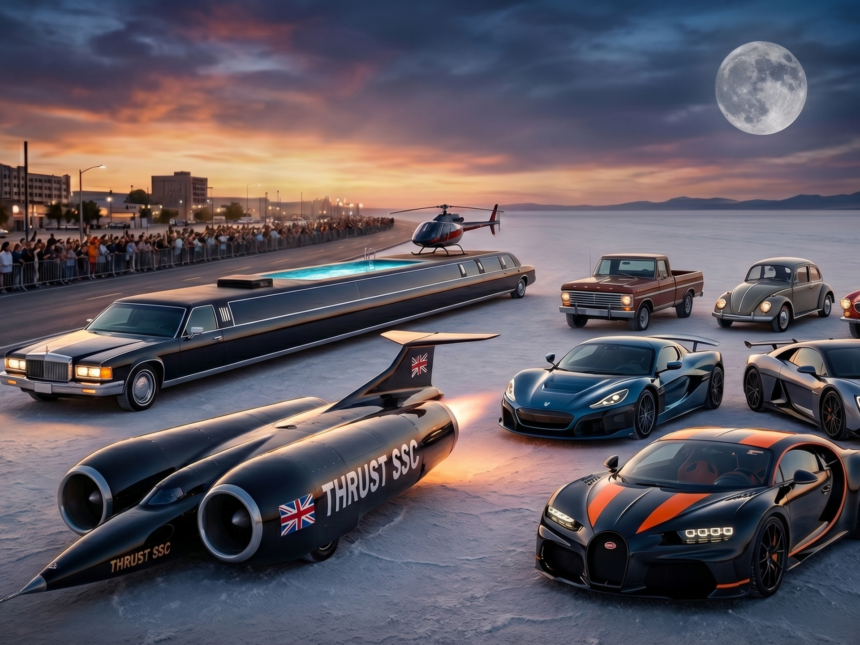
Can a car cover the distance between the Earth and the Moon 7 times without letting its owner down? How can a 30-meter-long vehicle carry a helicopter pad and a swimming pool on its back while driving down the street? Welcome to the most extreme and exciting side of engine engineering.
In this aspect, cars go beyond being mere pieces of iron and means of transportation, to become a direct reflection of human development in technology and ambition. Each new record is not recorded as a separate achievement, but rather as a link in a long chain of humankind’s ongoing quest to break the limits and red lines of the laws of physics.
In this report, we will not talk about the cars you see on your daily road, but rather we will delve into the world of “exceptional records” that have entered the Guinness Book of Records. Where extraordinary speeds approaching the speed of sound meet with the strangest, most efficient, and most insane designs in human history…to form together the image of a world that does not know how to stop, and is not satisfied with stability.

The most famous records in the history of the automotive world
The most famous records in automotive history come as a culmination of amazing technical excellence, and a living embodiment of continuous attempts that challenge prevailing engineering rules. Through these numbers, companies succeed in creating super vehicles that redefine the concept of performance and change the features of driving on the roads.
- The fastest cars in the world
The Bugatti Chiron Super Sport 300+ sits at the top of the fastest gasoline-powered cars in the world, with a speed of up to 490 km/h, and on the other side of the modern revolution, the BYD Yangguang U9 Extreme rushes to announce the era of electric supercars with a record speed of 496 km/h that was recorded in late 2025.
The story did not stop here. In the desert of the American state of Nevada in 1997, Briton Andy Green drove the fastest car on land in history (Thrust SSC), at a record speed of approximately 1,228 km/h, becoming the first vehicle on land to break the sound barrier.
Imagine for a moment that you are driving a car that reaches a speed of 341 meters per second, meaning that it travels one kilometer in less than three seconds. This is done by relying on two jet engines derived from military aircraft, in a project not for commercial use, but rather to challenge speed limits and break records.
As for the world of acceleration that breaks the sense of time, the Rimac Nievera R has set many records, most notably the start from zero to 400 km/h and then coming to a complete stop in just less than 26 seconds, in an experience that reduces distance and time to a fleeting moment.

- The best-selling cars in history
The Japanese Toyota Corolla leads the world’s automotive scene, with more than 54 million cars since its first launch in 1966, transforming from just a model into a global phenomenon that does not disappear from the roads.
In the world of pickups, the American Ford F-Series imposes its absolute dominance, with historical numbers and sales exceeding 43 million copies since the beginning of its production, proving that it is not just a truck, but rather an ongoing business legend across generations.
As for the legend that has maintained its identity for decades without radical change, it is represented by the Volkswagen “Beetle”, whose sales exceeded 21 million copies with almost the same design spirit, proving that some shapes do not dare to be changed by time.

- Heavier, lighter and shorter cars
In the world of cars, things are not always measured by speed, but sometimes by weight, size and height. For example, the British Bell B50 (1962 model) is considered the lightest car in history, with a weight of only 59 kilograms, making it the smallest commercial production car. It is as if it is closer to the idea of a car that came out of the world of miniatures, but was made to run on the road.
In complete contrast, the Mercedes-Maybach S 600 Pullman Guard (2017 model), as the heaviest car in history with a weight exceeding 5 tons, stands as a moving fortress on 4 wheels that does not resemble any ordinary car.
As for the shorter car category, the modified Lotus 7 appears as one of the most unusual designs, standing only about 81 centimeters above the ground, as if it were a car touching the road but not driving on it.

- The longest driving trip and the greatest distance traveled
With only one tank of fuel and without stopping, driver Mikko Marcic succeeded in setting a Guinness World Record in 2025 when he drove a Skoda Superb for a distance of 2,831 kilometers, on a trip that passed through several European countries such as Poland, Germany, France, Belgium, and the Netherlands.
As for one of the most strange trips in history, American Louis Matar drove a 1954 Cadillac for a distance of 10,171 kilometers without stopping the engine, while an accompanying truck was supplying him with fuel and performing maintenance while driving, on a trip that did not know the idea of a complete stop.
In terms of long-term endurance, the 1966 Volvo B1800 remains in exceptional condition after having traveled more than 5 million kilometers, a distance equivalent to orbiting the Earth at the equator more than 130 times, and the equivalent of a trip between the Earth and the moon back and forth about 7 times.
- The longest cars in the world
Rolls-Royce Phantom EWB VIII is one of the longest cars in the world, at nearly 6 metres. The brand’s luxury extends into an imposing presence on the road.
Sometimes the length of the car turns into an engineering challenge that is entered in the Guinness Book of World Records, and here the “American Dream” car appears as an unbelievable exception, with a length of more than 30 meters, containing 26 wheels, and a platform for landing a helicopter.

- Most and least fuel efficient
The 1986 Lamborghini Countach is one of the most fuel-efficient cars, with an average consumption of approximately 33 liters of gasoline per 100 kilometers. To enter the Guinness Book of Records as one of the worst fuel consumption rates for civilian cars.
On the other hand, the Volkswagen XL1 is the most fuel-efficient production car in history, with a consumption rate of only about 0.9 liters per 100 kilometers, in ideal driving conditions.

- The longest uninterrupted production car
The Chevrolet Suburban is considered the holder of the title of the longest uninterrupted production car in the history of the automobile industry, as its production officially began in 1935, and is still continuing to this day, recording a journey extending for 91 years of continuous development.
In the world of sports cars, the Porsche 911 stands out as the longest sports car in production, from its launch in 1963 until today, while maintaining its basic identity and developing over multiple generations without losing its original spirit and character.

- The first gasoline-powered car…and another with six wheels
The Benz car is the first car in history to operate with a gasoline-powered internal combustion engine. It was designed by German engineer Karl Benz in 1885, before obtaining a patent in 1886, beginning the modern automobile industry as we know it today.
In another aspect of engineering development, the Renault Type MH stands out in the list of the first commercial cars in the world with six-wheel drive, as it used 6 wheels on the road, in 1924.
- The most expensive cars in history
The 1955 Mercedes-Benz 300 SLR Uhlenhout Coupe is the most expensive car in history, after it was sold at auction in 2022 for an astronomical amount of $143 million.
The Rolls-Royce La Rose Noire Droptail is also considered the most expensive modern car manufactured and sold in history, with a price of about $30 million. Its high price is due to the fact that it is completely made to order, and it may be a unique or very limited copy, the number of which does not exceed the fingers of one hand.