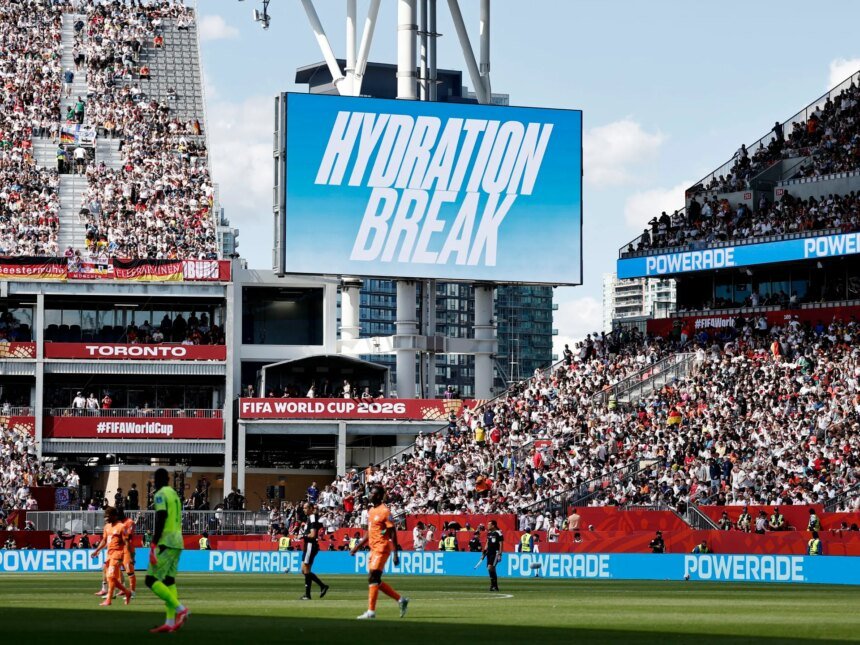
“Hydration breaks” are no longer just a preventive medical measure approved by FIFA to keep players safe; Rather, in the 2026 World Cup finals, it turned into a flexible and smart “time-out”, which technical managers exploited to reorganize their ranks and correct tactical errors.
Technical analyzes of recent matches confirm that the course of play and the offensive momentum change radically as soon as the three-minute break ends, making it a double strategic weapon that breaks the rhythm of the team in possession and gives the defending team a lifeline to rearrange its cards.
Read also
list of 2 itemsend of list
Offensive transformation after pauses
Data and statistics issued by global analysis platforms such as Opta Analyst and ESPN reveal sweeping offensive superiority and a remarkable rise in the match pattern after the stoppage periods, which is translated by the following indicators:
- Goal surge in the first half: Among the goals scored in the first half of the matches, the net was conceded only 14 times before the 22nd minute, while the average jumped to 19 goals in the period after the break until the end of the half.
- Decisive goals to change the state of the match: Statistics showed that 11 goals scored after water breaks (in the two halves) were pivotal goals that completely changed the course of the result, either by eliminating the tie or snatching the lead.
- Explosion of shot attempts: The tournament witnessed only 115 shots recorded before the first half break, compared to 170 shots in the period extending from the 25th minute until the end of the half; Which proves the immediate impact of technical instructions.
Among the 48 teams participating in the World Cup, 26 teams recorded a qualitative increase in their threat rates and shots after returning from the break, while the offensive performance of only 11 teams that were better before the break declined.

Living models… Breaks that changed the scales of the World Cup
1. Australia vs. Türkiye (2 – 0)
Before the break, the Turkish team imposed absolute dominance over the course of play and possession, amid an Australian deficit of one shot before the 22nd minute.
The Australia coach used the three minutes to drink water to reorganize his back lines and switch to quick counter-attacks; The result was Australia scoring the winning goals immediately after the first and second half breaks, with 3 decisive shots fired after the break.
2. Morocco vs. Brazil (1 – 1)
Before the break, the Moroccan national team imposed its fierce attacking style, extending complete control over the midfield.
In the 22nd minute, Brazil coach Carlo Ancelotti gathered his players with strict instructions to close spaces and apply reverse pressure; The momentum turned completely in favor of the Seleção, who succeeded in imposing their rhythm and adjusting the result.
3. Germany vs. Curacao (7 – 1)
Before the break, the Curacao team surprised the German “machines” with an unexpected tactical drawing that confused the guests’ calculations in the first minutes.
Coach Julian Nagelsmann took advantage of the pause to explain positional adjustments and how to strike a defensive block. The Germans returned with absolute dominance, culminating in a historic seven.
He said: “Today Curacao played a diamond formation, and we adjusted our attacking style before the water break. However, it took some time in some moments, because at the end of the day, you rarely face a team with a diamond formation these days. It is almost uncommon. Few teams do that now, and we needed some time. The water break was useful to confirm what we had adjusted beforehand.”

4. Japan vs. Netherlands (2 – 2)
The Netherlands dominated the match and were on their way to winning, while the Japanese attack limited themselves to two shots, with great difficulty in penetrating.
The Japanese coach made a fundamental adjustment to the attacking system during the second half break (minute 67); The “Blue Samurai” rose up and snatched the equalizer, with a jump in the shot rate to 5 dangerous balls thanks to the new tactical drawing.
These data prove that modern football is now decided in the details of time-out minutes. The smart coach is the one who has the ability to turn the mandatory medical rest into a strategic gain that turns the tables on his competitor.
Stars and coaches criticize
FIFA’s decision to implement a mandatory water break in all matches, regardless of the nature of the weather, sparked widespread controversy and sharp division between the parties to the game:
Virgil van Dijk, captain of the Netherlands national team, harshly criticized the idea in his statements to the official ITV website after the draw with Japan (2-2), saying: “I really don’t like these breaks, and even for the viewers behind the screens, it is not good because of the large number of commercials.”
He added: “If the weather is very hot, it is acceptable, but each match must be evaluated individually instead of being forced.”
As for Kylian Mbappé, the star of the French national team, media reports showed signs of dissatisfaction with the French star during the pauses, especially against Senegal.
When he was asked about his opinion about drinking water breaks, his response was: “What do I think about water breaks? Don’t ask us players for our opinion, we react quickly. If we were in control of the match tomorrow in the 25th minute, and then a water break came, we would be angry because that would upset our balance, but if the weather was hot, or we were defeated, I would be happy.”
Fast attackers believe that the break gives exhausted defenders a golden opportunity to catch a breath and regroup defensively, which aborts the “offensive momentum” and closes the spaces created by the attackers with continuous running.
As for the coaches, Argentina’s coach Lionel Scaloni stood out, who considered that drinking water breaks “helps the weaker teams.”
He said, “This may help the team that is considered weaker in theory, because it gets time to rest.” Adding that this practically divides the matches into “four rounds.”
As for Mauricio Pochettino, the coach of the US national team, his response was decisive: “I do not favor this decision; I prefer it only in harsh circumstances. However, in good circumstances, it is unnecessary.”
Coaches believe that turning the match into “four innings” gives them tactical flexibility and greater control to fix the problem early without waiting until the end of the inning.
Source: The island + social media sites + Agencies