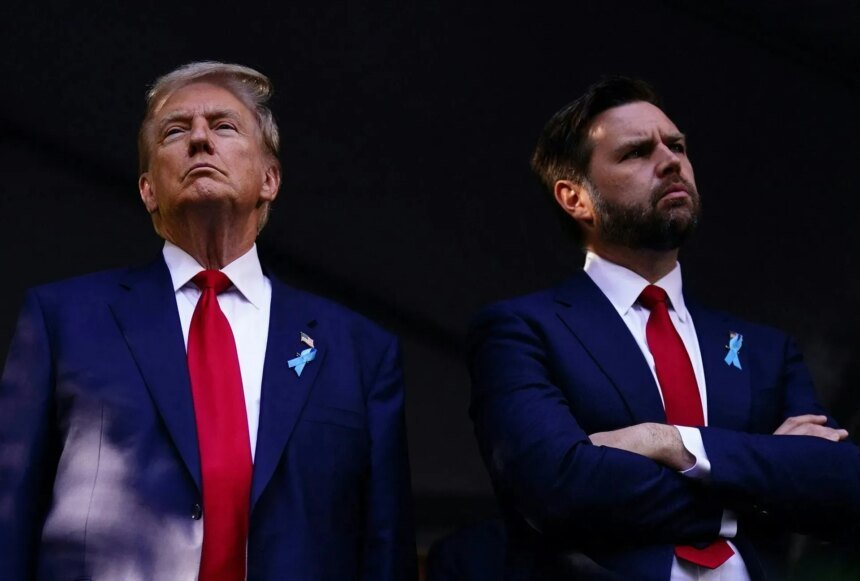
In an unusual tone between two allies who are accustomed to managing the dispute behind the scenes, US Vice President J.D. Vance issued harsh public criticism of Israeli officials who attacked Washington’s agreement with Tehran, describing the reaction inside Israel as “strange panic” and “panic,” before reminding Benjamin Netanyahu’s government that it does not have the luxury of attacking its “only strong ally” remaining in the world.
These statements, in and of themselves, do not mean that the American-Israeli relationship has entered a state of estrangement, but they reveal a real moment of tension in post-war calculations.
Washington wants to give the memorandum of understanding with Iran an opportunity to transform into a broader settlement within 60 days of negotiations, while Tel Aviv fears that the agreement will restrict its hand in Lebanon and postpone files that it considers essential, most notably the Iranian nuclear program and ballistic missiles.
The memorandum stipulates an immediate and permanent cessation of military operations on all fronts, including Lebanon, the reopening of the Strait of Hormuz and the lifting of the naval blockade on Iran, with a gradual lifting of sanctions on its oil exports.
It also opens the door to a reconstruction and development fund whose value may reach $300 billion, and postpones the more difficult issues – including the future of enrichment – to a later negotiating stage. Israel is not a direct party to the memorandum, but it is practically concerned with two basic items in it: the future of the confrontation with Hezbollah in Lebanon, and the fate of the Iranian nuclear program.

What did Vance say to the Israelis?
In an interview with the New York Times published yesterday, Thursday, and then in a White House briefing, Vance singled out National Security Minister Itamar Ben Gvir and Finance Minister Bezalel Smotrich, asking: “What exactly is your proposal? You are a country of nine million people. You cannot simply rely on killing as a means to solve every national security problem.”
At the White House, he stressed that “the problem for Israel is not Donald Trump, and anyone in Israel who believes that his biggest problem is the President of the United States must pay attention and realize the reality of the situation his country is going through,” recalling that two-thirds of the defensive weapons that protected Israel “were made by American hands and with American taxpayer money.”
Ben Gvir responded, via the “X” platform, saying: “This is the proposal… to deal with the Nazis of the twenty-first century, as the United States dealt with the Nazis of the twentieth century.”
This response reflects the intensity of rejection within the Israeli right of any truce with Iran and Hezbollah, especially in the Lebanese arena.

Lebanon is at the heart of the dispute
The Lebanese file increases the sensitivity of the scene. Trump said in his closing speech at the G7 summit in France that Netanyahu must adopt a “more flexible approach” towards Lebanon, adding that there is no need to demolish a residential building whenever a person from Hezbollah is searched.
He then announced in a post on Truth Social that he expected “a complete ceasefire on all fronts, including Lebanon, Hezbollah, and Israel.”
But Netanyahu did not go in the same direction. In his first comment after the agreement, during an official event, he stressed his appreciation for the relationship with Washington, but stressed that Israel would keep its forces in southern Lebanon as long as its security needs required it.
The Israeli army raids did not stop, as at least 16 people were killed as a result of Israeli raids that targeted the Nabatieh area in southern Lebanon on Friday night, according to what the National News Agency reported.
“Washington hawks” and the agreement
American criticism of the agreement does not come from Israel alone. Prominent Republican legislators and lobbying organizations close to Israel have criticized it, with Senator Ted Cruz describing it as “unwise,” and Senator Bill Cassidy calling it “the worst political mistake in a decade,” while Senator Roger Wicker, Chairman of the Armed Services Committee, said that what Iran will get makes the Obama agreement “seem trivial in comparison.”
The American Israel Public Affairs Committee (AIPAC) also issued a detailed statement criticizing the lifting of sanctions and the absence of clear restrictions on Iran’s nuclear and missile programs.
But what is striking is that many of them avoid direct confrontation with Trump, directing their criticism at Vance or at the executive details of the agreement, which, according to analysts, reflects Trump’s weight within the Republican Party and his ability to redefine the acceptable position on Iran and Israel at the same time.

Will Israelis’ confidence in Trump be shaken?
Inside Israel, concerns do not appear to be limited to the government. A poll by Israeli Channel 12, reported by The Times of Israel on Thursday, showed that 71% of Israelis do not trust Trump to take care of their interests within an agreement with Iran, and that only 11% believe that Israel emerged victorious from the war, while 52% saw that Netanyahu’s performance harmed their country’s interests.
These numbers reflect a shift in Trump’s image within Israeli public opinion, after for years he enjoyed wide support as an exceptional ally since he recognized Jerusalem as the capital of Israel and moved the embassy there.
Inside Israel, the opposition tried to use the American-Israeli debate to confirm that the crisis is broader than a passing disagreement over the Iran agreement.
Opposition Leader Yair Lapid said that one day witnessed the US Vice President’s anger at Smotrich and Ben Gvir, Foreign Minister Gideon Sa’ar cutting off communications with the European Union’s foreign policy chief, and Trump’s statements about Netanyahu’s “irresponsibility” in Lebanon.
He concluded that the continuation of this government, as he put it, threatens to erode Israel’s foreign relations.
However, the moment should not be read as a collapse in the relationship, as American-Israeli history reveals differences that often ended in stabilizing the alliance, not dismantling it.
In 2015, Netanyahu attacked Barack Obama’s nuclear agreement with Iran in front of Congress, before the Obama administration later signed the largest military aid package for Israel, worth $38 billion.

In conclusion, the exchange cannot be read as the end of the historic alliance between the United States and Israel, as Trump himself stated that it is “very likely” that he will support Netanyahu in the upcoming elections, describing him as doing a “good job” but needing to be “more rational.”
What appears publicly today appears to be a reset of the rules of political engagement between the two countries. Washington is sending a message that its unlimited security umbrella does not mean an open check to ignite wars that do not serve the broader American strategy, while Israel is trying to rebel against these restrictions to maintain regional deterrent power.