
Published on 6/15/2026
|
Last update: 17:18 (Mecca time)
Yemen – Just as adults devise their own ways to survive, young people in Yemen devise their own ways to conquer hunger.
In the exhausted streets of Taiz and Ibb, traffic “bumps” or potholes resulting from dilapidated infrastructure have turned, due to necessity, into forced labor platforms for children. There, where the wheels are forced to slow down, the children begin their daily run to speed up their livelihood dipped in the sweat of wasted childhood.
Under complex living conditions, millions of children in Yemen face existential challenges that have forced them to abandon classrooms and replace school bags with water refrigerators and sidewalk stalls.

Searching for a living under the sun
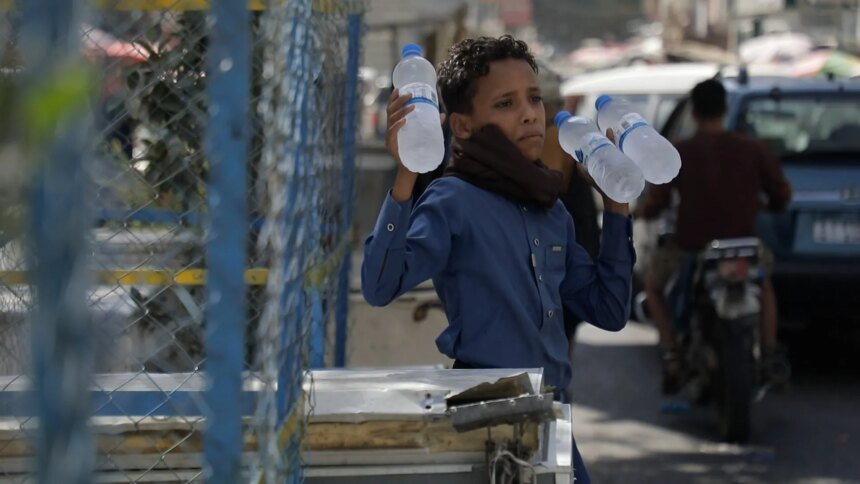
Every morning, the child Issa Hassan Ahmed (11 years old) wakes up to fight his daily battle selling cold water in the center of the city of Taiz. His journey begins with the first threads of dawn and does not end until the sun sets, draining his young body of energy that his young years cannot bear: “I go out early in the morning to sell water in order to provide a living for my mother and brothers.” With these spontaneous words that summarize a stolen childhood, Issa began his talk to Al Jazeera Net.
He explains how he divides his time between his school bag and the selling platform, saying: “On school days I go to school, but I am forced to leave before the end of the last classes, so that I can join my father and help him sell. As for my days off, I am stationed here from early morning until evening.”
Issa no longer looks at life with the eyes of a child waiting to play; Rather, in the eyes of a man responsible for a family: “I have been seeking God in the street for a year and a half, and thank God, the most important thing is that we provide for the household expenses. The market is weak and the income is low.”
Issa roams the crowded streets, tracking cars that slow down at turns and bumps, calling out to drivers and passers-by: “Do you want water?” Regarding the hardships of this long day, he says to Al Jazeera Net: “The sun and fatigue exhaust me a lot, and when I become very tired, I sit on top of the water refrigerator to rest a little, then I continue working until my bottles are full, and I go back to sleep to begin the struggle the next morning.”

Two dollars of wasted childhood sweat
Issa’s daily toll alone ranges between 2,000 and 3,000 Yemeni riyals (about $1.5 to $2, depending on local exchange rates), while the total toll of his struggle with his brother and six-year-old father reaches 8,000 to 9,000 Yemeni riyals per day.
This small amount, which is eroded every morning by the specter of inflation and high prices, goes directly to filling the family’s food gap. Issa explains to Al-Jazeera Net with an innocent materialism imposed by reality, saying: “All the money we collect we take for home immediately. We buy flour, sugar, and some necessary supplies.”
Despite this daily siege, Issa still has room to dream: “I dream of being an engineer or a doctor. I just want a stable job that will build a future for me and protect my family from this need.”

From the hell of Tihama to the sidewalks of Taiz
A few meters away from Issa, in the same noisy round, his father, Hassan Ahmed (60 years old), stands with a graying head and a back bowed before the vicissitudes of time.
The father speaks to Al Jazeera Net with tears remaining in the wrinkles of his face: “We are here not by choice. We are displaced people who fled the hell of war in Hodeidah Governorate (Tihama). We came to Taiz and we do not have anything from the rubble of the world. We lived in a random camp near Al-Jawla, and we found nothing but selling water as a way to survive.”
The father looks at his child, Issa, as he runs between the large transport buses, and goes on to say, his words choked with grief: “Issa comes to help me as soon as he leaves school… One day we get a living and the other day we find nothing, and we go on with what God decrees for us.”
He added, “Issa alone earns between 2,000 and 3,000 riyals. God knows that I do not want to throw a child of this age to the side of the road and at the mercy of car wheels, but what is there to do? How can we cover the expenses of rent, camp, and food if the children do not help me?”

A recurring scene
The story of Issa and his choice of speed bumps is not an individual case, but rather a daily “catalog” applied by thousands of children in Yemen who have begun to carefully study the geography of the sidewalk. Where is there a hole? Where is there traffic? There you find them grabbing passers-by.
This scene was monitored by Al Jazeera Net in a field survey that included several Yemeni regions. In “The Displaced People’s Street” in Shara’ab Al-Runa District, the child Asem Radwan stands behind a modest wooden stall, selling pens, notebooks, and simple school supplies, instead of being a consumer of them in the classroom.

In the streets of Ibb city, and the areas of “Al-Udayn”, “Hadba”, and “Najd Al-Jama’i”, the scene was repeated with the same features: children as young as roses standing amid exhaust and dust, selling tissues, water, and snacks.
On Jamal Street in Taiz, we met the child Rabei Muhammad (8 years old), sitting on the rough asphalt with small toothpicks in front of him, which he sold to passers-by. Rabie says to Al Jazeera Net with distressed innocence: “I sell a bag of sticks for 200 riyals to help my father buy bread for the house.” He adds sadly: “There are only a few people who buy from me, and the sun has burned me.”
The latest data from the United Nations Children’s Fund (UNICEF) indicate that there are more than 2.4 million Yemeni school-age children who are currently out of school, while about 8.5 million other children face the risk of dropping out as a result of the destruction of school infrastructure and the cessation of teachers’ salaries for years.
Child labor has also transformed from being merely “temporary family assistance” to a “survival strategy” for more than 35% of displaced and poor families who no longer find a source of income, forcing them to push their children into the streets and into hard professions such as construction, collecting plastic, and selling sidewalks.