Published on 6/15/2026
After a long delay, the European Union announced on Monday that Ukraine’s accession file has moved to the next stage, but this does not mean that Kiev’s path to full membership has become easy.
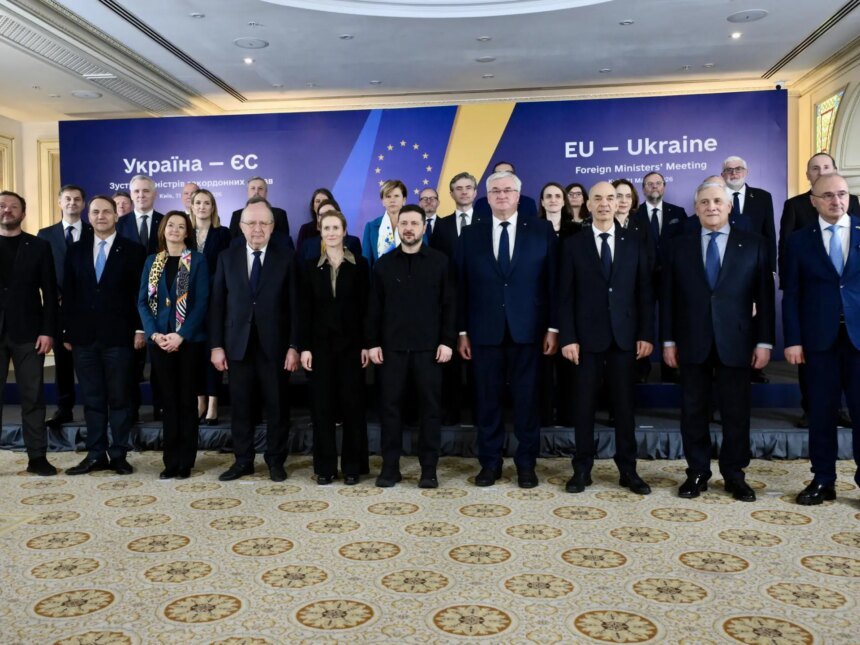
The foreign ministers of the 27 member states of the Union are scheduled to officially begin negotiations with Ukraine and its neighbor Moldova regarding compatibility with the first set of European Union laws.
This comes after Ukraine’s progress remained stalled for nearly two years due to Hungarian nationalist leader Viktor Orban’s use of his veto against all steps, but his defeat in the elections by his rival Peter Magar last April opened the way for it.
In a joint statement with European Council President Antonio Costa, European Commission President Ursula von der Leyen said: “This is an acknowledgment of the determination, courage and hard work that the two countries have shown in pushing forward reforms, even in the face of enormous challenges. In a world of increasing uncertainty, a greater European Union is in our common interest.”
The road is long
But despite the media hype, and Kiev’s repeated calls for rapid progress four years after it submitted its application to join following the Russian war, this does not mean that the war-torn country will join the European Union any time soon.
In practice, Ukraine still has huge work to do to align its laws, institutions and standards with EU standards, including negotiating 35 chapters covering everything from the environment and agriculture to justice and security, grouped into 6 groups.

As is always the case in the European Union, the issue is extremely political, and there are many points at which any member state can obstruct Kiev’s accession.
Agence France-Presse quoted a European diplomat – who declined to be named – saying, “This is a long process. Ukraine is in a state of war, has problems related to organized crime that need to be solved, and will become the third largest country in the European Union, but the possibility of its imminent accession is not at all realistic.”
In his opinion, he cited the position of the Hungarian “Magar” party, which pledged to hold a referendum on Kiev’s accession to the European Union if Ukraine completes all negotiations “during the next 10 to 15 years. After that, there appears to be a broader desire to curb Kiev’s ambitions, and increased talk about possible alternatives.”
From candidate to affiliate
Last April, German Chancellor Friedrich Merz said, “It is clear to everyone that Ukraine’s immediate accession to the European Union is of course not possible.”
Merz proposed making Ukraine an “associate member” of the European Union without voting rights, while Kiev goes through the lengthy full accession process.
This proposal raised doubts in Ukraine, which fears that any proposed temporary solutions will lead to it remaining permanently stuck in an unstable situation.
Ukrainian President Volodymyr Zelensky insisted that Ukraine’s accession be “complete with full rights.” But there are broader efforts to bring about a radical change in the accession process of Ukraine, Moldova and other countries wishing to join.
Six countries, including Germany and France, have urged the European Union to discuss restricting voting rights on key issues for new members, and to tighten rule of law guarantees.

Green signals and hidden barriers
Montenegro and Albania, two Western Balkan countries, are the closest candidates to join, and a large number of new members could make the EU ungovernable.
For Ukraine and its supporters, Kiev’s acceptance is of fundamental importance to the Union, and the EU must send a clear message about the timetable.
Last Friday, Zelensky said that the start of negotiations had brought “great political and moral support” to Ukraine, which… He believes that it “does what is necessary, and it is important that the European Union also fulfills its promises.”
For his part, Lithuanian Foreign Minister Kestutis Podris said that he wants the European Union to prepare itself to accept Ukraine by 2030, if the process is completed by then.
Budris believes that this “does not mean a guarantee that Ukraine will join the European Union in 2030. It is up to Kiev whether it will carry out reforms, but this means that the European Union will be ready for that.”