Published On 5/27/2026
The World Health Organization has warned that the ongoing war in eastern Democratic Congo greatly complicates efforts to contain the outbreak of the deadly Ebola epidemic, calling for an immediate ceasefire.
The organization’s Director-General, Tedros Adhanom Ghebreyesus, explained in a statement on his account on the
Tedros reiterated that the Bundibugyo strain of Ebola spreading in the Democratic Republic of the Congo “has no approved vaccine or treatment,” stressing that halting the transmission of Ebola infection “depends entirely on the arrival of humanitarian aid.”
He expressed his regret that the clashes “lead to mass displacement, push those in contact into crowded camps, and cut off vital containment corridors.”
He warned that “frontline workers are risking everything, while attacks on health facilities make tracking cases and their contacts almost impossible.”
He stated that it is not possible to build community trust or isolate patients while bombs fall, urging all warring parties to agree to an immediate ceasefire in order to contain this outbreak, and to enable us to have safe and sustainable access to medical teams.
He called for “making human survival a priority above any other consideration.”

Greater spread
The virus causes a highly contagious hemorrhagic fever that may lead to death, and it remains extremely dangerous despite recently developed vaccines and treatments whose effectiveness is limited to the “Zaire” strain, which is responsible for the largest portion of the outbreak waves recorded in the past.
According to an update dated May 24 published by the World Health Organization, the death rate among those infected with Ebola in the Democratic Republic of the Congo is less than 25%, which is a much lower rate than that recorded during the outbreak of previous epidemics.
The organization explained that 10 deaths resulting from Ebola were confirmed, compared to 223 other suspected deaths, indicating that the actual spread of the virus may be much greater.
Experts believe that the virus has been spreading for some time.
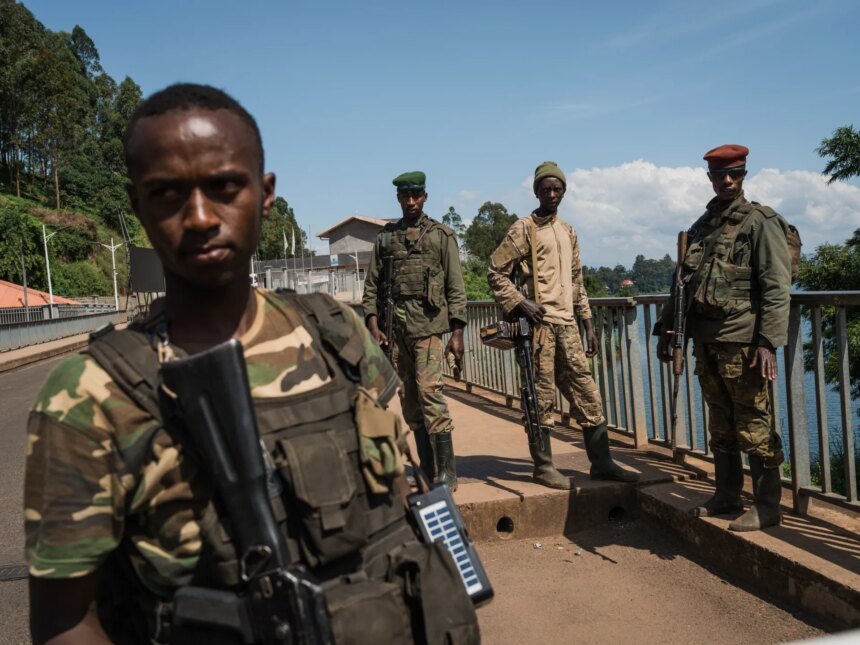
Insecurity represents a major obstacle to fighting the epidemic in eastern Democratic Congo, which has been suffering for three decades from a conflict in which many armed groups are involved.
Government services have been largely absent from rural areas in Ituri District for decades.
On the 10th of this month, at least about 70 people, most of them civilians, were killed by gunmen linked to the “Codeco” militia in northeastern Democratic Congo, in an attack that is the latest in a series of attacks in Ituri Province.
Other armed groups are active in the region, most notably the Allied Democratic Forces, which was formed by former Ugandan rebels who pledged allegiance to ISIS, and the Congress for the Popular Revolution (CRP), which says it is fighting to defend the interests of the Hema ethnic group.
Since 2021, the Ugandan army has been deployed alongside the Congolese army in the northern part of North Kivu and in Ituri to fight the Allied Democratic Forces.
The Congolese army sometimes resorts to the “Codeco” militia as an auxiliary force.