Published on 12/6/2026
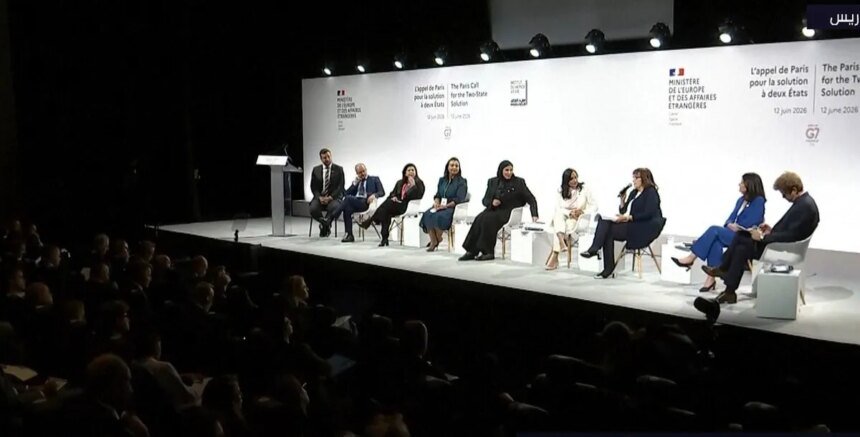
The “Paris Call for a Two-State Solution” conference was held today, Friday, in an attempt to end the deadlock in efforts to settle the Palestinian-Israeli conflict, amid calls to implement the agreement to end the war in Gaza and allow aid to enter the Strip.
Foreign ministers and senior officials from dozens of countries and civil society organizations participated in the conference, while the United States and Israel abstained from participating in it.
The meeting was held on the one-year anniversary of the United Nations-backed New York Declaration, which established a road map towards establishing a Palestinian state, after which about 12 countries, including France, Britain and Canada, recognized a Palestinian state.
The conference concluded by adopting an action plan called a “call to action,” consisting of eight points, calling for a permanent ceasefire, the reconstruction of Gaza, halting settlement construction, reforms to governance in the Palestinian territories, and strengthening international support for civil society.
The action plan stated, “The region remains divided. Gaza is devastated, and Israel remains under threat. Settler terrorism, settlement expansion, effective annexation, and threats to the Palestinian Authority are all factors that undermine the possibility of a future Palestinian state.”
It also stated, “Israelis and Palestinians alike are still living in fear, insecurity, and trauma. We are returning because this conflict, with the G7 summit in Evian, threatens to be marginalized again. The window for a solution is still open, but it is narrowing.”
The plan is scheduled to be delivered to the G7 leaders who will meet in the French Alps starting next Monday.
Participants in the Paris conference stressed the necessity of involving civil society in any future political path, as it is an essential element in building peace and ending conflict.
End the deadlock
French Foreign Minister Jean-Noel Barrot said that the Palestinian elections must be a starting point for enhancing democratic hopes and enabling the Palestinian state to assume its responsibilities, stressing that France is one of the countries that recognized Israel and the Palestinian state as a necessary step to achieve peace and reconciliation, as he put it.
In statements to Al Jazeera, French Foreign Ministry spokesman Pascal Confavro said that the Paris conference for a two-state solution aims to confront the existing stalemate on the ground in Palestine.
Regarding Gaza, Confafro said that there is an escalation in Gaza, and that the second phase of the ceasefire agreement has not yet begun, stressing the need for the international community to find practical solutions to ensure the arrival of humanitarian aid.
He added that his country strongly condemns the violence in the West Bank, considering that some Israeli measures there contradict international law.
For her part, European Union Foreign Policy Commissioner Kaya Kallas said that the initiative represented by the Paris conference represents a source of hope, noting that civil society is not just an auxiliary party to diplomacy, but rather represents a basis for building peace.
During the conference, Canadian Foreign Minister Anita Anand announced that her country supports the recognition of the State of Palestine as a step towards ensuring the coexistence of the two states, noting the provision of new humanitarian aid to the Palestinians, including the health, water, food and shelter sectors.
It also announced that Canada would join Australia and Britain in establishing an international peace fund, in addition to imposing new sanctions on extremist settlers in the West Bank.
For her part, Qatar’s Minister of State for International Cooperation, Maryam bint Ali bin Nasser Al-Misnad, affirmed Doha’s support for the political track and the two-state solution, stressing that peace is not achieved only by signing agreements, but rather requires a change in the way of thinking and building an environment that rejects hatred.
She said that human dignity represents the basis of peace, and can only be achieved by guaranteeing basic rights such as education and health care, stressing the importance of protecting civil society and not excluding it from political dialogue.
During the conference, Andorra’s Foreign Minister Emma Torre Faus stressed that the humanitarian situation in Gaza represents a “moral stain” on the conscience of the world, declaring her country’s support for recognizing the State of Palestine and enhancing the role of women and youth in building peace.
As for the representative of Mexico, she stressed that the solution cannot be military, calling for a permanent ceasefire and lifting restrictions on humanitarian aid to Gaza.
Canadian help
In conjunction with the two-state solution conference, the Canadian Prime Minister announced that his country would provide $100 million to support the Palestinians in the Gaza Strip and the West Bank, stressing that any permanent stability in the region will not be achieved without addressing the situation in Gaza and activating a political path that leads to a two-state solution.
During a press conference with French President Emmanuel Macron in Paris, Carney praised France’s role in pushing for recognition of a Palestinian state, considering that this step contributed to preserving the option of a two-state solution in the long term, in addition to supporting humanitarian aid at the current stage.
He said that his country supports the coexistence of two states, Palestinian and Israeli, side by side in peace, indicating that his country sees itself as a “force for peace” in this file.
Renewal of democratic life
During the Paris conference, activists spoke about the necessity of establishing peace between Palestinians and Israelis.
Israeli activist Ehad Nissan called for giving new generations of Palestinians and Israelis a greater role in shaping the future, pointing out that the majority of young people did not live through the Oslo Accords and did not know previous leaders who sought to achieve peace.
He stressed the need to renew democratic life on the Palestinian and Israeli sides, hold leaders accountable, and enhance the participation of women and youth in the political process.
As for the Palestinian activist from occupied Jerusalem, Nevin Sandouka, she warned against attempts to “steal the peace narrative” in favor of hate speech and extremism, stressing that peace must be linked to dignity, prosperity and security.
She pointed to the seriousness of the humanitarian situation in Gaza, settler violence in the West Bank, and displacement issues in East Jerusalem, calling on the international community to support the “International Peace Fund” to ensure sustainable funding for civil initiatives.