Published On 4/29/2026
In the heart of East Africa, researchers have uncovered new geological evidence that may change scientists’ understanding not only of the continent’s history, but also of the way the human race’s history has been preserved over millions of years, according to the study published April 23 in the journal Nature Communications.
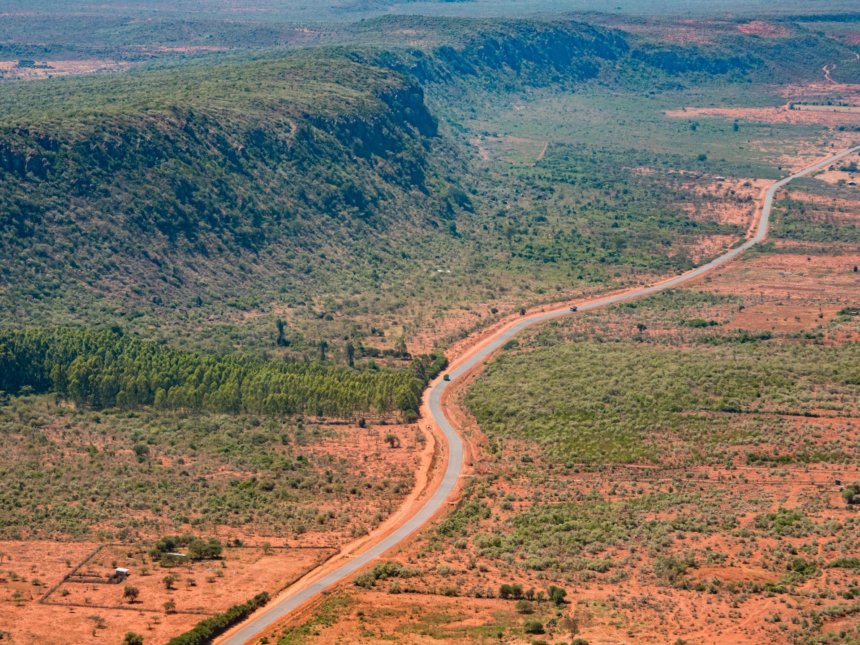
The study focused on an area known as the Turkana Rift, which is part of a huge system of ground fissures extending across East Africa from Ethiopia in the north to Mozambique in the south. This system, known as the East African Rift, is one of the most important places on the planet to study how continents break up.

The Earth’s crust is weakening very slowly
The study showed that the Earth’s crust in this region has become much thinner than previously thought. The thickness of the crust of the rift core does not exceed about 13 kilometers, compared to more than 35 kilometers in neighboring areas.
“You can imagine the Earth’s crust as a solid layer covering the planet,” says the study’s lead author, Christian Rowan, a doctoral student at Columbia University’s Lamont-Doherty Earth Observatory. “As this layer slowly expands, it becomes thinner and weaker, just like a piece of dough being pulled at both ends. Over time, this layer may crack, opening the way for a new ocean to form.”
This actually happens in East Africa, where tectonic plates move away from each other at a rate of approximately 4.7 millimeters annually, a number that may seem small, but over millions of years it is sufficient to completely redraw the shape of the continents, according to Rawan’s statements to Al Jazeera Net.
Researchers describe this stage as a critical stage, because the crust has become weak to the point that may allow it to separate in the future, with magma flowing from the ground and forming a new ocean floor. Although this scenario will take a very long time, the region seems closer to this stage today than ever before.

Archive of human history
The study also reveals that what is happening now is not the first attempt to divide the continent in this region; In the past, East Africa witnessed similar stages of expansion that were not completed, but left the crust weaker than it was.
According to the study, this means that the continent does not separate in one sudden event, but rather goes through a series of attempts over time, each one leaving a trace that paves the way for the next. With each stage, the crust becomes more fragile, which ultimately speeds up the process.
Rawan believes that the importance of these results is not limited to geology only, but extends to understanding the history of the human race. This region – especially the Turkana region – is considered one of the richest sites in the world in fossils, as more than 1,200 fossils were found in it, representing a large percentage of discoveries in Africa.
Researchers believe that volcanic activity about 4 million years ago led to changes in the shape of the Earth, such as subsidence of some areas and the accumulation of layers of fine sediments.
These conditions help preserve bones and organic remains for long periods, which increases the chances of finding them later. “In other words, East Africa may be a natural archive of human history,” Rawan concludes.