Published On 10/6/2026
Since founding SpaceX in 2002, Elon Musk has set a goal that seems closer to science fiction, which is to make humanity multi-planetary by establishing human colonies on Mars.
Today, this dream stands on the shoulders of one project, the giant “Starship” rocket, which does not represent just a new spacecraft, but has become the cornerstone of the company’s economic and technical future, and even in its potential ambitions to implement one of the largest initial public offering operations in history.

Recent financial reports indicate that SpaceX has invested more than $15 billion in developing Starship, which is the largest rocket ever built, with a height of about 124 meters. The company considers its success necessary to achieve its future plans in space, communications, and artificial intelligence.
Read also
list of 2 itemsend of list
A giant rocket to change the space economy
Starship is the first space launch system designed for “full reusability,” as the company seeks to recover both stages of the rocket and restart them repeatedly, which could significantly reduce launch costs and increase the ability to transport payloads to orbit.
The rocket is powered by 33 Raptor engines, making it larger than the Saturn-5 rocket that carried the Apollo astronauts to the moon in the 1960s and 1970s.

Analysts believe that Starship represents the key to all future SpaceX projects. The current Falcon family rockets are no longer able to meet the company’s growing ambitions, especially with regard to launching the new generation of Starlink satellites, which are larger and more capable, in addition to future projects such as space data centers.
Important successes…and obstacles that have not yet been resolved
Despite the company’s achievements, Starship is still far from routine operation. SpaceX has conducted 12 test flights so far, some of which ended with the vehicle losing control or its debris falling over areas of the Caribbean Sea, while one of the models exploded during a ground test.
US regulators also temporarily halted launches after losing control of the rocket booster during a test flight in May 2026.
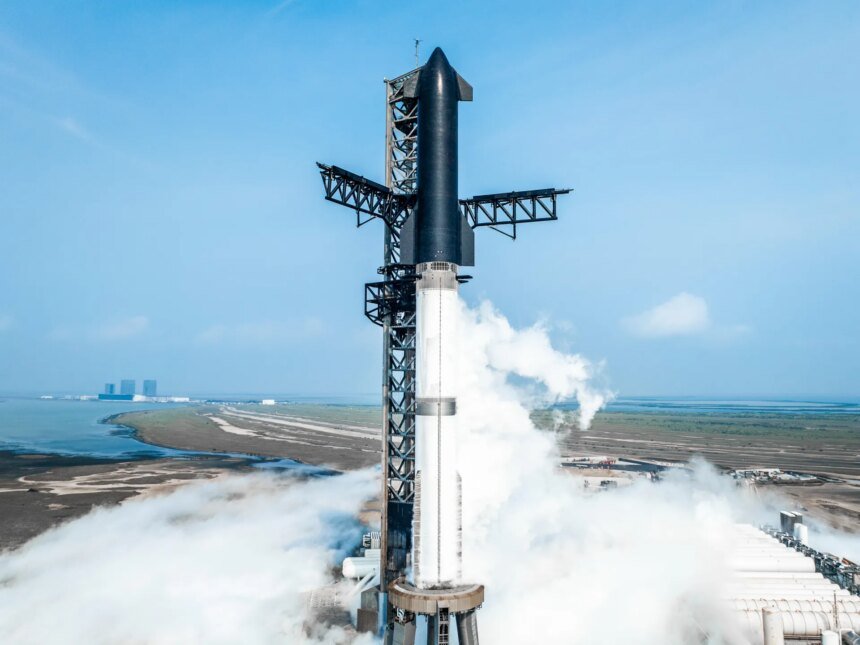
However, the company achieved a remarkable achievement in October 2024 when the giant “Michazela” arms succeeded in capturing the booster returning to the launch pad at Starbase in Texas, an essential step towards the rapid reuse of the missiles.
But the biggest challenge remains developing in-orbit refueling technology, which is necessary to carry out long-distance missions to the Moon and Mars.
Starship is the largest rocket in human history, with a height of about 124 meters, surpassing the Saturn 5 rocket that carried the Apollo missions to the moon. Its first integrated test flight was in April 2023, and since then SpaceX has carried out a series of successive test flights during which it has achieved remarkable progress, most notably operating the vehicle in space, recovering the giant “Super Heavy” booster, and capturing it by the arms of the “Mikazilla” launch tower.
Despite these achievements, the rocket is still in the development stage and has not yet entered regular operational service, as the company must prove the reliability of the system and master in-orbit refueling operations before using it on future lunar and Martian missions.
From Starlink to Mars cities
SpaceX confirms that Starship is not just a rocket, but rather an integrated economic platform. Today, the company has more than 10 million subscribers to the “Starlink” satellite Internet service, which achieved about $4.4 billion in operating profits in 2025. Starship is supposed to allow the launch of larger and more advanced satellites, which will enhance the network’s global capacity.
Musk also puts forward more daring ideas, including establishing huge data centers for artificial intelligence in space, taking advantage of solar energy constantly available outside Earth, and natural cooling there at the same time.

However, experts point out that this vision still faces major economic and technical obstacles, and that operating orbital data centers is still more expensive than their terrestrial counterparts.
As for the Mars dream, which Musk has been talking about for years, it remains the ultimate goal of the project. The success of Starship may allow hundreds of tons of equipment and people to be transported to the Red Planet, in preparation for building self-sufficient human settlements.
Ultimately, Starship’s future is not just about a rocket, but about a broader question about man’s ability to transcend the boundaries of his planet. Every successful or failed experiment represents a step in a long journey towards expanding the horizons of human civilization.
Between Mars ambitions and the realities of engineering, science remains the bridge that turns grand dreams into tangible reality.