Published On 4/29/2026
|
Last update: 15:06 (Mecca time)
The “Golden Fleet” project is a strategic vision led by US President Donald Trump to radically reshape the US Navy, within the framework of the largest modernization process the institution has witnessed since the Cold War. The project aims primarily to enhance the ability to confront China, by developing a new fleet based on huge ships equipped with hypersonic missiles and advanced weapons technologies.
This vision is based on reviving the classic character of American warships, as Trump rejected modern designs that he deems imposing, and called for the adoption of more powerful and symbolic designs that reflect traditional maritime prestige. This comes within a trend that seeks to combine the aesthetic dimension with military strength at the same time.
Information indicates that Trump is directly involved in the details of the project, through frequent meetings with Navy leaders to discuss the designs and make modifications to them.
In terms of structure, the plan includes replacing a large part of the American fleet, which includes about 287 ships, with a new fleet that includes huge battleships, each of which may weigh about 20,000 tons, in addition to smaller “corvette”-class ships designated for fast and flexible missions, creating a balance between strength and speed in naval operations.
Despite the magnitude of the project, the Golden Fleet faces criticism from military experts who question the feasibility of relying on giant ships in modern wars, especially in light of the rapid development of unmanned systems and networked warfare. The high cost and long implementation period – which may extend more than a decade – are among the most prominent challenges that may delay or hinder the realization of this vision on the ground.

Advertising and political context
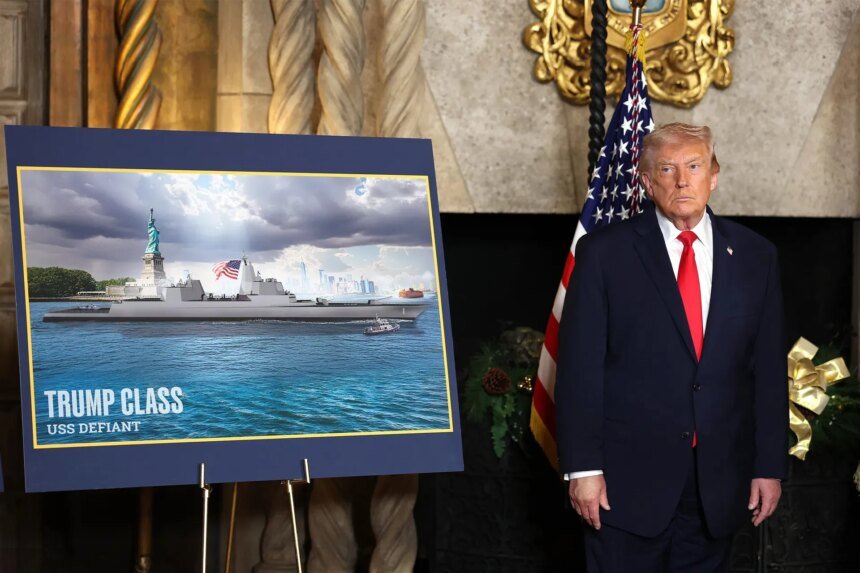
Trump announced the project on December 22, 2025, during his speech at the Mar-a-Lago resort in Florida, in the presence of a number of senior officials in the US administration. The plan was presented as an ambitious program to expand the naval fleet, including approval for the construction of the first Trump-class battleships – called USS Defiant (BBG 1) – with a long-term vision of building approximately 25 battleships.
The US President said that production would start with two ships, but could rise to ten ships, and perhaps up to 25 over an unspecified period of time.
Strategic vision
The Golden Fleet’s vision is based on three main axes: rebuilding the fleet through developing advanced naval platforms, revitalizing the marine industrial base to ensure the sustainability of production, in addition to reforming work mechanisms within the Ministry of the Navy in a way that enhances institutional efficiency.
Military capabilities
The United States is moving to reshape its naval capabilities by equipping the “Trump-class” battleships, technically known as “BBG-X,” with an advanced weapon system that is described as potentially giving them unprecedented superiority compared to previous generations of combat ships.
At the forefront of these systems are hypersonic missiles, which will enable ships to carry out precise and long-range strikes at speeds exceeding the capabilities of traditional air defenses. It is expected that these missiles will be integrated into launch cells deep inside the ship’s hull, enhancing its ability to carry out strategic offensive operations.
This category also relies on electromagnetic guns, a technology that uses electrical energy to launch projectiles at tremendous speeds without the need for traditional explosive materials.
In addition, the ships will be equipped with laser and directed energy weapons, which are used for both defensive and offensive purposes, especially in intercepting air and missile threats.
The weapon system also includes nuclear cruise missiles launched from the sea, which requires advanced modifications in the design of ammunition stores to ensure that this type of strategic armament is accommodated.
The ships will also rely on large vertical launch systems (VLS) capable of carrying a large number of diverse missiles, turning them into central attack platforms within the maritime operations network.
On the other hand, these battleships will rely extensively on artificial intelligence techniques to manage combat systems, design and operation processes.
However, analytical estimates indicate that a number of these technologies, such as electromagnetic guns and high-power laser systems, are still in the development stages.