Published On 5/28/2026
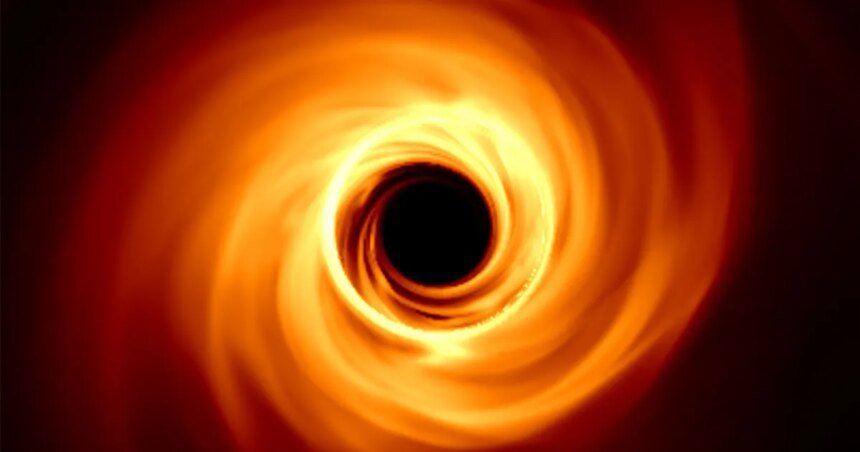
In an exciting scientific discovery that turns astronomical concepts upside down, an international team of scientists, led by the University of Cambridge, succeeded in observing a massive black hole dating back to the beginnings of the distant universe.

Using the exceptional optical and analytical capabilities of the James Webb Space Telescope, researchers were able to accurately measure the mass of this cosmic giant in a dwarf galaxy called Abell 2744 (Abell2744-QSO1), which is more than 13 billion light-years away from us. This discovery provides the clearest answer yet to an age-old dilemma: Which appeared first, the galaxy or the black hole?
Nature lenses and the red dot trick
This small galaxy, which belongs to the category of “Little Red Dots”, is located in an ancient era when the universe was no more than 700 million years after the Big Bang. Despite the galaxy’s small size, its diameter is only 1,300 light-years.
Read also
list of 2 itemsend of list
However, studying this small galaxy was made possible thanks to an amazing natural phenomenon known as “gravitational lensing” resulting from the Abell 2744 galaxy cluster. This galaxy cluster acted like a giant magnifying glass that tripled the light of the deep galaxy, allowing James Webb to capture its details with unprecedented precision.

Because the gravity of the Abell 2744 galaxy cluster acts as a natural magnifying glass, it distorts the path of light coming from the “little red dot,” causing it to appear in a triangular shape in three different locations in the sky. These letters (A, B, C) are used to name the three duplicate copies of the same object in the processed image, with QSO1A being the brightest and most visible copy for study.
Kepler in deep space…the first direct measurement
The revolutionary development in this study lies in the method of measuring the mass of a black hole. Before this achievement, all measurements in the early universe relied on indirect methods and guesses based on calculations of the local, nearby universe. But this time, scientists used the Integral Field Unit instrument on the James Webb Telescope’s Near-Infrared Spectrograph (NIRSpec).
This tool tracked the movement of hydrogen gas surrounding the black hole, and mapped its speed. Scientists discovered that the gas rotates in a Keplerian motion. This is the same regular motion with which the planets of our solar system revolve around the sun, which means that all the mass is concentrated at one point in the center of the galaxy.
A starless giant defies the laws of growth
Direct calculations of the gas’s velocity showed that the black hole’s mass was about 50 million times the mass of the Sun. The biggest surprise was that this hole alone constitutes two-thirds (66%) of the total mass of the entire galaxy! This percentage is thousands of times greater than what we see in nearby modern galaxies, where the mass of the black hole does not exceed a small part of its galaxy.

In addition, a map of the chemical elements of the galaxy revealed that its gas consists almost entirely of pure hydrogen and helium, with an almost complete absence of heavy elements such as oxygen, which confirms that the galaxy has not witnessed the birth or death of successive generations of stars to feed this hole.
Heavy seeds and the rewriting of cosmic history
These results force a radical change in the classical scenarios; A hole of this size cannot gradually grow by devouring stars in an empty galaxy. Scientists point out that this represents strong evidence for the hypothesis of “primordial black holes” that formed in the first second of the universe’s life, or the hypothesis of “black holes with direct collapse” from massive gas clouds directly without passing through the star phase.
In short, this black hole was born gigantic from the beginning as a heavy seed, and is now in the process of building its own galaxy around it, proving that the cosmic “engine” may sometimes precede the outer structure of the galaxy.