Published On 4/27/2026
Despite Israeli Prime Minister Benjamin Netanyahu’s announcement on Saturday that he had instructed the Israeli army to respond forcefully against Hezbollah in Lebanon, senior army officials confirmed that the rules of engagement had practically not changed.
Israeli army officials believe that Netanyahu is trying to hold the army responsible for the “disappointing” military results in Lebanon, according to the “Israel Hayom” newspaper.
After the Israeli army announced the bombing of military buildings used by Hezbollah throughout southern Lebanon, officials explained that the strike was not unusual, and certainly not “strong,” but it was carried out “within the rules of the game,” with the Israeli army keen to operate only in southern Lebanon and in areas devoid of civilians.

Blame policy
The newspaper “Israel Hayom” quoted officials as saying that Netanyahu’s statement was a cover to reduce public pressure, and did not change anything on the ground or regarding the directives issued to the army.
Officials add that Netanyahu’s statement was not a coincidence, but rather was to place blame on the Israeli army and portray the military institution as a failed party in implementation.
The newspaper revealed the escalation of disagreements between the Israeli army and the political echelon over operations in Lebanon, especially in recent weeks, accompanied by contradictions between public statements and field indicators, especially with regard to the goal of disarmament, which will not be achieved, according to a senior Israeli officer.
The same source also pointed out the great contradiction with the impression given by the political authority in Israel, which gave the residents of the north the impression that the campaign this time would not end without a decisive result, so the army found itself stuck in the middle.
The newspaper said that the feeling within the Israeli army and the security establishment has begun to grow that Netanyahu is looking for a “scapegoat” to bear responsibility for the disappointing results in Lebanon and the partial results in Iran, especially since the army is the only body that communicates with the population while Netanyahu and his ministers continue to avoid visiting the region.
On the Iranian front, it is expected that the responsible party will be the Mossad, while in Lebanon the blame will be placed directly on the shoulders of the Israeli army, despite the fact that it acted in accordance with the directives of the political level, as it is also doing now.
Complex field situation
The reality on the ground seems more difficult and complex, according to the newspaper “Israel Hayom”. The Israeli army already controls large areas and many sites in southern Lebanon, but it is restricted to providing full protection to the northern communities and its forces in the field, according to the newspaper.
The newspaper says that fear of US President Donald Trump made Beirut – the headquarters of Hezbollah’s leadership – and Baalbek, immune from targeting.
The biggest challenges emerge in that the circumstances are complex given the number of forces, the nature of their presence on the ground, the army’s tied hands, the weapons system facing it, and Hezbollah’s motivations for fighting, which stem from its growing sense of capability and from the desire to disrupt the peace talks currently underway between Israel and Lebanon in Washington.
The field reality reflects the inability of the Israeli army to secure the northern front, as a reality of daily exhaustion was imposed on the population. The irony here lies in the comparison with the security belt period, which provided broader stability to the border areas, in contrast to the current scene, which is characterized by the lack of clear political or military solutions.
On April 17, Trump announced a truce in Lebanon between Israel and Hezbollah for a period of 10 days, subject to renewal, before announcing on Thursday its extension for an additional 3 weeks.
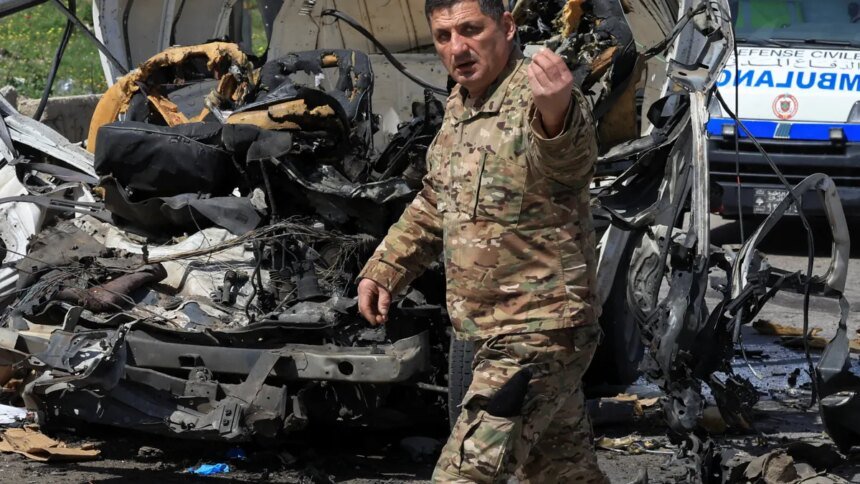
Before the truce, on March 2, Israel began an aggression against Lebanon, which as of Sunday resulted in 2,509 deaths, 7,755 injuries, and more than 1.6 million displaced people, according to the latest official data.
Israel has been occupying areas of southern Lebanon, some of them for decades and others since the previous war between 2023 and 2024, while during the current aggression it penetrated a distance of 10 kilometers into the southern border.