Published on 4/25/2026
Waiting for the release of a new novel by a famous writer was not a normal event, and literary pioneers were accustomed to awaiting any publication with the utmost eagerness, especially if the novels had popular parts. Acquiring a new novel was not easy either, as novel lovers sometimes stood in long lines in front of bookstores to obtain an original copy, or a copy signed by the novel’s author.
But today, in light of the development and progress we are witnessing, the scene has changed greatly. Novels have become available in stolen or leaked copies on the Internet, and apart from the pleasure of a paper book, novels have begun to be offered as electronic copies for tablet computers.
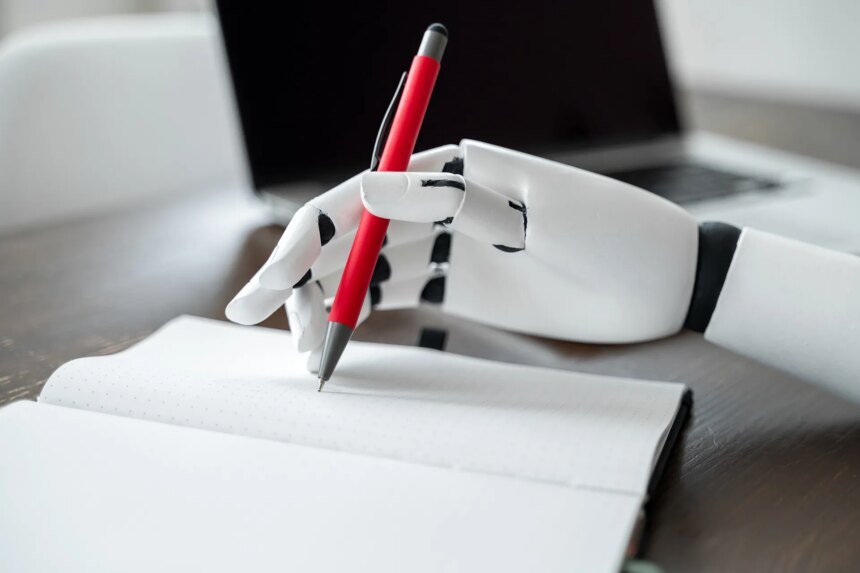
The matter did not stop there, as today the world is experiencing a new crisis due to artificial intelligence, as writing a novel is no longer a complicated or long matter or requires waiting, because artificial intelligence models have become able to present stories, novels, and drafts of imaginative and suspenseful events, without the need for there to be a writer for them or emanating from a living human literary sense.
How could artificial intelligence replace humans? Can it replace the writer’s spirit and his human touch in writing?

How did linguistic models learn to write novels?
Before we discuss the danger of novels and stories generated by artificial intelligence, we must understand the mechanism of work, as major linguistic models such as GPT-4, Claude, and Gemini do not create in a vacuum, nor do they write from their programmed mind. Rather, they consume huge amounts of human texts during the training stage, that is, when preparing and creating the model itself. Edited and published books are considered among the most valuable sources for them, because they do not contain errors, which makes them Like the precious jewels of these models.
But the problem is that most of these companies did not ask the permission of the owners of these books, according to what was stated in a lawsuit filed by the Writers Guild of America against OpenAI in 2023, in which it said, “These algorithms are the heart of a huge commercial enterprise, and at the heart of these algorithms lies systematic theft on a large scale,” as the books used in training GPT 3.5 and GPT 4 were stripped from electronic piracy repositories and then copied into the model structure itself.
In this lawsuit, which included more than 17 novelists, it demanded that OpenAI be stopped from continuing to use writers’ works to train its models, and that financial compensation could legally reach $150,000 for each work that violates its rights.
The flood of generated books…Does it threaten the market?
Amazon’s Kindle DP (KDP) platform is considered one of the largest platforms for processing digital books. Reports indicate that the platform alone processes approximately 1.4 million self-published titles annually, and it earns up to about $28 billion in book sales around the world.
But since 2023, the platform began to witness an unprecedented phenomenon, as dozens of copies of books generated entirely with artificial intelligence began to appear on a daily basis, some of which bear the names of real novelists.
In 2024, Canadian writer Catherine Tsalikis discovered that there was a fake copy of her book on her same page on Amazon, with a cover distorted by artificial intelligence and text that distorted her words. But the platform responded with limited preventive measures, including setting a maximum of three books per day for each writer, and requiring publishers to disclose content generated by artificial intelligence. The American company Barnes & Noble also began deleting thousands of low-quality titles from its online store as part of a quality control initiative.
In the same context, the American “Draft2Digital” platform recorded an increase in the volume of materials received by it by 50% compared to the usual rate in 2024. The operating director of the platform said that the platform tracks suspicious accounts based on abnormal publishing patterns, stressing that ill-intentioned parties are now relying on artificial intelligence after they used to resort to low-paid writers in developing countries, and he added that “ordinary writers do not publish ten books a day.” “One”.

Quality threat
Perhaps the most mysterious and most profound threat is the threat to literary quality itself. Studies have shown that readers cannot easily distinguish between material generated by artificial intelligence and material written by human hands. A text generated by artificial intelligence succeeded in passing the first round of qualifying for the Japanese Hoshi Shinichi Literary Prize, while the judges did not know that it was originally written by artificial intelligence.
However, an academic study from the American arXiv platform indicated that creative writing for artificial intelligence “is still characterized by vulgarity, flowery prose, and unnecessary extravagance,” and that reliance on generative tools “reduces the overall diversity in the content of novels.”
In the same context, a report from the University of Cambridge in Britain explicitly warned that artificial intelligence may lead to more superficial and stereotypical narratives that perpetuate stereotypes, as models repeat what they have absorbed from centuries of previous texts. Ironically, a third of the novelists surveyed admit to using AI for non-creative tasks, such as research, before starting to write.
Did Fractor AI put an end to the era of novelists?
Platforms like Character.ai rely on linguistic models that predict the next word based on statistical probabilities, and thus they give you a “simulation” of the character, but they lack what critics call “unity of fate.” The novelist does not just write dialogue, but rather builds an entire philosophy and psychological development stemming from a real human experience of pain, loss, and ecstasy, which artificial intelligence is unable to feel, no matter how accurately its simulation is.
Artificial intelligence also provides momentary pleasure and endless interaction, but it often lacks a comprehensive vision. The novel generated by artificial intelligence sometimes gets lost in the details of the dialogue and loses the “grand plot” or long dramatic cohesion. As for the novelist, he has the ability to plant seeds in the first chapter that only bloom in the last chapter. This type of strategic planning of emotions is a human trait par excellence until now.
But amid this scene, many writers and researchers are asking a fundamental question: Does artificial intelligence really pose an absolute threat? The answer was the academic study from ArXiv, and it was denied with reservations. The study relied on a systematic comparison between texts generated by artificial intelligence and human texts before a jury of doctoral students in literature. It concluded that artificial intelligence produces an “average” text that reflects a statistical average of millions of votes, not a unique voice, and that relying on these tools reduces collective diversity in literature.
On the other hand, it is noted that some novelists expect experimental writing to flourish as a response to the “mechanical style,” meaning that pressure may push human writing to its limits rather than destroy it, according to a Cambridge University report.

On the other hand, and from a technical standpoint, the danger extends to the “structural structure” of the novel. While the human novelist has the ability to plan long-term drama, algorithms, according to the “The Conversation” report, remain trapped in “momentary pleasure” and repetitive dialogues, which produces novels that lack “unity of fate” or honest psychological depth.
However, the Writers Guild of America points out that the technology is not an absolute evil if it is placed under a strict legal framework, such as the European Artificial Intelligence Act (EU AI Act), which has begun mandating automated content labeling to ensure transparency.
However, the existential challenge facing the contemporary novelist remains to preserve the “human imprint” and emotional honesty, which are areas that the machine is still unable to penetrate despite all its artificial intelligence, because the novel in its essence is a “human testimony” and not just an elaborate arrangement of words.
Observers say that what field monitoring, numbers, and legal positions reveal is that artificial intelligence will not end the novel, but it will redraw the map of who can write and live from it. The most vulnerable writers are beginners who pursue writing as a trade. As for deep literary voices, they seem to be relatively safe until now, but no one guarantees the continuation of this situation with the rapid development of models.
Observers also confirm that the real crisis is not what the machine writes today, but rather what the human writer will not be able to write tomorrow if the sources dry up before the new voices mature. At a historical moment in which the polarization between quantity and quality is increasing, we must reformulate the question: Does artificial intelligence write well? The new question becomes: Do we want stories and novels to be told using mathematical equations?