

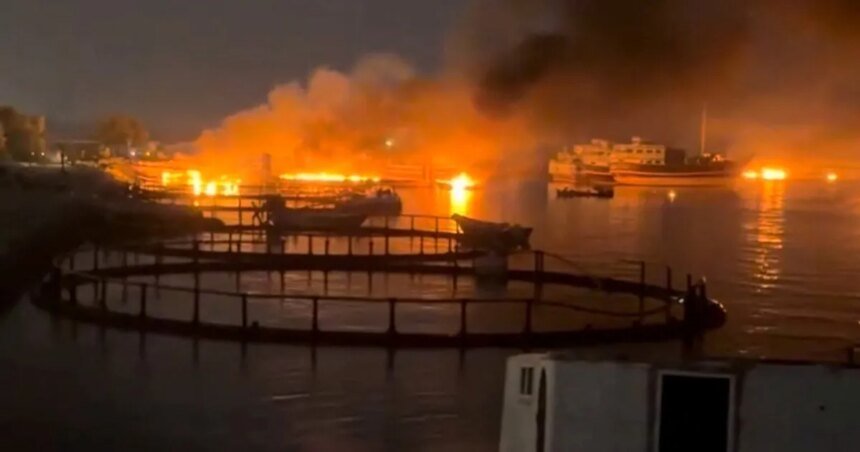
Last night’s exchange of military strikes put Washington and Tehran on the verge of returning to the war square again, following successive violations of the memorandum of understanding and ceasefire signed between the two parties.
In the face of this transformation, the region experienced a harsh night of escalation in which American missiles struck infrastructure and military sites deep in Iranian cities, launching the Iranian response to what it called “American bases in the region.” These rapid developments are summarized in detail in this article:
What are the targets that Washington announced?
For the second day in a row, Washington launched attacks on Iranian targets, which US officials say is an effort to get Tehran to stop striking commercial ships in the Strait of Hormuz.
The US strikes on Iran included the regions of Iranshahr, Bandar Abbas, Konarak, Chabahar, and Bushehr in eastern Iran, in addition to Aq Qala in the northeast of the country.
Al Jazeera’s correspondent in Tehran, Farah Zaman Shawqi, said that the round of targeting this time was the broadest geographically, as it included areas in northern and southern Iran compared to previous rounds that were approaching Gulf waters and the Strait of Hormuz.
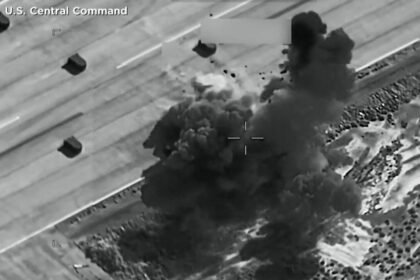
The US military’s Central Command (Centcom) announced early Thursday that it had completed “an additional round of strikes against Iran…to further weaken Iran’s ability to attack commercial ships and innocent civilian sailors in the Strait of Hormuz.”
Regarding the targets, Centcom reported that 90 Iranian military targets were targeted, “including air defense systems, coastal surveillance assets, missile and drone storage sites, naval capabilities, and military logistical infrastructure along the Iranian coast.”

On Wednesday, the US army bombed two railway bridges in northern and eastern Iran, in an incident that is the first of its kind in which Washington has struck Iranian infrastructure since the ceasefire on April 8, as the US army fired cruise missiles at the bridges, according to what the Axios website quoted an American official as saying.
The US official said that Wednesday’s strikes were broader than Tuesday’s strikes, and the targets included Iranian military coastal radars, anti-ship missile sites, and air defense systems.
Regarding the losses resulting from these strikes, the official news agency (IRNA) reported that a firefighter was killed in an attack on Iranshahr Airport.
For his part, a spokesman for the Iranian Ministry of Health said that the American attacks on July 8 and 9 targeted 5 Iranian provinces, killing 14 people and wounding 78 others so far.
Iranian officials had told Fars News Agency that the attacks on Chabahar included strikes on a naval control tower and a warehouse, and Iranian official media also reported that a railway bridge had been targeted in Ak Qala.
Trump promises more
In turn, US President Donald Trump said on Air Force One that Iranian officials “called a while ago. They want to make a deal.”
Trump said Wednesday’s US strikes on Iran were in response to Iranian attacks against commercial ships. “We hit them very hard,” he said. “When they hit, we hit back much harder.”
On the Truth Social platform, Trump threatened Iran on Wednesday that if it strikes commercial ships again, the response “will be much worse.”
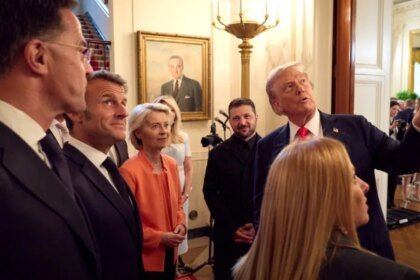
From the NATO summit in Ankara, Trump issued his threats to Iran after targeting the three ships. He said that the United States could reimpose its naval blockade and target electricity and water plants in Iran, adding that American forces might control the Iranian island of Khark.
How did Tehran respond?
Hours after these strikes, the Iranian army said that during the past hours, it had targeted, with drones, Patriot systems in Kuwait, an early warning site in Qatar, in addition to US Army fuel tanks in Bahrain.
The Kuwaiti Ministry of Defense reported that the country’s air defenses were facing attacks by hostile missiles and drones, and the Kuwaiti army announced the successful interception of 3 ballistic missiles, a mobile missile, and 10 enemy drones, as part of the air defenses’ response to hostile missile and drone attacks.
The Bahraini Ministry of Interior also announced the sounding of sirens twice, without immediate information being available regarding the nature of the attacks on it and their repercussions. It said in a statement: “We ask citizens and residents to calm down, go to the nearest safe place, and follow the news through official channels.”
In this context, the Iranian Revolutionary Guard announced that it attacked the Arifjan and Ali Al-Salem bases in Kuwait, and Al-Juffair and Sheikh Issa in Bahrain, adding that the future response may extend to other American bases in the region if the United States continues its attacks.
On the political level, Iranian Parliament Speaker Mohammad Bagher Qalibaf and Iranian Foreign Minister Abbas Araghchi described the attacks as “American bullying,” stressing in two separate statements that the United States only understands the language of force.
The spokesman for the National Security Committee in the Iranian Parliament, Ebrahim Rezaei, had warned of the Iranian response after the American attacks that occurred on Wednesday, and wrote on the X platform, “Wait for the harsh slap from the Iranians.”

Mutual accusations
Both the United States and Iran accused the other of violating the memorandum of understanding, which stopped the war, lifted the US naval blockade on Iran, and opened the Strait of Hormuz to a relative extent.
But it left more intractable issues, such as the future of Iran’s nuclear program and management of the Strait of Hormuz, to be determined during a 60-day negotiating period, making the chance of a return to war greater.
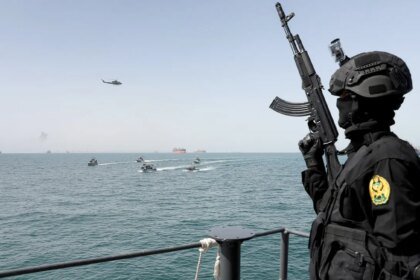
The main point of contention appears to be related to Clause 5 of the Memorandum of Understanding, which states that Iran “will make arrangements using its best efforts for the safe passage of commercial ships, free of charge for a period of 60 days only, from the Arabian Gulf to the Sea of Oman, and vice versa.”
Foreign Ministry spokesman Esmail Baghaei said on Wednesday that Iran interpreted this text to mean that it alone has “responsibility for determining arrangements for the safe passage of ships through the Strait of Hormuz.”
This position has been used to justify attacks on ships unauthorized to pass through the strait by Iran, and the former director of NATO operations at the Pentagon, David Des Roches, commented to Al Jazeera that the memorandum of understanding “required the United States to lift its mutual blockade of Iranian ports – which it did – and it required the United States to waive sanctions on the sale of Iranian oil – which it did – and it required Iran not to interfere in civilian shipping.” In the Strait of Hormuz.
He explained that when Iran attacked these ships, Tehran was trying to establish a new reality that goes beyond the terms of the memorandum of understanding, where the ships must pass through Iranian waters, and that Iran will attack them if they do not do so. “This is unacceptable to President Trump,” Des Roches said. “So these strikes are retaliation for that action.”
Following Wednesday’s strikes, Mohammad Bagher Qalibaf, the speaker of Iran’s parliament, said the Strait of Hormuz “will only be opened by Iranian arrangements, not by American threats.”
Ghalibaf posted on social media: “America has not yet learned that bullying and breaking promises are no longer without a price. Let me say it frankly: If you hit, you will get hit.”