

Published On 9/7/2026
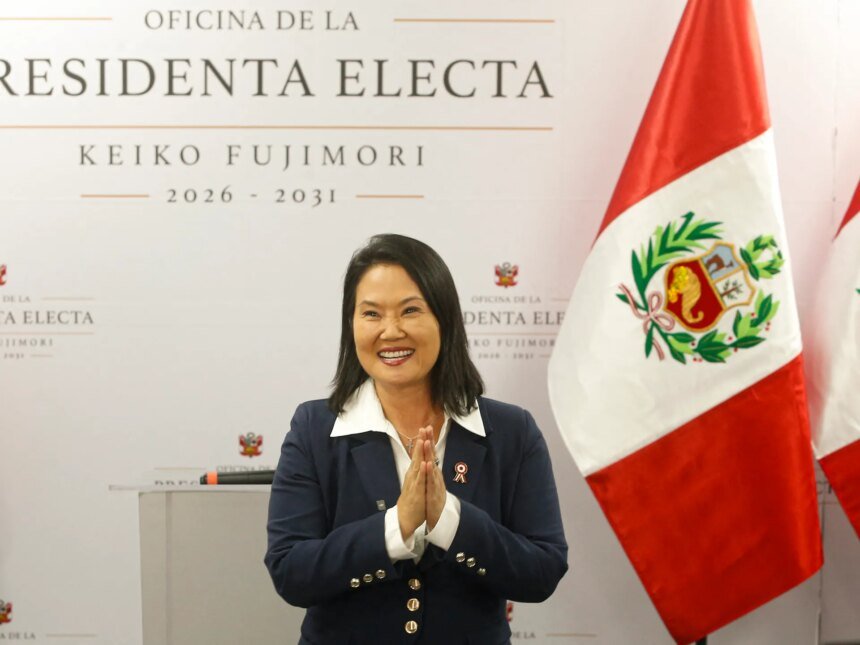
New Peruvian President Keiko Fujimori faces her first major economic and political test since her election victory, with the administration of US President Donald Trump seeking to limit Chinese influence in Latin America, at a time when China has become Peru’s first trading partner and one of the largest investors in its economy, according to a Bloomberg report.
The report believes that the challenge facing Fujimori is not limited to managing relations with the two economic powers, but rather is to preserve Peru’s commercial and investment interests without completely siding with either of them, as she confirmed during her election campaign that she would adopt a policy of “strategic balance” and reject “automatic alignment” with any party.
Economic legacy
The roots of the economic partnership between Peru and China go back to the early 1990s, when former President Alberto Fujimori opened the Peruvian economy to Asia and sought to attract foreign capital as part of a program of economic reform and reintegration of the country into global financial markets.
Since then, China has become Peru’s largest trading partner, with cumulative investments estimated at $30 billion, concentrated in the mining, energy and infrastructure sectors, according to estimates cited by Bloomberg.
The port of Chankai, whose construction cost amounted to $1.3 billion and was implemented by the Chinese company Cosco Shipping Ports, stands out as the most prominent symbol of this cooperation. The project aims to reduce shipping time to Shanghai by about ten days, and strengthen Peru’s position as a major logistics center on the Pacific coast.

Competition with economic dimensions
The United States believes that the expansion of Chinese influence in Peru goes beyond the commercial aspect, as it expresses concerns about the strategic dimensions of some investments, most notably the port of Chancay, which Washington considers to be of importance beyond commercial uses.
On the other hand, the Trump administration seeks to restore its economic influence in Latin America, but Bloomberg indicates that this task faces major challenges in countries such as Peru, where economic relations with China have become established and deep.
The agency quoted Luis Miguel Castilla, former Peruvian Minister of Economy and former ambassador to Washington, as saying that Fujimori’s approach reflects a pragmatic approach that has characterized Peruvian foreign policy for years, based on maximizing economic interests with various partners.
The report confirms that this approach is consistent with Peru’s vision of itself as an economy overlooking the Pacific Ocean and integrated into Asian markets, rather than being a party to the competition between Washington and Beijing.
While the new government is converging with the United States on issues of security, investment, and economic reforms, it seems keen at the same time to maintain the trade partnership with China, which has become an essential element in the growth of the Peruvian economy, especially in the mining, logistics, and energy sectors.
Bloomberg concludes that the Trump administration’s ability to reduce Chinese influence in Latin America will remain limited as long as the economic interests of regional countries push them to adopt policies that balance the two largest economies in the world, instead of completely siding with either of them.