


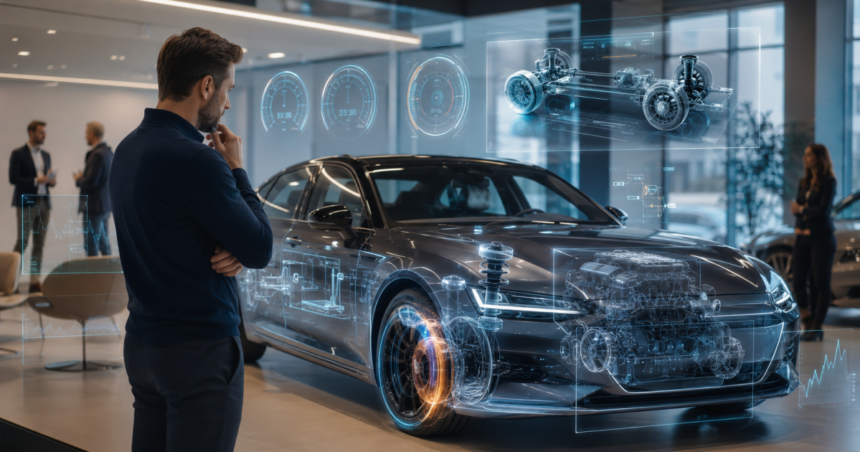
Behind the glamor of showrooms and attractive phrases in car brochures, there are numbers and engineering equations that determine real performance on the road, not marketing slogans alone.
When you decide to buy a new car, it is not enough to look at the exterior design or the horsepower number written in bold in the advertisement. The most important thing is to understand what these numbers actually mean, and how they reflect on your daily driving, whether in the city, on highways, or on long trips and off-road roads.
In this report, we break down the most prominent technical terms that may confuse the buyer, and explain the difference between horsepower and torque, the meaning of the “Overboost” feature, and how the specifications can be read with a realistic eye away from advertising temptations.
Horses and torque equation
Horsepower often makes headlines, but the smart buyer knows that engine performance isn’t measured in horsepower alone. There are two basic elements that complement each other: horsepower and torque.
Horsepower expresses the engine’s ability to complete work quickly over time, and it is often linked to the maximum speed and the car continuing to move stably at high speeds. The origin of the term goes back to engineer James Watt in the eighteenth century, when he used it to compare the power of steam engines and the ability of horses to work.
In practice, horses are important for long trips, driving on open roads, and overtaking trucks or slow vehicles at high speeds. If the nature of your use depends a lot on highways, then horsepower becomes a number worth paying attention to.
In contrast, torque represents the “muscles of the car.” It is the rotational force produced by the engine to move the car from rest, and its effect is clearly visible when starting off, climbing hills, or pulling trailers and heavy weights.
Therefore, torque is very important in SUVs and trucks, and it is also an influential element in daily driving within cities, where frequent stopping and starting at signals and traffic.
In simple terms, it can be said that torque is what launches the car from scratch, while horsepower helps it maintain its speed and flow on the road.

How to spot a number trick?
Many advertisements simply say something like: “250 horsepower engine.” But this number alone is not enough. The most important question: At what turnover rate is this number achieved?
A car may have high power on paper, but it only appears when the engine reaches a high number of rpm, which means that the driver will not feel this power in quiet city driving unless he presses the accelerator pedal hard, with higher fuel consumption and greater engine noise.
In conventional naturally aspirated engines, you may find, for example, 200 horsepower, but it is only achieved at 6,000 rpm. This number may seem attractive, but it does not necessarily mean that the car will be active in traffic or at low speeds.
Modern turbo engines often deliver their maximum torque at a low number of engine revolutions, such as 1,500 to 4,000 rpm. This makes the car more responsive in daily use, because you feel the power as soon as you touch the accelerator pedal without the need for violent pressure.
In electric cars, the rules change completely. The electric motor can provide torque almost instantly from the moment of launch, and therefore a family electric car may outperform gasoline-powered sports cars in initial acceleration, even though its advertising numbers may seem less exciting.
Overpost…temporary power
A feature known as “overboost” appears in some modern cars, especially those equipped with turbo chargers or in some electric models. It may sometimes be presented in advertisements as if it were additional power ready at any moment, but in reality it is temporary power and governed by conditions.
Engineeringly, this property is linked to the vehicle’s electronic control unit. In normal mode, the turbocharger pumps air into the engine at a specific pressure to protect mechanical parts and control fuel consumption and temperature.
However, when you press the accelerator pedal strongly and suddenly, especially during overtaking or merging quickly on a busy road, the car’s computer temporarily allows the air pressure to be raised above the standard level, increasing power and torque for a short period that may give the driver an additional boost, often ranging between 10 and 15%.
The function of this technology is not to provide constant power, but rather to assist the driver in specific situations, such as overtaking a truck on a narrow road, quickly merging into a fast lane, or exiting a situation that requires an immediate response.
But this extra power doesn’t last long. In many systems, the computer automatically disconnects it after a period that may range between 10 seconds and 20 seconds, to protect the engine and turbo and prevent overheating or stress on internal components. The car then returns to its normal limits until the cooling system regains its balance.
The idea of overboost is no longer limited to fuel engines, but has moved to electric cars as well, as some models provide a dedicated button that gives the engine a temporary electric boost for a few seconds, similar to the feeling of rush in traditional turbo cars.

City car… looking for a response
If your primary use is in the city, in traffic and frequent stops at signals, don’t let horsepower alone guide your decision. In this case, what is most important is the availability of good torque at low engine revs, because this makes the car more agile and responsive in starting and slow motion.
Small turbo engines may be suitable for this style, because they deliver their torque early, and electric cars are a strong choice for those who want immediate response and comfortable driving in traffic, if the charging infrastructure is suitable for them.
Highways… This is where horses appear
But if you travel long distances daily on open highways, the situation is different. Here horsepower becomes more important, because it helps the car maintain its speed, and gives it better ability to maneuver and overtake at high speeds.
In this type of use, it is not enough for the car to be energetic when starting off, but it must have a “long breath” at constant speeds, with good stability and a safe response when sudden acceleration is needed.
Rough roads and loads… torque first
If you plan to use the car on road trips, climbing hills, towing a trailer, or carrying heavy loads, the priority should be torque, not horsepower alone.
In this case, look for a high torque figure measured in Nm, and pay attention to its availability at low revs. That’s why diesel engines and larger turbo engines tend to excel at towing and payload duties, because they provide practical traction when needed, not just a shiny number on a spec sheet.
Don’t always buy the higher number
Advertising may sell you the dream of speed, but daily driving doesn’t always require the highest horsepower figure. The ideal car is not necessarily the one with the biggest number in the brochure, but rather the one that suits your lifestyle, your budget, and the nature of your roads.
Before buying, ask yourself: Do I often drive within the city? Do I travel a lot? Do I need to tow a trailer or climb hills? Am I looking for quick acceleration or everyday comfort and lower fuel consumption?
Answering these questions is more important than being fascinated by one number. Understanding the difference between horsepower and torque, and knowing the limits of the overboost feature, gives you a greater ability to read the specifications intelligently, and choose a car that actually suits you.