

Published On 7/7/2026
|
Last update: 17:20 (Mecca time)
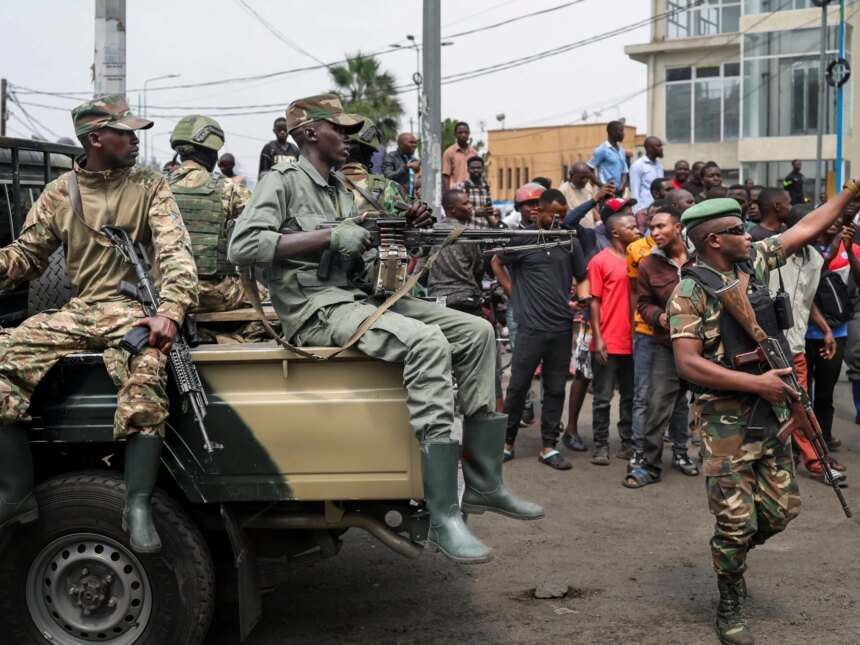
The United States imposed sanctions on two Rwandan businessmen and Rwandan companies that it said were contributing to financing the M23 rebel movement, which is active in the eastern Democratic Republic of the Congo, through illicit trade in “conflict minerals.”
The US Treasury Department said that these measures aim to dismantle the networks that smuggle minerals from the Democratic Republic of the Congo to finance the Rwandan-backed movement. The sanctions included Jean-Malick Kalema, Chairman of the Board of Directors of the Gasabo Gold Refinery, and Bosco Kayubutsi, General Manager of the company, in addition to four companies based in Rwanda: the Gasabo Gold Refinery, Bugambira Mining, Wolfram Mining and Processing, and the Rwenkwavu Mining Corporation.
The ministry said in a statement dated June 25 that “the M23 movement and its supporters are exploiting the vast mineral resources of the Democratic Republic of the Congo, a wealth that belongs legitimately to the Congolese people, to finance the purchase of weapons, pay the wages of fighters, and perpetuate a destabilizing rebellion that has caused a serious humanitarian crisis.”
An economic conflict at its core
Dadi Salih, an economist based in Kinshasa, says that the conflict in the east of the country has long been governed by competition over natural resources. He told Al Jazeera: “The wars that we have been experiencing for 30 years in the eastern region of the country are above all wars of an economic nature,” considering that external forces often seek strategic economic interests in conflict areas.
Saleh believes that the recent sanctions indicate a possible shift in international attitudes towards Rwanda. He said: “The natural resources of the Democratic Republic of the Congo have been plundered for decades, before and after independence, and today this plundering has intensified and is increasingly taking place through proxies.”
Local residents share this feeling. Nestor Sadeki, a resident of the city of Goma, the capital of North Kivu Province, said: “We are happy that the United States is gradually beginning to realize the devious methods that Kigali is adopting on our lands and that the masks are beginning to fall little by little. We have suffered a lot because of our natural resources, and this is not fair.”
Rwandan rejection and UN evidence
On the other hand, Rwandan officials rejected accusations linking Kigali to smuggling minerals or supporting armed groups, and Foreign Minister Olivier Ndohongirehi described the US sanctions as “biased” and “unjustified,” considering that punitive measures do not resolve the conflict, and that if sanctions alone were sufficient to bring peace to eastern Democratic Congo, the war would have ended a long time ago, and that lasting solutions require joint regional responsibility and not selectively assigning blame.
However, this rejection contradicts the conclusions of United Nations experts and Global Witness, which documented the movement of conflict minerals from eastern Democratic Congo through regional supply chains towards international markets. The British-based organization says that its research has traced links between mines in the east of the country and export networks in the region, noting that a large share of shipments are controlled by a few companies, and that smuggled minerals may enter global electronics supply chains before they reach consumer products.
According to the United Nations team of experts, large quantities of coltan are still being transported to Rwanda every month since the M23 movement took control of the mine in 2024.

The authorities welcomed and exiled the rebels
The authorities in the Democratic Republic of the Congo welcomed the sanctions, considering that they reinforce their old accusations that Rwanda is benefiting from minerals extracted from lands under the control of the rebels. Government spokesman Patrick Muyaya accused Rwanda of reaping profits from mineral flows in the region, pointing to its refining capabilities despite the limited local production. He wrote on the The sanctions disrupted, as he described it, “the chain of state-sponsored theft.”
As for the M23 movement, which controls large areas of the east of the country, it denies that it benefits from the mineral trade, saying that local miners sell minerals independently while its fighters provide security around mining sites, and accuses Kinshasa of using allegations of mineral smuggling to cover up its military and diplomatic setbacks. Kambiri Mwisa Lumumba, spokesman for the governor appointed by the Congo River Alliance in Goma, told Al Jazeera: “We have no interest in minerals. What matters to us is the survival of the people. We are fighting to make the people feel With security, we fight for strong institutions, not strong individuals.”
Despite the increasing international pressure on Rwanda, Dadi Saleh, an economist based in Kinshasa, believes that the country’s future remains dependent on its internal leadership. He concluded by saying: “We Congolese should not think that the Americans are our solution. They are part of the solution, like the Chinese and the rest of the world, and we must be able to take charge of our affairs ourselves.”