

The Chinese press believes that the aftermath of the Iran war will be a moment to redraw the rules of the regional order in the Middle East, as the noise of battles has subsided, but the stakes of security, energy, and political influence have risen to the surface.
In this context, Chinese coverage and analysis revealed a complex vision, monitoring the paths of conflict and settlements and looking for margin to establish a role for Beijing as a mediating force and guarantor of market stability, without slipping into the model of traditional military alliances.
Read also
list of 4 itemsend of list
Formulating the regional system
In an article by researcher Hao Nan published by the South China Morning Post, the writer believes that the question after the war is no longer about the possibility of containing Iran or keeping the Strait of Hormuz open, but rather about who writes the rules of the game in the Middle East after the strategic shock caused by the conflict.
This perspective reflects a clear Chinese interest in the new structure of the regional order, not only from a military perspective, but also from the perspective of its impact on energy markets, maritime supply chains, and maritime insurance.
The China News Network website indicates that the war has caused a deep rift in the foundations of security and stability in the Gulf, making rebuilding a “reliable and sustainable” security system a common demand for the countries of the region, and a central topic in the discussions followed by the Chinese press.
China does not provide the Gulf states with air cover, missile defense systems, or maritime dominance, and therefore its contribution remains diplomatic, based on giving the parties a platform for dialogue.
Three intertwined paths
The South China Morning Post analysis identifies three parallel paths shaping the new regional order:
- An American path is based on expanding the Abraham Accords and integrating Israel into the regional system while keeping Iran under restrictions.
- The path of (regional independence) is led by the quartet of Saudi Arabia, Egypt, Turkey and Pakistan.
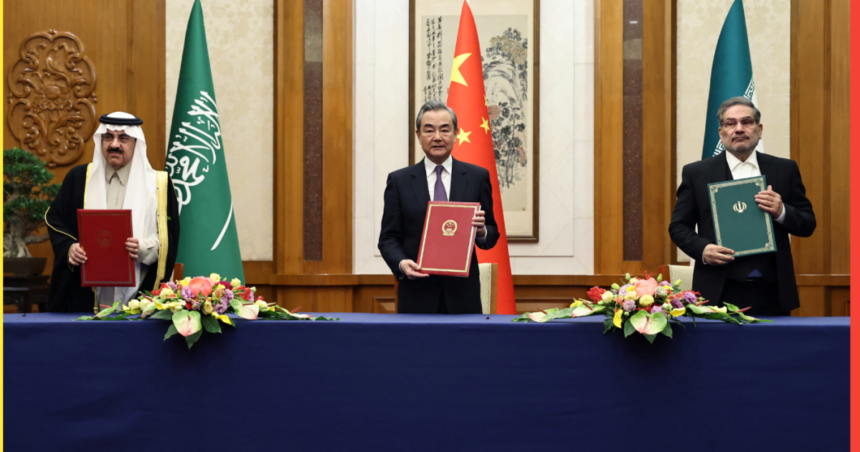
- A de-escalation path supported by China and based on Saudi-Iranian reconciliation.
The author points out that these paths – despite their differences – intersect in the goal of preventing all-out war, ensuring freedom of navigation in Hormuz, protecting energy markets and securing supply chains, which are goals that are compatible with China’s direct economic interests.
But the fundamental disagreement remains over Iran’s position in the regional system, the limits of Israel’s normalization, and the centrality of the Palestinian issue, in addition to who will be responsible for providing security in the event of renewed crises.
Mediation without a military umbrella
The same article presents the path supported by China as a path based on “integration under control,” and is embodied in the Saudi-Iranian reconciliation sponsored by Beijing, which gives the two parties a platform to reduce tension, protect energy infrastructure, and open channels for dialogue on issues such as Yemen and the security of the straits.

However, the writer, a researcher in economic geography and nuclear security in East Asia and the Middle East, acknowledges that China does not provide the Gulf states with air cover, missile defense systems, or naval dominance, and therefore remain Its contribution is essentially diplomatic, based on giving the parties a framework for dialogue more than providing solid security guarantees.
On the other hand, the writer believes that this path serves multiple interests. On the one hand, Saudi Arabia reduces the risks of targeting its vital facilities and links its security to its economic vision. On the other hand, Iran opens a door out of isolation, while China guarantees energy security and the stability of the sea lanes.
However, the analysis stresses that Beijing cannot force Iran to control its agents, accept strict inspections, or change its behavior in the Strait of Hormuz, nor can it replace the American security umbrella, which sets clear limits to the Chinese “mediation power.”
The regional reality in the Middle East has produced dispersed security with multiple levels and mechanisms, which opens room for a limited functional mediation role for China through crisis management mechanisms.
Security dilemma and new frameworks
In an analytical article by the writer “Ding Long”, Huan Qiu newspaper paints the scene from the perspective of Gulf security, as it sees that after the war, the region entered the stage of collapse of the old security without the establishment of a new security, with the shaking of confidence in American promises, the decline in the effectiveness of the Gulf Cooperation Council, and the tension of the “cold peace” between Iran and the Arab countries.
Deng points out that Iran is pushing towards a regional security framework independent of external powers, while the Gulf states are reluctant to accept a model that excludes the United States for fear of possible Iranian superiority, continued control over the Strait of Hormuz, and the accumulation of historical and sectarian differences.
In this vacuum, a Gulf division emerges between countries seeking a comprehensive pragmatic framework that includes reconciliation with Iran, and others tending to strengthen the alliance with the United States, Israel, and India.
Ding, a professor of international studies at Shanghai University, believes that the regional reality has produced a dispersed security with multiple levels and mechanisms, without amounting to a unified system, which opens room for a limited functional mediation role for China through crisis management mechanisms.
A Chinese vision for a hybrid system
The Chinese vision seems closer to the conviction that the Middle East will not return to what it was before, and will not be subject to the dictates of one pole again, but rather will move to a hybrid and fragmented arrangement in which overlapping American, regional, and Chinese paths coexist.
In this arrangement, China is betting on consecrating its image as a mediating force and a path to reduce escalation and protect energy markets, with a clear awareness of the limits of its security influence compared to the United States, and a diligent effort to employ its diplomatic and economic tools to ensure that the region does not once again turn into a bottleneck for energy and the supply chains on which it depends for its growth and the activation of its role at the international level.