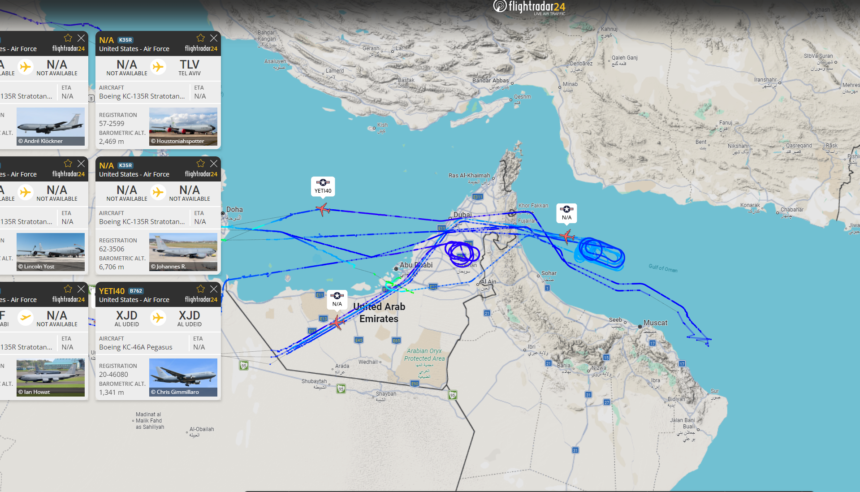
Aerial navigation data monitored by the Al Jazeera Network’s open source unit via the “Flight Radar” platform showed intense activity of refueling and reconnaissance aircraft belonging to the US Air Force and Navy during the last 48 hours.
The data reveal that American planes carried out 67 air sorties between June 30 and July 2, coinciding with an Iranian warning against the continued flying of American planes over the Strait of Hormuz, and a threat to respond to any violation of the routes or protocols that Tehran says it defines in the sea corridor.
Read also
list of 4 itemsend of list
The Iranian military headquarters of Khatam al-Anbia said that any violation of the specified routes or disregard for protocols in the Strait of Hormuz will face an immediate response, warning that the continued flying of American aircraft over the Strait will lead to destabilizing the security of the Strait and the region.
Intense activity in the last 48 hours
According to data analysis, the observed movement was distributed among 64 appearances of refueling aircraft, including 46 Boeing KC-135 Stratotanker aircraft, and 18 Boeing KC-46A Pegasus aircraft.
The data also monitored 3 movements related to reconnaissance and early warning aircraft, which included two Boeing E-3B Sentry aircraft, and a Northrop Grumman MQ-4C Triton drone, which are aircraft usually associated with surveillance and early warning missions and building a broader air and sea picture of the theater of operations.
The data shows that the intensity of activity reached 31 flights on June 30, then 27 flights on July 1, and 9 flights on July 2 at the time of monitoring, an indication of the continued layer of American air support in the region.

Why are fuel jets important?
Refueling aircraft are of particular importance in such environments, as they allow extending the time in which combat and reconnaissance aircraft remain in the air and extending the range of their operations without the need to quickly return to bases.
The US Air Force describes the KC-135 as providing the primary air refueling capability for the US Air Force, and also supporting Navy, Marine Corps and allied aircraft.
As for the E-3 Sentry aircraft, they provide an additional dimension to monitoring, as the US Air Force defines them as an early warning, command and control platform capable of providing an immediate picture of the battlefield, and monitoring and tracking air and sea targets.
Iranian warning and American message
This air activity puts the Strait of Hormuz once again at the heart of tension between Washington and Tehran. Iran says that passing ships must adhere to the routes it specifies, and warns against any American military intervention or overflight, which it considers a threat to the security of the Strait and the region.
On the other hand, the United States adheres to freedom of navigation in the strait, and continues to demonstrate an air and naval presence in its vicinity, especially with the escalation of tension regarding transit routes and the risks of targeting ships.
The Strait of Hormuz represents one of the most important sea lanes in the world, as large quantities of oil and gas exports from the Gulf to global markets pass through it. Therefore, any tension in the strait does not only affect military or commercial navigation, but also quickly extends to the energy, insurance, and shipping markets, especially when accompanied by mutual military warnings or changes in transit routes.
Flight tracking data alone does not confirm the nature of the operational mission of each aircraft, but it reveals a clear pattern of continued American supportive and reconnaissance movement in the vicinity of the theater of tension, in parallel with a direct Iranian threat to any flight or route that Tehran considers in violation of its rules in the Strait of Hormuz.