

Published On 7/8/2026
The International Federation of Association Football (FIFA) is strengthening its financial position during the 2026 World Cup despite refereeing decisions, ticket prices, the interference of politics in the game and multiple problems, according to a report by Bloomberg.
The 2026 World Cup is the first to be held in three countries: the United States, Canada and Mexico. It is also the first with the participation of 48 teams instead of 32, and 104 matches instead of 64, which increased the number of matches and expanded the market for tickets, sponsorship, broadcasting and hospitality. According to a report by S&P Global Market Intelligence, the tournament represents the largest commercial restructuring of the World Cup in 28 years, and could generate about $9 billion for FIFA this year, including $3.9 billion from television broadcasting rights.
Read also
list of 2 itemsend of list
In the budget for the 2023-2026 cycle, FIFA expects revenues of $11 billion, an increase of $4.56 billion over the 2022 Qatar World Cup, driven especially by broadcasting, marketing, ticketing and hospitality rights.

Greater revenue
According to FIFA’s expected revenues, growth is clearly evident in tickets and hospitality, which is expected to bring in approximately $3.1 billion in the current session, benefiting from holding the tournament in 16 cities and from a more profitable hospitality model.
S&P Global says that tickets and hospitality for the 2026 edition will be much higher than the Qatar 2022 edition, benefiting from the flexibility of the sporting events market in the United States and its ability to absorb higher prices.
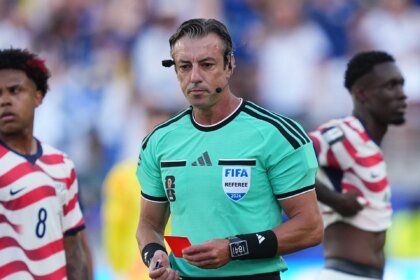
But this expansion comes amid a state of controversy after FIFA’s decision to allow American striker Folarin Balogun to play against Belgium after a previous red card, after US President Donald Trump intervened and asked FIFA President Gianni Infantino to review the decision.
The controversy increased after the American Associated Press reported that European lawmakers sought to open an investigation into Infantino because of his contact with Trump before the United States-Belgium match, considering that changing the red card penalty during the tournament harms the principle of justice and impartiality in sports. FIFA said that the decision was taken by an independent disciplinary committee.
Although the United States exited the tournament with a loss of 4 goals to one against Belgium, the crisis of striker Balogun left question marks about FIFA’s ability to overcome any criticism as long as the tournament generates record money for the federation, the participating teams, and the host cities.
FIFA increased the value of the money distributed to the 48 teams to $871 million, after an additional increase of 15%, with each team receiving $2.5 million to prepare for the World Cup, and $10 million for qualifying for this tournament, meaning at least $12.5 million before counting the bonuses for the teams’ results in the World Cup rounds.
Infantino’s influence
The FIFA president is scheduled to run in new elections in 2027, while the Asian and African federations announced their support for him, and they have 101 votes out of 211 in the FIFA presidential elections.
The President of the Asian Football Confederation, Sheikh Salman bin Ibrahim Al Khalifa, said that FIFA is in its “best position ever,” declaring its support for Infantino for the 2027-2031 term.
Regarding the cities hosting the competitions, data from the Bank of America Institute for the period from 10 to 21 last June showed that spending on credit and debit cards in the hosting cities increased by 6.3% on an annual basis, while spending by non-local visitors increased by 16.7%. The institute said that the tournament “started strong” and that it was achieving an early gain for the economies of the host cities.
The Associated Press reported that ticket prices for the 2026 World Cup ranged from $60 for the group stage matches, and reached $6,730 for the final, with the adoption of variable pricing that allows prices to be adjusted according to demand.