

Published On 7/6/2026
|
Last update: 7/7/2026 15:04 (Mecca time)
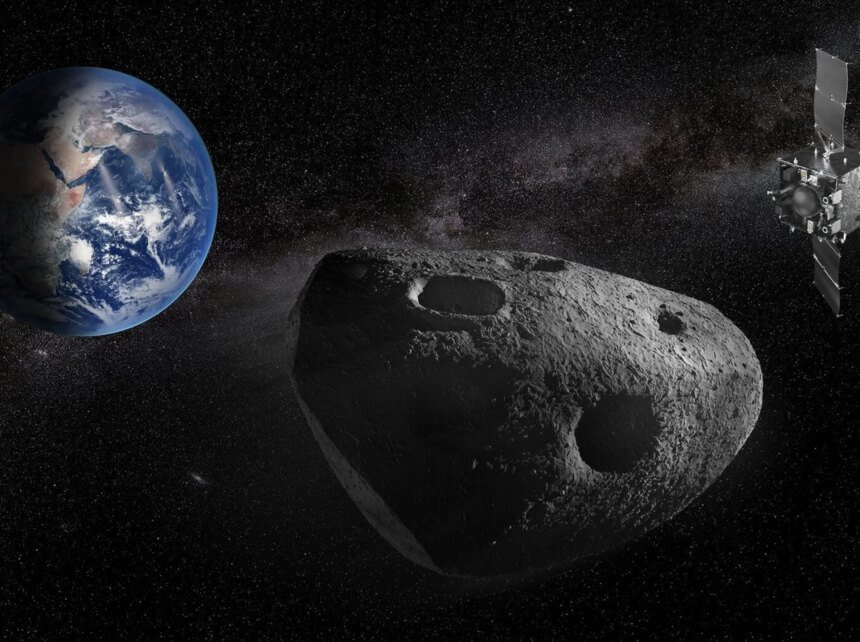
Three years ahead of schedule, astronomers have begun charting the precise paths of one of the most exciting astronomical events in modern history. It is the safe crossing of the skyscraper-sized asteroid Apophis near Earth.
The story of this giant potato-like asteroid goes back to 2004 when it was first discovered, and the world held its breath after initial calculations indicated a terrifying 1 in 37 chance of collision in 2029, making it the most dangerous asteroid at the time.
Read also
list of 2 itemsend of list
But the American Space Agency (NASA) continued to carefully monitor it for two decades, until it completely ruled out any danger of a collision in 2029 or during the next century, turning cosmic panic into an unprecedented scientific passion.
World vision map and celestial show times
During a recent scientific workshop held at the University of Padova, Italy, entitled “Apophis: 3 Years to Go,” retired cartographer Michael Zeller and astronomer Rick Feinberg revealed detailed sighting maps.
Calculations indicate that about 90% of the world’s population – that is, about 7.6 billion people – live in areas that allow them to see the asteroid with the naked eye on April 13, 2029, provided that the sky is clear and free of light pollution.

The historic transit will last for 7 hours, starting over Australia at 3 p.m. GMT, and reaching its peak brightness over Cameroon at 8:35 p.m. GMT, providing an ideal viewing opportunity for about 3.9 billion people in Africa, Asia, eastern South America, and parts of Europe.
After one hour, the asteroid will be at its closest point to Earth at an altitude of 31,600 kilometers above the North Atlantic Ocean, a distance closer than geosynchronous satellites.
What will the asteroid look like in the sky?
Scientists explain that the asteroid will not appear as a flaming meteor tearing up the sky, but rather will appear as a star-like spot of light moving steadily, as it travels every minute a distance equivalent to the apparent width of the full moon, that is, about half a degree.
In this context, astronomer Rick Feinberg said: “The asteroid will certainly be noticeable, but its movement will be slower than that of satellites, as it will cross the sky within hours, not minutes, and it will appear to onlookers only as a bright dot.”

For his part, Professor Richard Binzel, professor of planetary sciences at the Massachusetts Institute of Technology, emphasized the historicity of the event by saying: “This is the first time in human history that we have been able to predict the passage of an asteroid that can be seen with the naked eye, which represents a shared global human experience.”
Professor Benzel reassured everyone, repeating his phrase three times for emphasis: “Apophis will pass safely, Apophis will pass safely, Apophis will pass safely.”
Free physics laboratory and a unique scientific opportunity
With the threat of collision gone, the scientific community sees this event as a rare opportunity to closely observe how our planet’s gravity affects celestial bodies.
Researchers expect that Earth’s gravity will attract the asteroid to a new orbit around the sun without any future danger, but the same gravitational forces may put pressure on the asteroid and expand it, which may stimulate landslides on its surface or reveal pure materials hidden under its crust affected by space factors.
Professor Binzel from MIT comments: “We simply do not know exactly what will happen. The asteroid may pass without much impact, or we may see a fundamental change, which is why we have to monitor. In either case we will learn a lot.”

Scientists hope to accurately monitor this transit through several astronomical stations, most notably the Canary Islands in Spain, due to their strategic location in the Atlantic Ocean, which provides an ideal view of the closest point the asteroid reaches, with great opportunities for clear weather.
This anticipated event embodies the true power of science, research and exploration. Through creative minds and advanced technology, humanity has been able to transform a vague cosmic threat into a scientific festival awaited by generations.
Studying these rocks floating in space not only protects our planet, but also opens invaluable windows to understanding the origins of our solar system, and proves that human curiosity based on the rigorous scientific method is the true shield and beacon that leads us towards a safe and enlightened future in the midst of this vast universe.