Published On 7/7/2026
|
Last update: 16:53 (Mecca time)
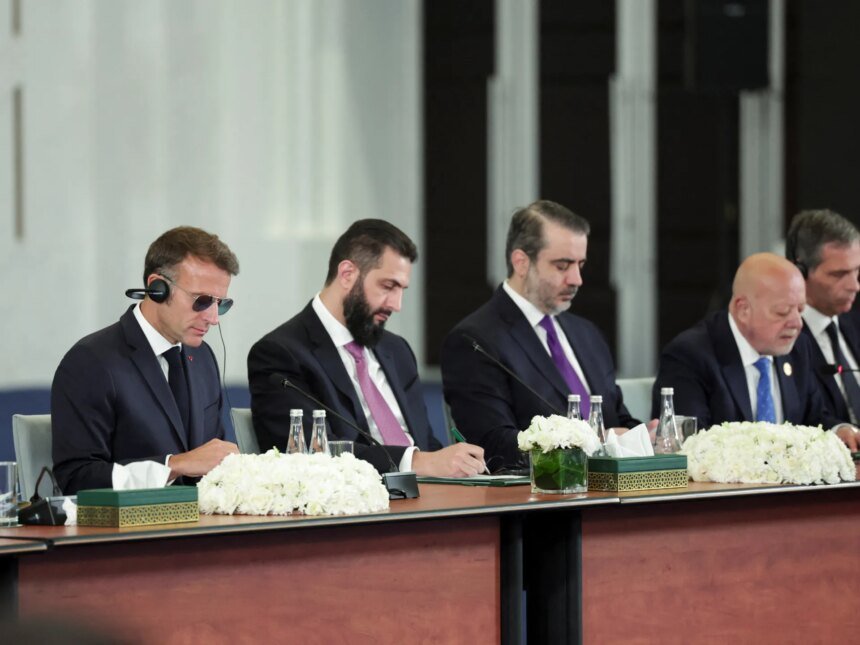
Today, Tuesday, the Syrian and French governments concluded 15 bilateral cooperation agreements in several fields, including civil aviation, health, the banking sector, water and road infrastructure, at the conclusion of the joint round table whose meeting was chaired by President Ahmed Al-Sharaa and his French counterpart, Emmanuel Macron.
Syrian Foreign Minister Ahmed Al-Shaibani and his French counterpart, Jean-Noel Barrot, signed a comprehensive cooperation framework to strengthen relations between the two countries. They also signed a memorandum on a declaration of intent regarding the funds that France confiscated from Rifaat al-Assad.

The Syrian Ministry of Higher Education signed a memorandum of understanding with the medical educational company “Ellipse Projects SAS” to develop university hospitals and medical educational institutions.
The signing included memorandums of understanding for cooperation in the health field and a cooperation agreement protocol in the field of standard water treatment solutions and energy solutions in Homs Governorate.
A declaration of strategic partnership was signed in several areas, the most important of which are sea and air transport and logistics services, and an agreement with the French Development Agency.
The two sides also signed a declaration of intent in the field of civil aviation, and a protocol for the agreement to manage the circulation of airborne cargo and the marketing of air cargo services.
A memorandum of understanding was also signed for cooperation in the field of institutional strengthening, technical support and capacity building for the Central Bank of Syria, and a memorandum of understanding to enhance economic cooperation and develop trade relations.
At the beginning of the meeting, President Al-Sharaa stressed that “Syria is a country that decided to rise,” pointing to the importance of its strategic geographical location and its role in the global corridors market.
During the meeting, Al-Shara presented an integrated roadmap for reconstruction and partnership.
In turn, Macron spoke about “expanded and joint economic committees working to support reconstruction in Syria, and there will be a partnership with Gulf countries,” adding that his country is ready to build confidence with Syria, and that it will be a partner in several fields, including energy and the banking sector.
Al-Shaibani: A new phase of partnership
Al-Shaibani said that President Macron’s “historic visit” to Damascus represented a turning point in the course of Syrian-French relations, and established a new phase of partnership based on mutual respect and common interests.
He added in statements that the visit culminated in the signing of memorandums of understanding and the launch of strategic cooperation paths, which reflects the growing international confidence in Syria and its role in enhancing security and stability.
Al-Shaibani stressed that “the Syrian state continues to protect its citizens, preserve its security and stability, and confront terrorism in all its forms,” as this is the basis for recovery and development. The competent authorities are following up on all incidents, and will hold accountable every party or individual proven to be involved in targeting Syria’s security or the safety of its citizens, in accordance with the law.
Integration into the global economy
The Syrian Minister of Economy and Industry, Nidal Al-Shaar, said that his country “chose to open a new page in its economic approach to be more competitive and able to integrate into the global economy.”
He added, during the roundtable meeting, “We look forward to an active French presence in industry, transportation, infrastructure, education, and health, while achieving added value to the Syrian and French economies.”
In turn, the CEO of the CMA-CGM Group, Rudolph Souad, explained that the group is reactivating the port of Latakia, and we expect important partnerships with Damascus in various fields.
Oil cooperation
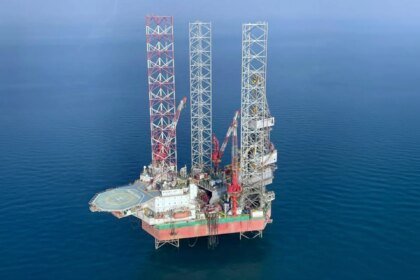
Total Energy CEO Patrick Pouyanné said in statements reported by Agence France-Presse that Syria could become an “important transit country” for oil coming from Iraq towards the Mediterranean Sea, and provide “alternative routes” to the Strait of Hormuz.
He added in his statements on the sidelines of today’s meetings that Syria is “a country located at a crossroads in the Middle East,” explaining that “what happened in the Strait of Hormuz” during the American-Israeli war on Iran “also increases the importance of Syria,” after it became “clear that if we want to invest in the Middle East, we will have to find alternative paths.”