


In a small corner of an oil painting painted more than four centuries ago, a scene appears of a bat flying in the sky, with a small bird in its mouth. At first glance, it may seem like a passing artistic detail within a work crowded with birds, symbols, and myths. But for a team of ecologists, this scene was enough to raise an interesting question: Did the Belgian painter Jan Bruegel the Elder record real behavior that modern science has only recently understood?
The study, published on June 29 in the journal Proceedings of the National Academy of Sciences, is based not on a laboratory experiment, nor on modern tracking devices, but on a painting called “Air,” painted by Bruegel in 1611.
The painting represents “Air” in a wide, symbolic scene, in which Urania, the goddess of astronomy in Greek mythology, appears surrounded by dozens of birds, while the chariots of the sun and moon pass in the background.
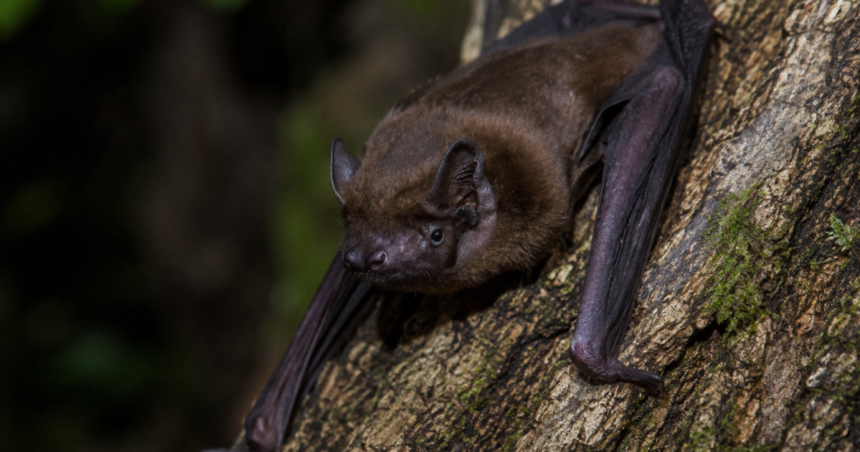
Amid this richly detailed scene, researchers noticed something unusual. Among the more than 60 species of birds included in the painting, several bats appear. One of these bats, in the upper right corner, looks remarkably different, as its ears are short and wide, its wings are long and narrow, and its fur is reddish-brown.
These characteristics, according to the researchers, are strongly consistent with the great nocturnal bat, or at least with bats of the genus Noctule. But the bat does not appear alone, but rather carries a small passerine bird in its mouth.

Behavior that science does not easily believe
Recent previous studies suggest that the great nocturnal bat, Europe’s largest bat, can indeed hunt night-migrating songbirds and eat them in flight.
“The idea that a European bat was hunting birds in the air was not readily accepted at first,” says the study’s lead author, Pedro Romero Vidal, a researcher at the Doñana Biological Station of the Spanish National Research Council. “The scientific evidence began about two decades ago, when bird feathers were found in the feces of this species of bat. Subsequent analyzes showed that bird remains appear more frequently during periods of nocturnal bird migration, indicating that it is not a matter of accident or accidental ingestion.”
Subsequently, DNA analysis proved that the diet of these bats may include dozens of species of migratory birds. Finally, modern tracking techniques, which combine recording sounds, movement, and location, have come to confirm that the bat does not pick up dead or fallen birds, but rather chases them in the air and eats them while it is still flying.
Pedro explains in statements to Al Jazeera Net that what the new study suggests is that this behavior may have been known, or at least observed, long before modern science.
Bruegel did not draw a general bat eating a bird randomly, but rather he painted a bat whose characteristics appear close to the type known today with this specific behavior. If this interpretation is correct, the painting may be one of the earliest visual references to bat predation on birds.
 Popa-Lisseanu AG, Delgado-Huertas A, Forero MG, Rodríguez A, Arlettaz R, & Ibáñez C – Popa-Lisseanu AG, Delgado-Huertas A, Forero MG, Rodríguez A, Arlettaz R, et al. (2007) Bats’ Conquest of a Formidable Foraging Niche: The Myriads of Nocturnally Migrating Songbirds. PLoS ONE 2(2): e205. doi:10.1371/journal.pone.0000205
Nyctalus lasiopterus showing its impressive teeth to the researchers” width=”484″ height=”362″> DNA analysis has proven that the diet of these bats may include dozens of species of migratory birds (PLOS ONE)
Art as an archive of nature
The researchers treat the result with caution; The painting is not direct scientific evidence that Bruegel himself witnessed a bat preying on a bird. He may have relied on artistic imagination, or on symbolism that combines bats, darkness, birds, and light, or on stories he heard from others, according to the main author of the study.
Also, the real behavior known today does not exactly match the painting; The bat usually grabs the bird with its feet and tail membrane, and removes its wings and perhaps its head during flight, in a process that may take long minutes. The painting, if it actually depicts the behavior, may capture an early or simplified moment of predation.
There are other limitations that Pedro explains: The painted bat may be the great nocturnal bat, but it may represent a closely related species such as the common nocturnal bat. The bird itself cannot be accurately determined due to its small size and lack of details, although its general shape is consistent with small passerine birds. Other copies of the “Air Painting” do not necessarily contain this scene, which makes its interpretation more complex, and opens up the possibility that the detail may have been added or modified in a specific copy.
The authors point out that the study was funded by the Human Resources Support Program for Research, Development and Innovation of the Andalusian Research, Development and Innovation Strategy, and by the “Accelencia Severo Ochoa” grant funded by the Ministry of Science and Innovation, the Spanish universities and the government research agency. The research team declared no conflict of interest.