Published On 7/7/2026
|
Last update: 15:54 (Mecca time)
As global attention turns to other crises, Sudan is approaching a new chapter of humanitarian catastrophe. In the city of El Obeid, the capital of North Kordofan State, international warnings intersect with criticism of the positions of the capitals of influential Western countries regarding the conflict, in a scene that brings to mind the atrocities witnessed in the cities of El Fasher and El Geneina in the Darfur region.
The alarm bell in Al-Obeid
International fears are rising that the city of El-Obeid – which is one of the most important humanitarian and commercial centers in Sudan – will turn into a scene of large-scale massacres as battles intensify and the Rapid Support Forces approach the city, at a time when the United Nations confirms that about half a million civilians are at risk of mass atrocities.
Read also
list of 2 itemsend of list
This tragic reality was analyzed by the British newspapers The Guardian and the Financial Times, and Save the Children warned of its repercussions on the most vulnerable segment of the city’s population.
In an editorial, The Guardian newspaper considered what is happening in Sudan to represent a new collapse of the international community’s promise not to allow the tragedies of Darfur to be repeated.
The newspaper says that two decades ago the world raised the slogan “Never Again,” but facts prove today that the tragedy is repeated again and again, while international interest in it remains limited.
There are campaigns within the United States calling on major companies and institutions to reconsider their relations with regional parties accused of involvement in the Sudan war, noting that the failure of governments has prompted civil society organizations and celebrities to fill the void.
The newspaper warns that the city of Al-Obeid faces the risk of becoming a scene of mass crimes, in light of the approach of the Rapid Support Forces, the continuation of march attacks, and the tightening noose on the city.
But it considers that the crisis is not only due to the intransigence of both sides of the war, but also to the continued external support that allows the conflict to prolong, criticizing the reluctance of Western governments to exert real pressure on regional parties accused of fueling the conflict.
The newspaper believes that the sensitivity of these regional parties towards their international image makes political, economic and media pressure more influential than believed.
The editorial cited campaigns that have already begun within the United States to demand that major companies and institutions reconsider their relations with regional parties accused of involvement in the Sudan war, noting that it is the failure of governments that pushes civil society organizations and celebrities to try to fill this void.
The political engineering of violence
In an analytical reading of the depth of the crisis, the political advisor to the Sudanese Transitional Sovereignty Council, Amjad Farid Al-Tayeb, believes in an article in the Financial Times that what Sudan is witnessing is not just passing violence, but rather a deliberate dismantling of society at the hands of a militia whose political project represents violence.
Al-Tayeb explains that the Rapid Support Forces, which emerged from the womb of the Janjaweed militia, reproduced the tools of ethnic terror and demographic engineering that they previously practiced in Darfur, supported this time by clear regional powers.
The writer strongly criticizes the attempts of the international community, and Britain in particular, to hide behind the language of diplomatic balance and equality between the two parties in responsibility for violations.
In this context, Al-Tayeb cites data from the Armed Conflict Monitoring Project (ACLED) for the year 2024, which prove in numbers that the Rapid Support Forces are responsible for 77% of the damages and violations recorded against civilians, compared to about 10% resulting from government forces.
In this regard, he says that putting the two sides of the conflict in one box “is not neutrality, but rather a distortion of reality,” adding that the insistence of Britain and its partners on treating the two sides of the conflict as equal in responsibility gave the Rapid Support Forces, in practice, a kind of institutional immunity.

Accusations against Britain
Based on this understanding, the author calls on the British government to take four steps that he believes are capable of making a tangible difference in the course of the war: The first is to classify the Rapid Support Forces as a terrorist organization under the British Terrorism Act, allowing the prosecution of their financing networks and the criminalization of their activities within the United Kingdom.
Secondly, suspending arms export licenses to the relevant regional authorities as long as the risk of military equipment being transferred to the Rapid Support Forces exists.
The third step is to open an independent investigation into accusations that spoke of downplaying internal warnings related to the risk of genocide in order to preserve relations with those regional parties, while the fourth step is to prosecute those responsible for the violations, as well as external parties that provide political or military support to them.
In this regard, he cited reports of British-made equipment being found in the possession of the Rapid Support Forces, including guidance systems and engines for armored vehicles.
The writer’s criticism is not limited to foreign policy, but extends to British domestic policies, as he considers that the suspension of granting study visas to Sudanese last March harmed students and researchers who had already fled the war, saying that Britain “publicly shows its sympathy for the suffering of the Sudanese, but in reality it punishes them with its policies.”

Children are in danger
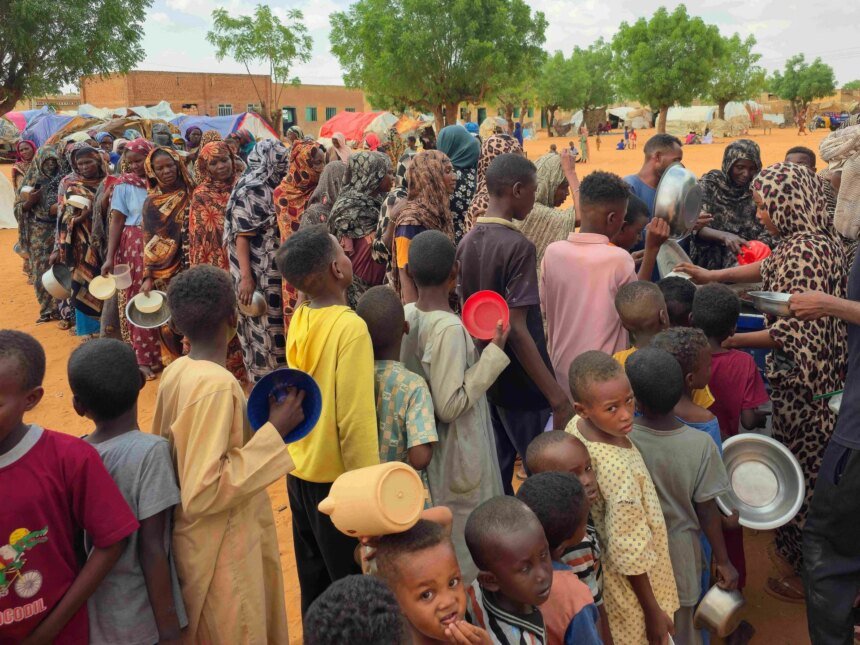
These political calls come at a time when the features of a humanitarian crisis are unfolding as a result of the repercussions of the war in North Kordofan. Save the Children warned in a recently published report that more than 11,000 people, including about 5,500 children, were displaced from the city of El Obeid during the past two weeks, as a result of the escalation in fighting.
At the same time, hundreds of thousands face the risk of siege and the interruption of water, fuel, and basic services, in conjunction with the outbreak of cholera and the faltering arrival of humanitarian aid, according to the report.
These waves coincide with systematic march attacks that targeted infrastructure, including gas stations and water tanks, which led to economic paralysis and a crazy rise in prices, as the price of two bottles of water reached 6 thousand Sudanese pounds (about 10 dollars).
What compounds the tragedy – according to Save the Children – is that the displacement coincided with the fall season and the outbreak of the cholera epidemic, which recorded more than 300 cases in the Kordofan region, in light of the deprivation of children from basic health care.
Francesco Lannino, the organization’s deputy director in Sudan, explained that the repeated displacement of children does not only mean the loss of a home, but it means the destruction of safety networks, the loss of education, and health care, not to mention the profound psychological effects that haunt an entire generation, in which children constitute about 55% of the total 14 million displaced people in Sudan, which represents the largest displacement crisis in the world currently.
Source: Guardian + Financial Times + social media sites