

As the world was fixated with the ongoing 2026 FIFA World Cup and as crowds filled the streets of Tehran for the funeral ceremonies of Iran’s former Supreme Leader Ali Khamenei, one of the most consequential political announcements since the Gaza war began came not from Iran or the United States but from besieged Palestinian territory of Gaza. The Palestinian militant group said it was dissolving the body that has governed Gaza for nearly two decades and was preparing to transfer civilian administration to a United Nations-backed “technocratic committee” established under the US-brokered ceasefire. The announcement immediately raises a question that Hamas, after ruling Gaza since 2007, what exactly comes next?
The announcement marks the biggest political concession Hamas has made since it seized control of Gaza after its split with Fatah. The group said only technical and professional staff involved in delivering public services would remain at their posts while the new committee assumes responsibility for civilian administration. Hamas described the move as evidence of its commitment to reconstruction after almost two years of devastating Israeli attacks.
Advertisement – Scroll to continue
Neither Hamas nor its officials said the movement would disarm. The ceasefire framework envisages a single governing authority with control over weapons, but Hamas has stopped short of accepting that condition. Israeli officials quickly argued that any civilian administration would remain subordinate to Hamas as long as the group retained its military capability. The “Board of Peace”, the new US-led body overseeing the ceasefire and reconstruction process, responded cautiously, saying implementation would be judged by “actions, not promises.”
That distinction actually matters because Gaza’s political future has repeatedly become trapped between announcements made at negotiating tables far from the Strip than the realities on the ground. Nine months after the ceasefire agreement was signed, negotiations over its second phase remain stalled, while Israeli military operations continue despite the reduction in large-scale fighting.
“The timing is significant in the sense that it’s trying to build consensus and pressure on Israel to stop the violence,” Professor Simon Mabon of Lancaster University told NDTV. “It’s, I think, trying to say, look, we are serious about a ceasefire, but we need concrete steps for this to actually be a ceasefire.
“And I think that’s why we’re only seeing sort of a partial offer of sort of stepping aside for the technocratic government, but not a unilateral disarmament. So I think that it is, it is genuine pressure on the Israelis to try and enact a deal and enact the next phase of the process and to try and make real this ceasefire that has obviously not been a ceasefire and led to the killing of huge numbers of people.”
For almost twenty years Hamas has combined armed resistance with day-to-day administration in the Gaza Strip. It has operated ministries, schools, municipal services and health institutions while simultaneously maintaining an armed organisation. The current war has fundamentally altered those governing conditions.
“The situation in Gaza is dire,” Professor Mabon told NDTV, arguing that the scale of destruction means Hamas can no longer function as the service provider it sought to become. Without sustained humanitarian access, medicines, fuel and basic supplies, governance itself becomes impossible.
According to Professor Mabon, the movement’s decision acknowledges a practical reality as much as a political one. Civilian institutions cannot function if hospitals lack equipment, infrastructure remains destroyed and aid continues to face restrictions. Stepping aside therefore becomes less an ideological shift than recognition that another mechanism may be better placed to restore basic services in the Strip.
Hamas has repeatedly adapted after previous wars without abandoning either its political ambitions or its military identity when it comes to Israel.
Following earlier conflicts in 2008-09, 2014 and 2021, Hamas rebuilt administrative institutions while maintaining its armed capability. Nothing in the latest announcement necessarily signals a departure from that pattern nor does it reveal anything about their stance on the continued Israeli occupation.
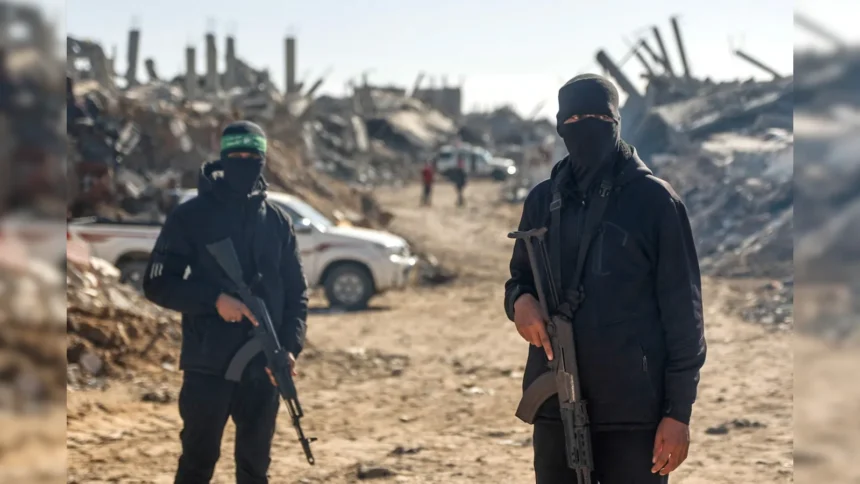
Hamas militants guard an area where they are searching for the bodies of hostages with the help of the ICRC in Gaza City.
Photo Credit: AFP
“I don’t see that this is the transformation into a purely political actor. I don’t think that that is possible for Hamas right now. I think what it is, is the realisation that something has to give, some type of pressure has to be asserted on the Israelis and the Americans to get some movement into trying to get people the things that they need to survive,” Professor Mabon told NDTV. “And that is obviously hugely challenging right now. But I think it’s not going to happen by the escalation of an armed struggle. I think there’s a realisation of that. And so this is perhaps a survival strategy, sure, but I also think it’s a pragmatic and in some ways instrumental decision to try and put pressure on Israel and the United States to get a move on with actually implementing a ceasefire.”
The “technocratic committee” now expected to administer Gaza faces equally difficult challenges.
Headed by Ali Shaath and backed by the United Nations and the US-led Board of Peace, the committee has been tasked with restoring essential services and overseeing civilian affairs. Yet legitimacy cannot simply be declared.
Many Palestinians remain sceptical of externally designed governance structures. Others question whether any administration can operate effectively while Israeli restrictions continue and major political disagreements remain unresolved.
Mabon believes those concerns are real but says immediate humanitarian needs inevitably take precedence.
His argument is that legitimacy is unlikely to emerge from diplomatic recognition alone. It will depend on whether the committee succeeds in delivering food, medicine, shelter, electricity and functioning public services. If it cannot enter Gaza freely or exercise authority, questions of legitimacy become almost secondary because governance itself cannot begin.
The effectiveness of the newly created Board of Peace will also be closely scrutinised.
Created under President Donald Trump after the ceasefire agreement, the body has presented itself as the mechanism that will supervise implementation and reconstruction. Its response to Hamas’s announcement emphasised measurable outcomes rather than political declarations.
“I think the need to actually put pressure on Israel to stop the destruction or the further or continued destruction of Gaza is paramount. Whether the Trump administration has the political will to do that at the same time as putting pressure on Israel vis-a-vis South Lebanon and also Iran, I’m not sure that it does,” Professor Mabon told NDTV.”
“But if it wants to be taken seriously, if the Board of Peace actually want to have a role to play here, then they need to rein in Israel. They need to get them to withdraw to the geographically agreed upon areas to let the technocratic government actually enter Gaza, to let it begin its governance, and to let aid get in properly. So essentially alleviate the conditions of hell that have been imposed,” he added.
Regional actors will also shape whether the transition succeeds. Iran remains Hamas’s principal strategic backer, although Tehran is now balancing multiple regional crises alongside renewed engagement with Washington. Representatives from Hamas attended ceremonies honouring Ayatollah Khamenei.
Qatar arguably occupies the most influential diplomatic position as it continues to maintain channels of communication with Hamas while serving as a central mediator between the parties. Egypt, meanwhile, remains indispensable because of its control over Gaza’s southern border and its longstanding role in ceasefire negotiations.
The Palestinian Authority presents another complicated issue. For years, the rivalry between Hamas in Gaza and the Palestinian Authority in Ramallah in the West Bank has complicated Palestinian politics. A technocratic administration potentially offers a framework that avoids immediately resolving that dispute, but whether it develops into a lasting governing model depends on cooperation that has often proved elusive..
Disarmament sits at the centre of those concerns.
Without clarity over Hamas’s weapons, Israeli objections are unlikely to disappear. Conversely, Hamas continues to argue that discussion of its arsenal belongs in later phases of negotiations rather than as a precondition for civilian reconstruction.
At the end of the day, it is the poor people of Gaza, who remain in uncertainty.