Published On 7/6/2026
While contemporary societies measure their development by the ability to keep pace with the future, the “Old People” exhibition at the Museum of Man in the French capital, Paris, re-asks a simple and profound question: “What if aging was not a burden, but rather one of the greatest human success stories?”
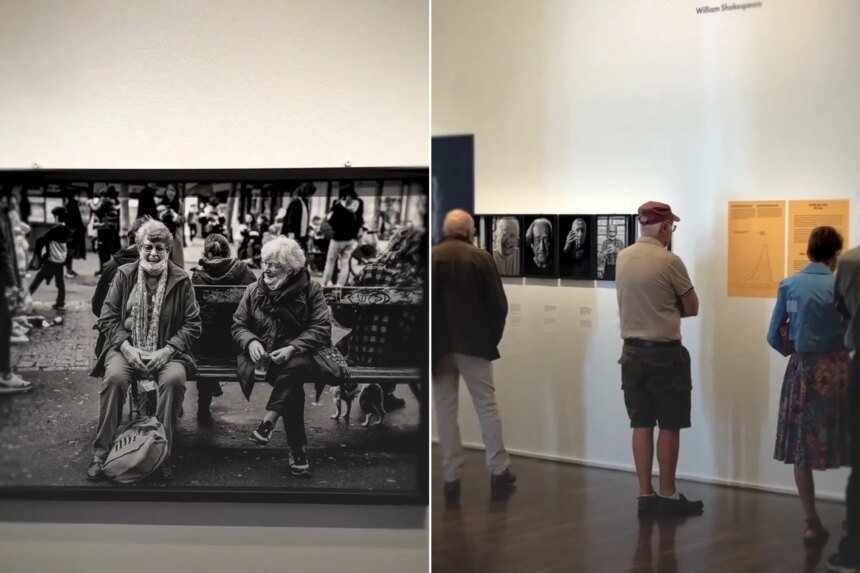
The exhibition, which will continue until January 2027 in the Germaine Théon space inside the Museum of Man – overlooking the Trocadero Square and the Eiffel Tower – combines the lens of French photographer Nikos Alidiagas with the vision of bio-demography researcher Samuel Pavard.
In this space, science meets image – according to journalist Abdul Khaleq Jabbahi – to transform the wrinkles and features of the elderly into material for contemplation of the human journey, from transferring knowledge between generations to confronting the challenges of isolation, disease and climate change.
A historical role and a complex reality
In an exclusive statement to Al Jazeera, exhibition director Samuel Bavard stressed that the elderly have played a very important role throughout history in the development of the human race, specifically in transferring environmental and technical knowledge between generations, which is knowledge that has contributed to the development of cultures, languages, and cognitive abilities, and has formed a basic foundation for building societies.
Bavar explained that the exhibition does not present a stereotypical image that reduces aging to “weakness,” but rather presents its health, biological, and social reality in all its complexity, highlighting the contrast between elderly people who enjoy independence and support from their families, and others who face illness, isolation, and suffering without any help.

Bavar recalled a poignant moment during the preparation of the exhibition when he visited a nursing home in France, where he was stopped by a painting made by the children of one of the inmates to help her remember her identity and her family members.
He pointed out that his personal experience with a family member suffering from Alzheimer’s disease made this aspect particularly affecting him, because it reflects the daily suffering experienced by many families.
In the same context, the exhibition linked aging and environmental crises, stressing that the elderly are the most vulnerable in the face of heat waves and pollution, and that protecting the climate and biodiversity also means protecting the ability of humans to live longer lives in the future.
Black and white philosophy
The exhibition went beyond the dry language of numbers to human stories documented by Alediagas’ lens in black and white, turning the images into tales of memory, love, unity, and resilience. The most prominent of these is a picture of a couple over 100 years old, documenting their daily meetings inside the nursing home, recalling more than half a century of shared life.
These shots sparked great interaction from visitors, as Marine Delvanne saw that the power of black and white gave the faces of the elderly a deep emotional dimension that is difficult to express in words, while Patricia described the exhibition as “a journey inside life itself” that summarizes memory, fragility, and hope.
Bavar sums up the exhibition’s main message in one conclusion: “Aging in our contemporary societies is not a problem, but rather one of the achievements of our societies.”