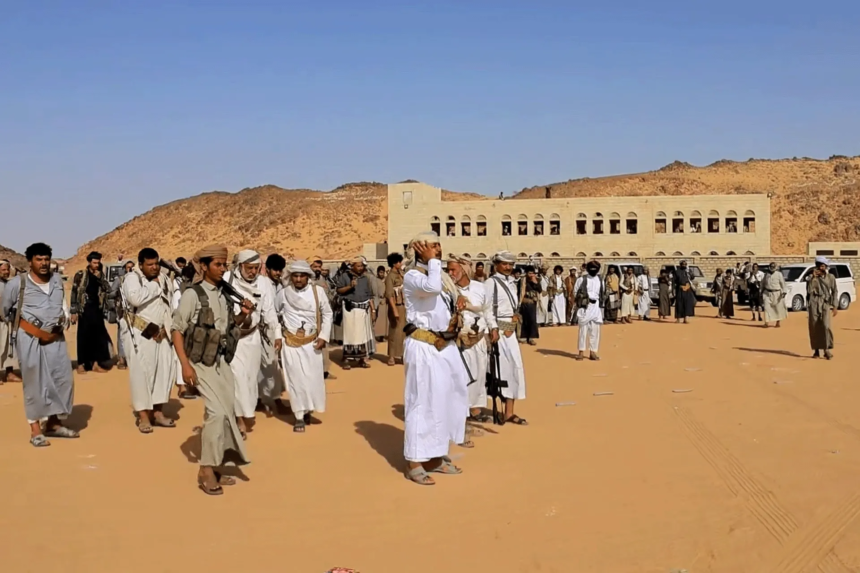
Sanaa- For the second week in a row, large tribal mobilizations continue in the Matarih Al-Rayyan area in Al-Jawf Governorate, northeastern Yemen, coming from several Yemeni governorates and regions, in response to a call issued by the tribal sheikh Hamad bin Rashid bin Fadgham Al-Hazmi for what is known as the “tribal nakf” (general rally), in a scene that brought back to the forefront the role of the Yemeni tribe and its ability to mobilize in moments of crises and major transformations.
Delegations representing tribes from Al-Jawf, Ma’rib, Hadramaut, Shabwa, Sana’a, Al-Bayda, Ibb, Taiz and other governorates arrived at Al-Matarih, amid the continued arrival of participants, in one of the broadest tribal responses that the country has witnessed in recent years, according to local sources to Al-Jazeera Net.
While the organizers of the crowds confirm that the goal is to support Sheikh Bin Fadgham and defend tribal customs, observers believe that the wide scope of participation raises questions that go beyond the direct issue regarding the return of the tribe as an influential player in the Yemeni scene in light of the continuation of the war and the decline of state institutions.
From “Mira” to “Nakaf Al Karama”
The roots of these crowds go back to the case of Mrs. Mira, who previously claimed to be the daughter of the late Iraqi President Saddam Hussein, and accused leaders of the Houthi group of seizing her house in Sanaa and looting her property, before she turned to Sheikh Hamad bin Fadgham, requesting his support.
After adopting the case of “Mira” and leading tribal mediation to restore her home in Sana’a, the Houthi group arrested Sheikh Hamad bin Fadgham along with his “Rabi’a” or his “accused”, Mira, before releasing Sheikh bin Fadgham about fifty days after their arrest, while “Mira” remained in detention, according to those close to the case and media reports.
Following his release, Ben Fadgham returned to his tribe to announce the “deny of dignity” on June 24, considering the case “an issue of honor and tribal honor,” and calling for Mira’s release and the return of her property.
The call quickly received a wide response, as tribal delegations from several Yemeni governorates began arriving at Al-Rayyan’s slaughterhouses, and the crowds continue to grow.

What is “tribal mumps”?
“Tribal Nakf” is one of the most ancient tribal customs in Yemen, and is based on the principle of general mobilization and collective mobilization to support the oppressed or confront an exceptional event, through a call issued by a tribal sheikh or social authority that mobilizes allied tribes or those associated with tribal customs.
Researchers in tribal affairs say that “nakf” is not limited to the military dimension, but rather represents an integrated social and tribal solidarity system, reflecting the status of tribal customs and their ability to mobilize tribes around one issue, even in light of the political divisions that the country is experiencing.
Sheikh Hamad bin Fadgham based his call on one of the most prominent tribal symbols, when he broke the “jabiya” (breaking the upper part of the Yemeni dagger) and threw the shawl in front of those present, a step considered in tribal custom to be a declaration of exposure to grave injustice and an official request for support, in a way that stimulates the system of tribal customs and alliances, and places the tribes under a moral and social obligation to respond to the call.
The “janabiya” (the Yemeni dagger) has a special symbolic status in Yemeni tribal society, as it represents honor, prestige, and social consideration. Breaking part of it is an announcement that its owner believes that his dignity has been violated and that he has no recourse but to resort to the tribe.
As for the shawl, it symbolizes status and social prestige, and throwing it in front of those present is considered an explicit declaration of support, and one of the highest levels of mobilization in Yemeni tribal custom.
Crowds
Perhaps the most prominent feature of the “Matareh Al-Rayyan” crowds was their unusual geographical expansion, as they brought together tribal delegations from several Yemeni governorates under the umbrella of a single tribal issue, in a rare scene since the outbreak of war in the country in 2014.
Yemeni media activist Osama Al-Jasser described these crowds as one of the largest tribal gatherings that Yemen has witnessed in recent years, noting that they included delegations from the far east of the country to the west, and considering that “what was separated by political divisions was brought together this time by tribal and tribal ties.”
The head of the delegation of the “Al-Haymatin” tribes in Al-Karama Muttrah in Al-Rayyan, Sheikh Nazih bin Rabish Al-Ali, in his interview with Al-Jazeera Net, confirms that the response to the call for “Al-Nakaf” came out of a “tribal duty dictated by customs and inherited ancestors,” adding that the issue “no longer concerns Sheikh Hamad bin Fadgham or the Dahm tribe alone, but rather has become the issue of all the tribes of Yemen.”
Al-Ali says that the size of the participation “was large and unprecedented,” noting that tribal delegations came from most of the Yemeni governorates, including areas under the control of the Houthis, stressing that the tribes “are still stationed in the outskirts of Al-Rayyan and will not leave before their demands are met.”
What do the tribes want?
Some participants believe that the crowds do not only aim to stand in solidarity with the cause of Sheikh Bin Fadgham, but rather to send a message that the tribe is still capable of imposing its presence and defending its customs, while some of them talk about the possibility that these protests will lead to a broader tribal framework if the crisis continues, and that judging its outcome remains dependent on future developments.
The head of the delegation of the “Nihm” tribes to Al-Karama Muttrah in Al-Rayyan, Sheikh Zaid Al-Shaleef, says that the wide response to the “Al-Nakaf” call came as a result of “accumulations of violations to which the Yemeni tribesmen were subjected,” considering that the crowds saw in this call an opportunity to support the oppressed and restore their dignity.
Al-Sharif added, in his interview with Al-Jazeera Net, that the participation is “unprecedented.” It included tribes from various parts of Yemen, noting that the message carried by the crowds is that “the word of the tribes is one, and their demand is to restore the dignity of the Yemenis,” stressing that the participants are talking about subsequent steps if their demands are not met.
For his part, the head of the delegation of the “Haymatin” tribes, Sheikh Nazih bin Rabish Al-Ali, believes that the crowds sent a message stating that “the Yemeni tribe may get sick, but it will not die,” considering that tribal customs are still capable of uniting the tribes and defending what they describe as issues of dignity and honor.

Political implications
Political analyst and expert in Yemeni tribal affairs, Saif Al-Hadhiri, believes that the widespread response to the “Al-Nakf” call reflects that “the popular will is still present, and that the problem was not the willingness of society, but rather the absence of a leadership capable of transforming this energy into an organized national project.”
Al-Hadhiri considered that the Al-Rayyan battles represent an “exceptional national event” that goes beyond being a tribal mobilization, and may have repercussions on the political and military scenes if it is handled well.
On the other hand, and despite the absence of any official declared position from the Yemeni authorities towards these crowds, no measures have been recorded so far to obstruct the holding of the festivals or prevent the arrival of participants to them, while observers believe that this approach reflects a conservative position and leaves room for tribal movement, without adopting it officially.
Al Jazeera Net was not able to obtain a comment from the Sanaa authorities regarding what the crowd organizers were saying about the circumstances of the case, and it had not issued an official statement addressing these accusations until the time of preparing the report.
While tribal delegations continue to arrive at Al-Rayyan sites, the question remains open: Will these crowds remain a tribal protest station linked to a specific issue, or do they establish the return of the tribe as a more influential player in the Yemeni power equation, after years of military and political actors dominating the scene?