


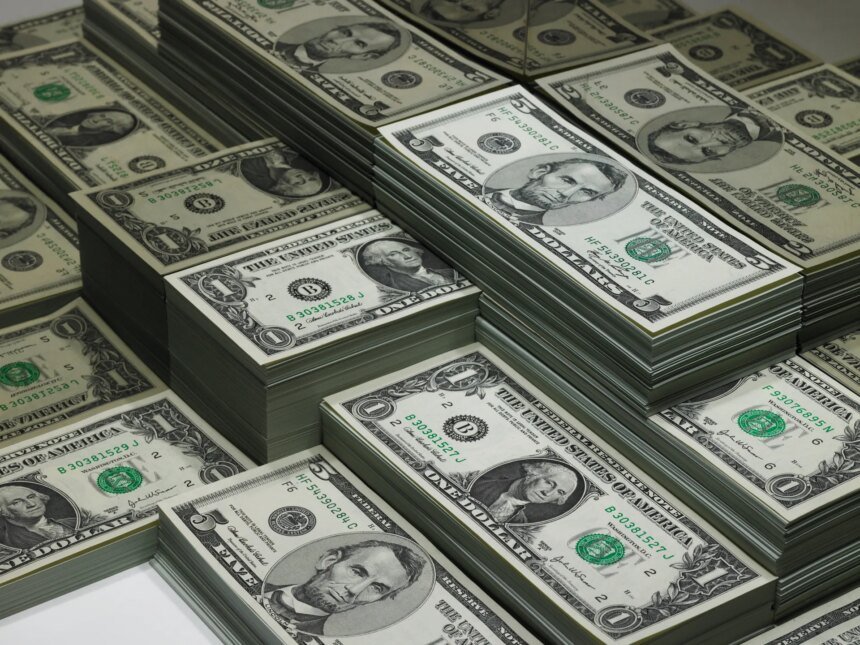
On July 4, 1776, the United States of America declared its independence from the British Crown, only two years after announcing the establishment of Congress, which began working to confirm the sovereignty and independence of the American states in various fields, most notably economic sovereignty.
At that time, Congress sought to favor the Spanish dollar in its transactions and limit the use of the pound sterling to consolidate financial independence from Britain, but the British currency remained accepted in circulation with other European currencies.
Read also
list of 4 itemsend of list
The United States Congress quickly decided to settle the competition in favor of the American currency, and in 1792 it issued the Mint Act, according to which the US dollar became the country’s official currency. But other currencies remained accepted in circulation.
The matter remained this way until 1863, when Congress passed the “National Banking Act,” which prohibited the circulation of other currencies, including the Spanish dollar and European currencies, and US dollar bills known as “Green Bucks” entered circulation, and were known by this name because of the use of green ink for writing on the back.
As for the origin of the word dollar itself, it is the word “thaler”, which is a word of German origin that was used to refer to silver coins in Europe, according to what the World Economic Forum mentioned in its explanation of the meanings of the names of currencies, and it was transferred to the United States with European immigrants.
With Congress needing more money to finance the expenses of the Civil War, which lasted from 1861 to 1863 between the southern and northern states, it asked the Treasury Department to issue bonds on demand without interest, and this was the beginning of American bonds, which are still accepted in circulation and can be redeemed, according to the American currency history awareness website of the US Federal Reserve (the central bank).

Establishment of the Federal Reserve
Congress passed the law establishing the Federal Reserve in 1913 to manage American monetary policy, including setting interest rates, ensuring the presence of enough dollars according to the needs of the American market, and regulating the work of banks in a way that ensures that crises do not occur that affect monetary stability.
The importance of the Federal Reserve was particularly prominent during the Great Depression, from 1929 to 1934, during which the United States suffered from a widespread recession that caused the bankruptcy of many companies and institutions.
At that time, the US administration resorted to following a set of monetary and financial policies to get out of this crisis, and the Federal Reserve played an important role in implementing them.
Bretton Woods Agreement in 1944
The Bretton Woods Agreement came near the end of World War II at a time when the major European countries, including Britain, France, and Germany, were completely exhausted after years of war.
At that time, there was an urgent need for another country, outside Europe, to lead the global economy and provide support to European countries to recover from the effects of the war, a role that the United States was qualified to play, especially with the large size and diversity of its economy, and its lack of destruction during the war that it fought outside its lands, in Europe and Asia, and emerged victorious from it.
The Bretton Woods Agreement confirmed the role of the dollar as a currency for international exchanges, especially since the American currency at the time was linked to gold at a fixed price of $35 per ounce.
RBS International Investment Management Company, in a report published on the 250th anniversary of the independence of the United States, indicates that after the Bretton Woods Agreement, major currencies were linked to the dollar, which in turn is linked to gold, so that “the United States became the cornerstone of the international monetary system,” from that time until today.
This agreement formed the basis for the beginning of the dollar’s superiority over major currencies at the time, led by the British pound and the French franc, in a way that reflects the rise of American economic power and the decline of the role of Britain and France in the global economy after World War II.

Canceling the dollar’s peg to gold
But the conditions of the global economy changed over time, and the United States was no longer able to fulfill its obligations based on linking the dollar to gold, especially in light of the pressures of the Cold War with the former Soviet Union and the cost of the Vietnam War. America began to face important economic problems, most notably the high level of inflation and the decline in the level of economic activity.
Then US President Richard Nixon, after consulting with senior economic officials, led by Arthur Burns, Chairman of the Federal Reserve at the time, canceled the dollar’s peg to gold in 1971.
This cancellation gave the Federal Reserve the flexibility necessary to control the money supply of dollars according to the needs of the American economy, and to use the interest rate to achieve two basic goals, which are increasing employment and maintaining price stability.
Although the abolition of the dollar’s peg to gold provided flexibility for the US government in managing its economic policy, it opened the way for expansion in increasing the money supply and increasing borrowing through the issuance of US Treasury bonds.
Oil pricing in dollars
But Nixon was afraid that, with the United States leaving the gold system, demand for the dollar might decline, according to what Mamdouh Salama, an oil expert, told Al Jazeera Net. So he asked OPEC member states to price oil and sell it in dollars, in order to enhance the role of the dollar in international exchanges, and the result was that “the dollar became the currency of oil in the world,” according to what Salama explained.
Salama says that “pricing oil in dollars gave the American currency special strength against other currencies,” and the demand for the American currency increased and “made it the undisputed first currency in the world.”
However, the peak that the dollar reached began to shake in 2018, as the US currency was exposed to a major threat from China when it introduced the petro-yuan to the markets to compete with the dollar in the global oil market.
The Chinese currency has achieved remarkable success, according to Salama, because the petro-yuan is backed by gold, meaning that if China buys oil and pays in petro-yuan, it can later be converted into gold on the Shanghai Stock Exchange.

Gradually abandon dollarization
The rise of American economic power after World War II contributed to supporting the role of the dollar, at the expense of other currencies, but the rise of other economic powers, such as China and the European Union later, limited this rise.
In this context, a survey by the Forum of Official Monetary and Financial Institutions, a research group based in London, which included 74 central banks around the world, showed that these banks are heading to reduce the weight of the dollar in their cash reserves in favor of other currencies such as the euro and the yuan.
The American CNN network explained that the results of this survey highlight what has become known as “de-dollarization,” which means a decline in the use of the dollar in international trade and central bank reserves, which may be reflected in its exchange rate in the long term.
CNN quoted the US bank JPMorgan as saying that the US dollar’s share of central banks’ foreign exchange reserves fell to its lowest level in two decades last year.
She pointed to the escalation of fears in the markets about the risks of American policy and the difficulty of predicting it, which was clearly demonstrated in the American war on Iran and the customs duties imposed by US President Donald Trump on his country’s trading partners.
But the head of the research department at the Financial and Monetary Institutions Forum, Andrea Correia, explained in an interview with CNN that the share of the dollar has remained around 58% of central banks’ allocations over the past five years, indicating that it still represents a major currency for the reserves of these banks, while the survey indicates a gradual process of abandoning the dollar.
The survey shows that central banks are seeking to adopt other alternatives to the dollar in their reserves, led by the yuan and the euro, in addition to increasing the weight of gold in these reserves.

Reducing dependence on dollar assets
In the same context, a Reuters report stated that a group of sovereign wealth funds and central banks, which manage assets worth $29 trillion, are moving to invest more in energy, and have concerns about the dollar, according to a study conducted by Invesco, an investment and financial services management company.
Reuters explained that the study, which included 90 sovereign funds and 54 central banks, highlights the keen interest of these institutions in diversifying their investment portfolios so that they can “withstand shocks and persist.”
The study pointed to a group of factors that push these giant institutions to reduce their dependence on dollar assets, such as American bonds, and the most important of these factors are the closure of important sea routes, such as the Strait of Hormuz, American customs duties, and the war between Russia and Ukraine.
These institutions see the importance of investing in energy infrastructure, especially in light of the expansion of the artificial intelligence sector, which relies on data centers that consume energy intensively.
The Invesco study, according to what was reported by Reuters, showed that 61% of the central banks that participated in this study believe that the high level of US debt negatively affects confidence in the dollar, as a reserve currency.
It is noteworthy that the volume of American debt reached about 39 trillion dollars at the end of June 2026, according to US Treasury Department data, with expectations that this debt will increase as a result of the continuing deficit in the US general budget.

The role of the dollar is declining
Expert Mamdouh Salama believes that, in light of the current conditions in the global economy, the dollar will not remain the main currency in the world for a long time, and will lose its current position. In favor of the yuan and the euroAs happened with the British pound before.
He attributed the safety of this to the following reasons:
- International transactions and central bank reserves are converted into non-dollar assets.
- High demand for the Chinese yuan. Measuring China’s GDP by the real purchasing power of the yuan will turn it into the first economic power in the world, ahead of America.
- Confidence in dollar assets has declined with the rise in US debt, which is expected to reach more than $41 trillion by the end of 2026 due to the increasing costs of the war on Iran.
- Interest on US debt will reach $1.5 trillion, which is “massive” and increases concerns about the future of the dollar.
The bottom line is that there is a general trend among large financial institutions, including investment management companies and central banks, to reduce reliance on the dollar and American bonds, and to shift towards investments in currencies that reflect large economies, such as the euro and the yuan, which means that the dollar has entered a decline cycle, after having remained on an upward path for decades.