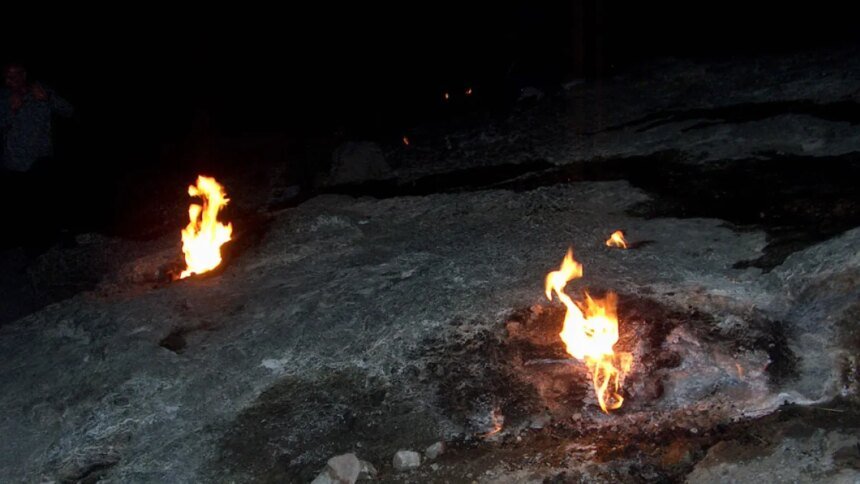
On a mountaintop in southwestern Turkey, flames continuously flare from cracks and fissures spreading across the rocky slopes, across an area of nearly 5,000 square metres, in one of the most astonishing geological phenomena in the world.
This site is known as Mount Kemera or Yanartash, which is a Turkish word that means “burning rock,” and refers to the emission of dozens of small natural fires directly from the foot of the mountain, creating a mysterious and unique scene that increases in magic and excitement after dark.
Unlike most known fires, these fires are not fueled by wood or by human intervention, nor do they require any fuel source on the surface of the Earth, and they have been burning continuously for more than two thousand years.
Since then, this phenomenon has aroused the astonishment of ancient peoples, and inspired many myths and tales that attempted to explain the secret of this eternal flame, while scientists have continued for decades to explore the geological mechanisms that allow these fires to continue burning for this period of time.

The meeting point of geology, archaeology and mythology
The Burning Rocks of Yanartas – the modern name of what is believed to be the ancient mountain of Chimera from Greek mythology – are located within the boundaries of Olympus Beydağları National Park on the Mediterranean coast west of the Turkish state of Antalya, a captivating Mediterranean area where picturesque nature blends with echoes of ancient myths until the past seems closer to reality.
The mountain’s reputation for fire dates back to classical antiquity. Greek and Roman writers described the existence of an eternal flame burning in this region. As for the most accurate documentation from a descriptive standpoint, it was provided by the Roman writer and scientist Pliny the Elder, who indicated in his book “Natural History” that the fire was never extinguished.
Although the ancient Greek writer Palaivatos tried to refute many Greek myths, such as the white winged horses, the bull-headed Minotaur, the Trojan horse, and the vengeful gods, when he dealt with the strange tales associated with the Olympus region in present-day Turkey, he found no way to acknowledge that some of them were actually real.
In his book “On Amazing Things,” Palaivatos described the presence of “a great hole in the ground from which fire comes out,” noting that the mountain is called “Chimera.” After many centuries, this description still applies accurately to the place actually located near the village of Cirali in the state of Antalya on the Mediterranean coast of Turkey, where fires continue to rise from holes in the ground without interruption, as they were in ancient times.
A natural gas geochemist and geochemist, and director of research at the Italian National Institute of Geophysics and Volcanology, Giuseppe Etiope, points out that the connection between the Chimera and ancient myths seems strong, as the Greek poet Homer mentions in his epic “The Iliad” the Chimera as a mythical female fire-breathing creature, combining the characteristics of a goat, a snake, and a lion. This creature terrorized the ancient kingdom of Lycia until it was killed in this location by the famous hero Bellerophon. Riding the winged horse Pegasus. It is likely that this legend was inspired by the natural fires rising from the ground at this site.
Speaking to Al Jazeera Net, he added, “In the modern era, the British travelers Thomas Spratt and Edward Forbes provided a detailed description of the site during their visit in 1842, pointing to constantly burning jets of gas emanating from rock cracks on the sides of a crater-like cavity, 5 or 6 feet deep, and to the local population’s use of them for cooking and preparing coffee.”
In addition to these legends full of wondrous stories, Mount Chimera is a prominent archaeological and cultural site that includes the remains of the ancient city of Olympus.
Near the eternal fires of Yanartash, the ruins of a temple dedicated to Hephaestus, the god of fire and metalworking in Greek mythology, were found, strengthening the connection between the unique natural phenomenon and the mythical and historical heritage of the site.
While these facilities help to understand the mythological and cultural background with which the region has been associated over the centuries, Giuseppe points out that historical accounts contribute to proving that the phenomenon is not recent, but rather has continued over many centuries without interruption, which supports the geological hypothesis that there is a pressurized gas reservoir that constantly feeds these emissions.
From myth to scientific explanation
Local legends have long linked the fires in this exceptional place to the breath of the mythical Chimera monster. Today, scientists have become aware that these fiery tongues feed on unusual types of methane gas that leaks naturally through cracks in the rocks of the Earth’s crust.
Unlike methane gas associated with fossil fuels, which is formed from organic materials over time, part of the methane emitted from deep underground in Chimera is formed as a result of chemical reactions that occur deep in the Earth’s crust.
This type of gas is known as “abiotic methane,” because it does not result from the decomposition of living organisms (plants, algae, or ancient animals) or their remains buried in sedimentary rocks, as is the case with biogenic methane. Instead, this gas arises from interactions between water and types of rocks at depths that may extend to several kilometers below the Earth’s surface.
Giuseppe explains that “the continuation of this phenomenon for long periods of time is likely due to the continuous flow of gas from a pressurized natural reservoir located underground. It was first formed within the source rocks, and then later accumulated in highly permeable reservoir rocks, in a manner similar to what happens in traditional oil and gas systems.”
He adds, “The pressure of this tank is the main factor that explains the continued leakage of gas to the surface. The process can be likened to a gas leak from a compressed cylinder. As long as the tank maintains its pressure, the gas continues to flow, and thus the fire continues to burn.”
Complex configuration mechanisms
A series of studies conducted by researchers within an international project known as the Deep Carbon Observatory indicate that these unusual types of methane are more widespread on Earth than previously thought, and that they are part of a deeper and more widespread carbon cycle in the Earth’s interior.
Over the past decade, researchers have been able to monitor hundreds of gas reservoirs in more than 20 countries, in addition to several deep-sea sites whose characteristics are similar to the Chimera fires.
Giuseppe says, “The Kemera site is not completely unique in the world, as there are similar flammable gas leaks, albeit smaller in size and less known, most notably in the Qizildag ophiolite in eastern Turkey, and at the Tanjung Abi site on the Indonesian island of Sulawesi.”
However, Kimera remains one of the most prominent natural sites on Earth that is susceptible to flammable methane emissions, thanks to the abundance of its emissions and the continuity of combustion over a long period of time, as well as its close connection to the history of the region and its ancient myths.
During years of field work, researchers collected samples of gases emitted at hundreds of different sites, precisely identified the sources of methane, and analyzed them using advanced tools and techniques that enabled them to pinpoint the sources of methane accurately.
Through these studies, they have come up with something like the “basic recipe” for the formation of abiotic methane that feeds these fires: hydrogen extracted from water, inorganic carbon found in minerals or gases, in addition to a metal-rich mineral that acts as a catalyst for the reaction. When these components combine under the right conditions, methane is formed naturally without any biological contribution.
Giuseppe, a member of the scientific team that contributed to uncovering the mechanism of the formation of the Chimera fire in 2014, explains that hydrogen in this site is often generated through a geological process known as serpentinization, which is a chemical reaction that occurs between peridotite rocks rich in olivine and the water seeping into these rocks.
As for methane, he says, it is likely to have formed inside rocks rich in metallic minerals, such as chromite, through the Sabatier catalytic reaction, which combines hydrogen with carbon dioxide under conditions of high pressure and temperature and in the presence of a catalyst that helps produce methane, which rises from the ground to the surface through rock cracks, where it ignites immediately upon contact with oxygen in the air.
Geological implications and open questions
Thanks to modern instruments designed to study the depths of the Earth, scientists are able to distinguish between methane produced by the activity of living organisms and methane generated from purely geological reactions.
The importance of this matter is not limited to understanding deep geological systems and processes, but extends to revealing the secrets of the origin of life on Earth, and studying the possibility of its existence in other places in the solar system, such as the interior of Mars or the oceans lurking under the icy crust of Saturn’s moon Enceladus.
The similarities between the ways in which microorganisms produce methane and abiotic geological methods suggest that early life may have been inspired by or mimicked natural processes that had been occurring within the Earth since time immemorial.
Giuseppe confirms that “abiotic methane is of special scientific importance, because it may be one of the chemical precursors that contributed to the emergence of early life on Earth, and it can also form on other planets such as Mars, which makes it an important focus in planetary science research and the origin of life and the possibility of its existence outside Earth.”
He adds, “The hydrogen associated with this phenomenon is seen today as a potential source of energy with low climate impact, as its combustion does not lead to the release of carbon or carbon dioxide into the atmosphere, which raises questions about the possibility of the presence of natural hydrogen reservoirs in Kimera that can be used in the future as an energy resource.”
In the future, researchers hope to determine the nature of the gas reservoir that feeds the Chimera fires more precisely, including determining its location, size, depth, type of rocks it contains, and the level of pressure prevailing within it, as well as estimating the actual amounts of abiotic methane present in the ground and the mechanisms of its accumulation.
To uncover these aspects, Giuseppe says, “Advanced geophysical studies will be needed that use seismic surveying techniques and gravity and magnetic measurements, which are the same tools used in oil and gas exploration, as they can help determine the location of the gas reservoir feeding the fire, and draw a clearer picture of the deep geological structure responsible for this unique phenomenon.”