Published on 6/27/2026
Since the discovery of the first interstellar object to pass through the solar system in 2017, astronomers have dreamed of one day reading the “chemical identity” of a world that formed around another star. Today it seems that this dream is beginning to come true. An international team of researchers announced that the interstellar comet “Atlas-3” (3I/ATLAS) has an unprecedented chemical composition, clearly different from all comets that originated around our sun, in a discovery that may change our understanding of how planetary systems are formed in our galaxy.

The results of the study were published in The Astrophysical Journal Letters, and it was led by researcher Nathan Roth from the American University, based on data from the ALMA Observatory in the Chilean Atacama Desert.
A chemical fingerprint from a distant star system
“Atlas-3” is the third known interstellar object to enter the solar system after “Oumuamua” in 2017 and “Borisov” in 2019, but the surprise this time was not in its orbit or speed, but in its chemical composition.
Read also
list of 2 itemsend of list
Scientists have detected exceptionally high amounts of methanol gas compared to hydrogen cyanide, levels not recorded in any known solar system comet. Researchers believe that this abundance reflects the physical and chemical conditions in which the comet formed around its parent star billions of years ago.

Nathan Roth said: “Monitoring Atlas-3 is like taking a fingerprint from another solar system. Its chemical composition tells us where and how it was born.”
ALMA Observatory draws a map of gases for the first time
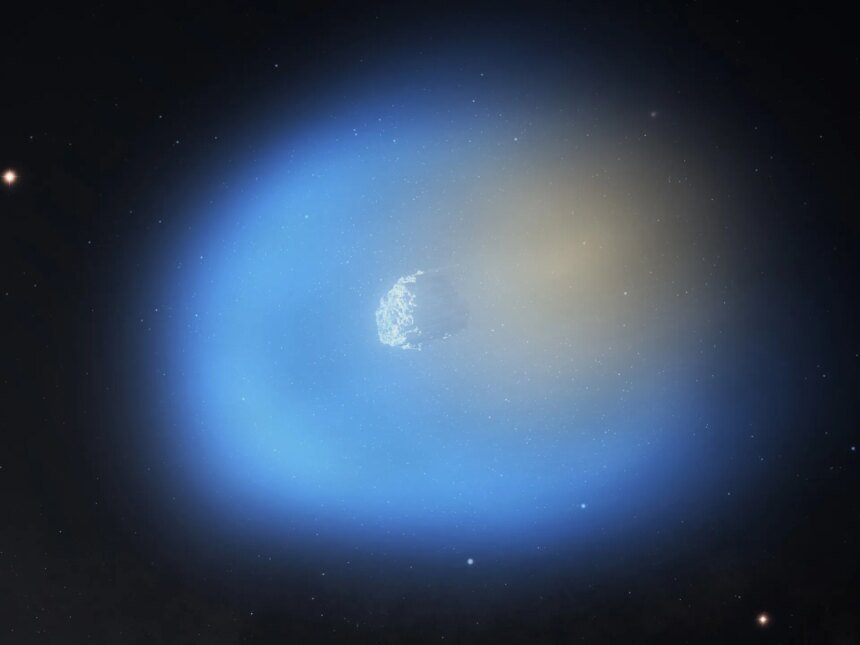
The team used the ALMA Observatory’s integrated antenna array to monitor the comet as it approached the sun, as the sun’s heat began to transform its ice directly into gases that formed a shell surrounding the nucleus known as the corona.
Not only did scientists measure the amount of gases, but they were also able, for the first time in an interstellar body, to determine the locations of their emission. It has been shown that hydrogen cyanide is emitted directly from the comet’s nucleus, while methanol comes from two sources at the same time: the nucleus itself, and ice grains scattered within the corona, which release the gas after being heated by sunlight.
This represents the first spatial depiction of the extended emission process in an object coming from outside the solar system.
Confirmation from the James Webb Telescope
These results are not separate from previous studies, as the James Webb Space Telescope had previously revealed that the comet’s halo is also unusually rich in carbon dioxide compared to solar system comets.

Combined with the new ALMA results, scientists now have two independent pieces of evidence that Atlas-3 was formed in an environment radically different from the environment in which our sun’s comets were born.
The researchers believe that the abundance of methanol may mean that the material from which the comet was formed passed through extremely cold conditions or was inside a protoplanetary disk that differed in chemical composition from the disk from which the solar system arose.
A window into the chemistry of other worlds
Scientists have only three known extrasolar visitors so far, so each one represents an exceptional opportunity to study star systems that are not directly accessible.
While 2I/Borisov looked very similar to our comets, Atlas-3 provides evidence that some stars produce icy worlds with completely different compositions, expanding scientists’ perception of the chemical diversity in the Milky Way.
This comet may not be just a passing icy rock, but rather a frozen message that traveled light years long, telling us that the universe creates its planetary systems in more diverse ways than we ever imagined.
Every interstellar visitor who crosses the vicinity of the sun carries with him a page from the history of another star, reminding us that knowledge does not always come from the journeys we take, but sometimes from travelers who come to us carrying the secrets of the universe within them.