

Published On 7/2/2026
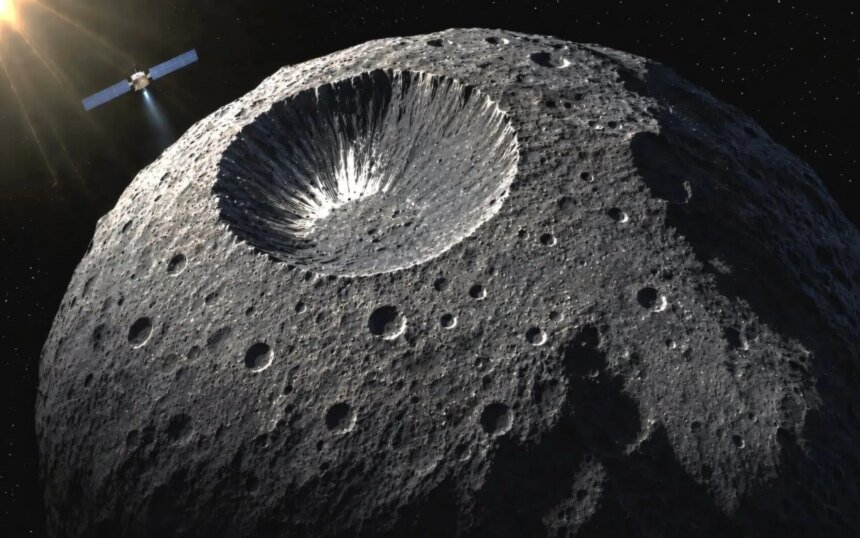
The Institute of Earth Physics in Paris, in cooperation with the US space agency NASA, announced an exciting astronomical discovery regarding the asteroid Vesta, the second largest object in the asteroid belt, which was discovered by the German scientist Heinrich Olbers in 1807.
The chapters of this discovery began when NASA launched the Dawn spacecraft in 2007 for a journey that continued until 2018, arriving at the asteroid in July 2011, during which it orbited this asteroid for about 14 months to collect thousands of images and topographical data.

Today, a new study published in the international journal Astronomy & Astrophysics has redrawn the geological map of Vesta, confirming that its surface, which is full of scars and rock collapses, hides visual evidence that enables scientists to read the age of the surface and the degree to which it is affected by space factors thanks to an advanced statistical model that decodes the light reflected from cosmic dust.
Read also
list of 2 itemsend of list
The brightness code and cosmic physics
The research team at the Institute of Geophysics in Paris focused on two main areas of the asteroid: rockslides within Cornelia crater, and the rock cover created by impacts near the Matronalia Rupes scarp.

These ultra-bright areas appear in images of the asteroid, but visual brightness alone has always been deceptive to scientists. It can be affected by the size of particles or lighting angles. To solve this complexity, the researchers applied a complex physical model known as the Hapke photonic model, and integrated it into a statistical framework that analyzes the probability of light scattering behavior.
The results showed that the brightest regions reflect a very high scattering efficiency that is not related to angular optical illusions, but rather reflects a real and completely new material nature of the asteroid soil that has not been exposed to long space weathering.
Collapses as an indicator of geological youth
A comparison between the Cornelia crater and the Matronalia slope revealed a very consistent pattern; It turns out that modern rock deposits and collapses are always brighter than their ancient surroundings. Researchers at the institute explain this phenomenon by saying that mechanical processes, such as collapses and collisions, peel the outer surface of the asteroid and displace old soil.

This action reveals finer, smaller rock grains that have not yet been bombarded by micrometeorites and scorching solar winds that over time darken the soil and change its optical composition.
The scientific report issued by the institute’s research team stated: “This constant gradient in brightness represents a powerful diagnostic tool that allows us for the first time to separate geometric optical illusions from the true geological novelty of the soil of space bodies.”
The language of light in silent worlds
The importance of this discovery goes beyond the asteroid Vesta to include all space bodies that lack an atmosphere, such as the Moon and other asteroids. In the absence of traditional atmospheric erosion, such as wind and water, as occurs on Earth, the movement of dust and collisions becomes the only driver of geological development.
Hence, relying on the language of light and brightness provides an innovative tool for classifying terrain and arranging it chronologically according to its modernity, even in the absence of the ability to determine absolute age in years. This method provides an indirect means of tracking space soil renewal rates and learning how small bodies respond to continuous cosmic bombardment, transforming it from a mere visual observation into a geological archive that tells the history of silent space changes.

This scientific discovery puts us before an inspiring philosophical truth; Man, who lives on a planet protected by atmosphere and water, was able, with his mind and telescopes extending into the deep void, to translate the silence and emptiness of the universe into readable lines.
The light reflected from the dust of a space rock millions of kilometers away from us is no longer just a fleeting flash, but has become a historical document and a record that narrates the movement of cosmic time.
This research comes to enhance the value of continuous scientific exploration, as the matter does not stop at understanding asteroids only, but extends to deepening the connection of human consciousness with the vast cosmic existence, proving that the research instinct is the true light that illuminates the darkness of the unknown and secures the future of human knowledge in this vast space.