


Published On 1/7/2026
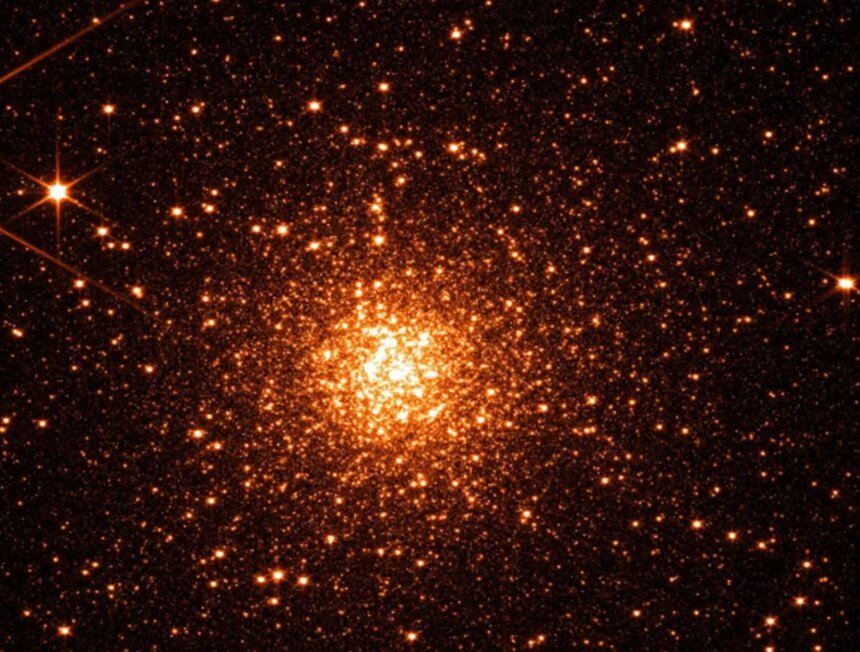
In a remarkable astronomical discovery, an international team of researchers announced that the Terzan 5 globular star cluster system, which was previously classified as an ordinary globular cluster, actually includes four different groups of stars that formed at separate times over more than 10 billion years.
This achievement came thanks to the integration of data from the James Webb Space Telescope with archival observations from the Hubble Space Telescope, which allowed scientists to reconstruct the complex history of this unique object.

The discovery of “Terzan-5” dates back to 1968 by the Turkish-French astronomer of Armenian origin, Agop Terzan, whose name the system later bore. This star cluster is located about 19,000 light-years away in the direction of the Sagittarius constellation, within the central region crowded with stars in the Milky Way Galaxy, and includes hundreds of thousands of stars.
Read also
list of 2 itemsend of list
From an ordinary globular cluster to a historical record of the galaxy
Globular clusters have long been considered ancient star clusters, usually containing a single generation of stars that formed around the same period. But the picture of “Tirzan-5” began to change in 2009 when scientists discovered that it contains two clearly different star clusters.
In 2016, Hubble provided the first estimate of the ages of these two groups, as it was found that one of them formed about 12 billion years ago during the early stages of the formation of the Milky Way Galaxy, while the other arose only about 5 billion years ago.

This large discrepancy in ages raised questions about the nature of this system, and whether it is actually a globular cluster or the remains of a more complex star system. With the arrival of James Webb’s advanced capabilities, it became possible to study faint stars hidden behind dense dust clouds that obscure the view towards the center of the galaxy.
“Webb’s new infrared observations, combined with Hubble data, have given us a much clearer picture of the history of Terzan-5,” said researcher Giorgia Zullo from the University of Bologna.
James Webb reveals two additional generations of stars
Scientists took advantage of James Webb’s ability to penetrate cosmic dust and observe large numbers of stars that were not previously visible. By analyzing the colors and brightness of the stars, the team was able to classify them according to their age and chemical composition.
To distinguish the stars of Terzan-5 from other stars in the background, researchers used Hubble observations spanning 12 years to measure the precise movements of the stars and accurately identify the stars belonging to the system.

The results showed the existence of two new star clusters that were not previously known, one of them formed 3.8 billion years ago, and the other only 2.5 billion years ago. The study also improved previous age estimates, showing that the oldest stars formed 12.5 billion years ago, while the second generation arose 4.7 billion years ago.
This discovery means that Terzan-5 witnessed four independent waves of star formation, which is almost unprecedented for an object that was thought to be a globular cluster.
The remains of a giant system that survived the merger
Some previous studies had suggested that Terzan-5 might have collided with another star cluster or a huge cloud of gas, providing new material for the formation of a second generation of stars. But the presence of 4 different generations makes these hypotheses less likely.
Measurements of the chemical composition of stars, made using the Keck Observatory in Hawaii and the European Giant Telescope in Chile, also showed that each star group carries its own chemical signature.
“This system preserves a fossil record of the process of gradual enrichment with heavy elements produced by supernovae,” said astronomer Michael Rich of the University of California, Los Angeles.
Scientists believe that the original predecessor of “Terzan-5” was much more massive than it is today, which enabled it to retain gas and heavy elements ejected by stellar explosions, to be used later in the formation of new generations of stars over billions of years.
As for Francesco Ferraro from the University of Bologna, he said: “For some reason, this star cluster formed separately from the bulge of the galaxy and was not destroyed during its formation.” He added, “Terzan-5” represents what is today called a “fossil fragment of the galactic bulge,” that is, a rare remnant of the first building blocks that contributed to building the core of the Milky Way.
Science reads the memory of the universe
The importance of this discovery lies not only in finding new groups of stars, but in revealing a preserved page in the history of our galaxy dating back almost to the beginnings of the universe. Each stellar generation in Terzan 5 represents a different chapter in the story of the formation of elements, stars and galaxies.
With each more sophisticated observational instrument, man comes one step closer to understanding his cosmic origins. Rare objects like Terzan 5 remind us that the sky is not just a beautiful scene above our heads, but rather an enormous archive that preserves the memories of billions of years, waiting for someone to read its pages and reveal its secrets.