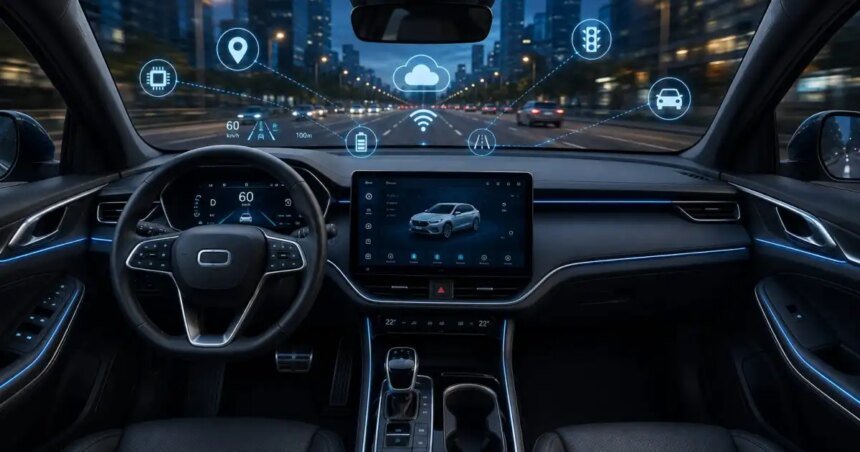
Beware…the dangers may not be on the road as you think, nor under the hood of your car. Rather, they may sneak up on you silently without you realizing it through an “electronic vulnerability.” The threats facing modern cars are no longer limited to traditional theft or mechanical malfunctions, but rather extend to a more complex digital world in light of the rapid technological development in this industry.
A single push of a button from behind a computer screen thousands of kilometers away may be enough to give hackers the ability to carry out electronic attacks on your car, which portends the emergence of threats that were not present in the world of cars a few years ago.
Although smart technologies and Internet communication systems have opened wide horizons for comfort and innovation, in return, they have created major security challenges, as electronic attacks have become capable of targeting the personal data of drivers, as well as the operational systems inside cars.
As car manufacturers race to provide more smart features and digital communication services, cybersecurity experts raise an important question about the extent to which protection measures keep pace with this continuous technological development.
With modern cars turning into mobile computers connected to the Internet, cybersecurity has become an essential element of the safety system. Today’s vehicles include dozens of electronic control units, and despite the convenience and efficiency that these technologies provide, they also open new doors for hacking attempts.
Here a worrying question arises: Could the car you rely on daily turn into a security weakness on the road? Certainly, cybersecurity has become as important a factor as brakes, seat belts, airbags and other safety systems that protect drivers and passengers.

When intelligent systems become a weakness
Internet-connected cars have become an increasing target for cyber attacks, due to their reliance on software and wireless communications. The following are the most prominent types of these attacks:
- Attacks via wireless networks: Wi-Fi and Bluetooth systems are among the most prominent vulnerabilities in Internet-connected cars, as they can be exploited to gain unauthorized access to vehicle systems or intercept data during transmission, especially if they are not protected by strong encryption or up-to-date security settings.
- Attacks via entertainment and information systems: The digital control panel is considered one of the most common penetration points in modern cars, due to its direct connection to the Internet. If a security vulnerability exists, an attacker may exploit it to access user data or other internal networks in the vehicle.
- Attacks via software updates: Modern cars rely on over-the-air software updates, but this feature can be exploited if not adequately secured. Attackers can manipulate the update process and send malicious software files into the system.
- Attacks by jamming navigation systems: GPS is an essential component of modern cars, but it can be vulnerable to spoofing and tampering attacks by sending false signals that affect the accuracy of the system, thus changing the location or directions displayed. This may cause the driver to be misled or directed to incorrect routes, which threatens driving safety.
- Attacks over the core internal network: Modern cars rely on an internal communication network (CAN Bus) to connect various electronic units, and if this network is compromised, important functions such as the engine, brakes, and steering can be affected.
- Denial of service attacks: It is one of the types of cyber attacks that aim to confuse the car’s systems or disable some of its parts by flooding its electronic systems or external networks with a large amount of fake data, which may completely paralyze the car and prevent it from performing its vital functions.
- Attacks via smartphone applications: Smartphone apps are one of the biggest cybersecurity vulnerabilities in the automotive world. Once the phone is linked to the vehicle, the application can access a number of functions and sensitive data.
If the phone is hacked or a vulnerability in the application is exploited, the attacker may be able to access car information or control some available services remotely.

Techniques to protect cars from hacking
As cyber attack methods evolve, auto companies are racing to develop smarter defensive technologies to protect connected vehicles.
Among the most prominent of these technologies are custom security modules, which are smart chips integrated into the car’s electronic control units, acting as a “fortified digital vault” that keeps encryption keys and sensitive data out of the reach of hackers and any potential hack, even if they are able to access other parts of the system.
Modern cars also rely on intrusion detection and prevention systems, which are advanced software that monitors data movement within the car’s network around the clock, and analyzes messages exchanged between its various systems to detect any abnormal activity, to intervene immediately by blocking suspicious messages and issuing security alerts.
Protection does not stop at the borders of the vehicle itself, as vehicle security operations centers play a pivotal role in confronting cyber threats. These cloud centers monitor data received from millions of connected cars around the world in real time, allowing mass cyberattacks to be detected early and dealt with before their impact expands.
Thanks to these technologies and multiple layers of protection, the modern car turns into a digital system capable of defending itself in the face of increasing cyber threats.

Cybersecurity challenges
The rapid technical and technological development in the world of cars has imposed unprecedented security challenges. The most prominent of these challenges are:
- Increased reliance on permanent Internet connection in cars.
- Secure software updates and deliver them to the car securely.
- Difficulty discovering security vulnerabilities and remediating them quickly.
- The complexity of the interconnected systems inside the car, and the difficulty of securing them.
- Poor security awareness among some users.
- Increasing reliance on smart driving systems, which may be vulnerable to cyber attacks.
Enhancing cyber security
With modern cars turning into digital platforms connected to the Internet, their protection is no longer limited to traditional security systems, but rather they need an electronic shield to protect them from increasing cyber threats.
Hence, the responsibility of car companies is increasing in enhancing levels of protection by encrypting communications and data, launching continuous security updates, isolating vital systems responsible for driving and safety from entertainment and communication systems, in addition to conducting advanced penetration tests to monitor potential vulnerabilities and address them before they are exploited.
On the other hand, the consumer plays an equally important role in maintaining the security of his digital car, by installing official updates as soon as they are available, using strong passwords for accounts linked to the car, activating multi-factor authentication, avoiding linking the car to untrusted devices or applications, as well as paying attention to any unusual behavior or activity that may indicate the presence of a security problem.
In the era of smart cars, cybersecurity has become a shared responsibility, requiring continuous cooperation between manufacturers and consumers to ensure a safer and more confident driving experience.
Have there been cyber attacks on cars before?
Indeed, cyber attacks have occurred on cars over the past years, most of which were within the framework of security research with the aim of discovering vulnerabilities and improving protection.
One of the most prominent cases of hacking carried out by “ethical hackers” – cybersecurity experts authorized to test digital systems to discover security vulnerabilities before exploiting them – was the famous Jeep Cherokee incident in 2015, when two researchers succeeded in hacking the car remotely, to the point that they controlled the engine to stop and completely disable the brakes, which prompted the manufacturer to recall more than a million cars, becoming one of the first major recalls due to a cyber vulnerability.
Between 2016 and 2017, the American company Tesla was subjected to a remote hacking of its Model S car, as researchers were able to execute several commands in the car, including opening the roof and controlling the screens and doors. The company immediately made software updates to address the vulnerabilities, which contributed to strengthening the system’s protection and preventing the reoccurrence of the attack.
Modern cars are not completely immune
The goal is no longer just to prevent cyberattacks on cars, but rather the trend is to predict them before they happen and deal with them proactively. With the increasing dependence of vehicles on constant connection to the Internet, the concept of car protection is evolving to reach more advanced and intelligent levels.
Automotive companies are currently working on developing the concept of a “cyber-self-defense vehicle,” whereby the role of security systems is not limited to repelling attacks, but rather they are integrated with artificial intelligence to enable the car to detect electronic threats early and deal with them automatically before they reach the car’s vital systems.
In light of the ongoing race between the development of electronic attack methods and the strengthening of defense and protection methods, there is certainly a need for revolutionary updates in the face of these cyber threats, which prompts companies to apply the principle of “design-based security”, that is, integrating protection systems from the design stage of the car and not after its production.
Cooperation between automobile companies and cybersecurity authorities will also play a greater role in establishing global surveillance networks to monitor attacks and exchange information in order to overcome these problems.
In the near future, car protection will become part of an integrated digital system, where software, artificial intelligence, and physical devices integrate to provide a level of safety capable of keeping pace with the rapid development in the world of smart driving.