Published on 6/30/2026
|
Last update: 22:07 (Mecca time)
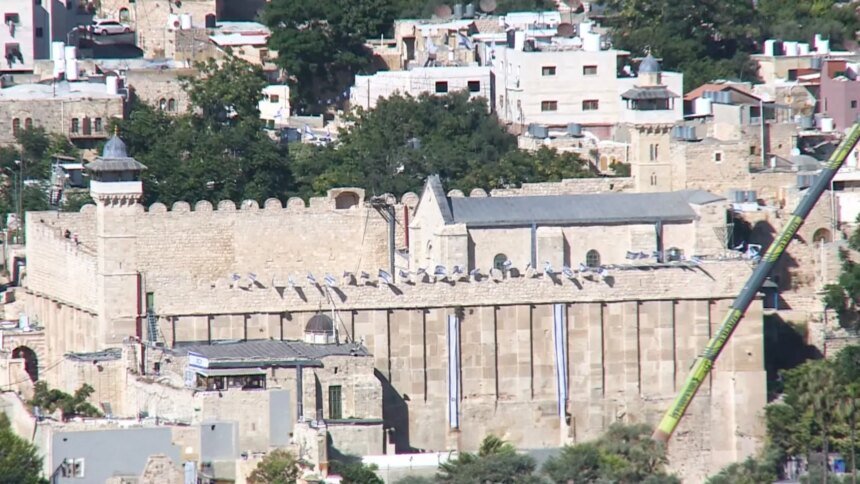
The Ibrahimi Mosque in the Palestinian city of Hebron faces a new chapter of architectural changes and modification of its historical features. These measures are accompanied by the introduction of iron mechanisms and cranes into the courtyards of the mosque, in conjunction with the prohibition of the call to prayer, which places the religious and historical landmark before a new field reality.
According to a field report by Muhammad al-Atrash, the occupation authorities began building an iron roof over the open area of the mosque known as the “Sahn al-Haram.”
This step raises concerns between the Hebron Municipality and the Palestinian Endowments regarding the occupation’s efforts to strip Palestinian bodies of their powers and cancel their role in managing and maintaining the Mosque in favor of expanding the settlement outposts surrounding it.
The mayor of Hebron, Yousef Al-Jaabari, confirmed that what the municipality had previously warned about withdrawing powers is now being implemented on the ground by the occupation, by roofing the courtyard to obliterate the Islamic architectural features of the Haram, and attacking the powers of the Palestinian Endowments and the municipality for the purpose of increasing settlement outposts.
Tawfiq Jahshan, head of the Legal Department of the Hebron Reconstruction Committee, warned of the construction impact of the roofing project for the open courtyard of the Haram. Jahshan explained that the courtyard constitutes a natural ventilation area for the old building, and that closing it will lead to the accumulation of moisture inside the walls and the erosion of the stones, which may result in cracks that threaten parts of the mosque.
Gradual path… strangulation plan
The current architectural change step did not come as a surprise. Rather, it was the last stop in a gradual process over months under the auspices of Israeli Finance Minister Bezalel Smotrich.
This path began last January, when the Supreme Planning Council of the Civil Administration of the Israeli Army approved the withdrawal of planning powers related to the mosque from the Hebron Municipality, to facilitate the issuance of a building permit for the roofing project of the mosque’s courtyard, after the municipality rejected repeated Israeli requests to implement it.
This was followed last February by the Mini-Ministerial Council for Political and Security Affairs (the Cabinet) approving decisions that included abolishing the Jordanian law prohibiting the sale of Palestinian lands in the West Bank, and transferring the powers of building licensing in Hebron from the municipality to the Israeli Civil Administration.
In mid-June, Smotrich announced the completion of procedures for canceling the provisions of civil planning and construction, and transferring full responsibility to the Israeli side in line with the plan to implement field sovereignty. On June 23, mechanisms began removing the historical canopy in the courtyard in preparation for the artistic roofing.
Hebron Protocol 1997
The current path represents a change in the legal and political framework that was approved on January 17, 1997, under the Hebron Protocol signed between the PLO and Israel within the Oslo arrangements.
The agreement at that time stipulated that the city be divided into two regions: “H1”, which is under Palestinian control, and “H2”, which is under Israeli security control, which includes the Old City, the Tomb of the Patriarchs, and settlement areas.
Despite the security control over the H2 area, the protocol explicitly stipulated that civil powers remained in the hands of the Palestinian Municipality of Hebron, including the files of construction, planning, infrastructure, water, electricity, and public services.
The current Israeli decision specifically aims to cancel this clause, as it approved the construction of the “Shafi Hafron” religious school with an area of about 1,000 square meters near the “Beit Romano” settlement without Palestinian approval, which Palestinian officials see as a step to reduce the role of national institutions and change the status quo in the Ibrahimi Mosque, which has been listed on the UNESCO World Heritage List in Danger since 2017.
The roots of the crisis
This architectural measure is linked to the roots of the plan that began after the events at the Ibrahimi Mosque in February 1994, when gunfire by a settler inside the mosque resulted in the killing of 29 worshipers and the injury of dozens.
Subsequently, the occupation authorities formed the Israeli Shamgar Committee, which decided to divide the Temple Mount temporally and spatially, while encircling the Old City with more than 120 military checkpoints and checkpoints.
In July 2025, the Israeli authorities transferred planning and administrative powers over the Ibrahimi Mosque from the Hebron Municipality to the Religious Council of the Kiryat Arba settlement. This decision allowed the implementation of current architectural changes and the construction of buildings without the approval of the Hebron Municipality, leading to the beginning of roofing the courtyard with iron.
Observers point out that tightening the measures on the military checkpoints and electronic gates surrounding the mosque aims to restrict the access of worshipers and isolate them, to impose Israeli control over the Holy Mosque for the benefit of the settlement project in the heart of the city of Hebron.