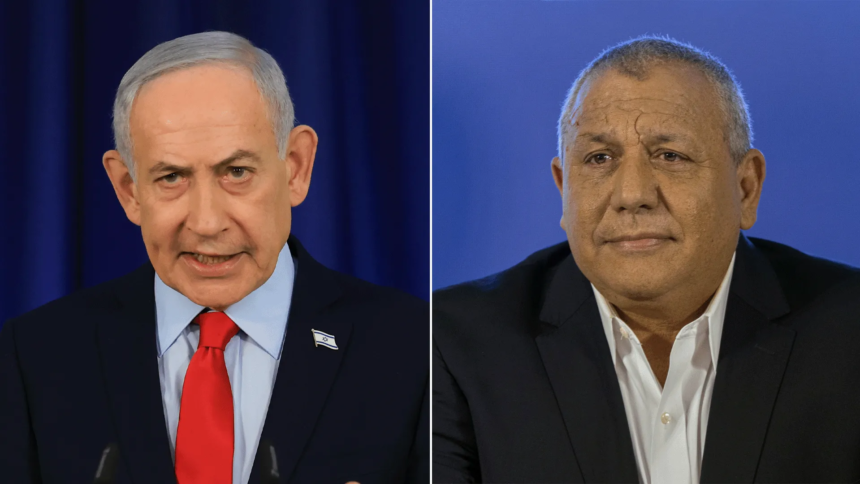
At a time when Israel is heading towards elections that appear to be the most complex in years, former Chief of Staff Gadi Eisenkot is emerging as the most prominent change in the political scene, after he succeeded, within a few weeks, in moving into a direct competitor to Prime Minister Benjamin Netanyahu.
The importance of Eisenkot’s rise lies not only in his lead in some opinion polls, but also in his ability to redraw the balance of power within the centrist camp and the opposition, and to impose himself as a candidate with security and political capital that makes him able to attract segments of voters who have moved away from Netanyahu, without moving to the Israeli left.
The latest polls show that Eisenkot is ahead of Netanyahu for the first time as the most suitable person to head the government, and his Yashar party continues to strengthen its political presence in the Knesset, which reflects the shift of a portion of voters searching for a security and political alternative that combines military experience and less polarizing rhetoric.
End of the October government
The head of the Yashar Party launched his election campaign on Tuesday evening, according to what was reported by the Israeli Broadcasting Corporation, thus announcing his official entry into the political race.
Eisenkot said in his speech that the “October government” will end its work next October, opening a new phase in Israel’s history, adding that “Israel deserves a new chapter, and we will write it together.”
According to Eisenkot, who served as chief of staff between 2015 and 2019, the government he will lead will be characterized by the ability to make “courageous decisions” on the fundamental issues facing Israel, most notably security, the duty of military service, and formal education for all.
He also announced his commitment to forming an official investigation committee into the events of October 7, 2023, with the aim of drawing lessons and enhancing preparation for the future, considering this an essential step that represents for him a “primary duty.”

Appearing as an alternative
It seems that Eisenkot is trying to present himself as a responsible alternative that combines security experience and the ability to manage the state away from sharp partisan divisions, taking advantage of the state of erosion that has afflicted the image of the current government.
In this regard, Eisenkot invited Netanyahu to a public debate, in response to a campaign launched by the Likud Party against him under the title “Enough incitement.”
The call came after Likud published a video clip attacking Eisenkot, claiming that he would not be able to form a government without the support of the Arab parties, based on previous statements by a number of Arab representatives. Netanyahu also re-published the video through his account on the X platform.
In his response, Eisenkot accused Netanyahu of incitement and evading direct confrontation, saying that it was time to stop publishing video clips and engage in a public debate in front of the public. He added, “Determine the time and place, and come to answer the citizens’ questions.”
Eisenkot also benefits from his image as a former military commander who is not associated with traditional party conflicts, which makes him more able to attract votes from the center camp, in addition to a portion of moderate right-wing voters who have lost confidence in Netanyahu’s management of the war, but do not wish to vote for left-wing parties.
This rise gives the center camp an opportunity to strengthen its electoral presence, but at the same time it places it before a difficult test regarding the leadership of this camp.
This transformation comes at a time when the Israeli political arena is witnessing an unprecedented state of restructuring, with declining confidence in the current government and continuing controversy over the management of the war and its results, in addition to escalating talk of early elections if the legislative process for dissolving the Knesset is completed.
Until recently, former Prime Minister Naftali Bennett was seen as the person most capable of competing with Netanyahu, but Eisenkot’s rapid progress imposes a new equation that may redistribute the balance of power within the opposition.
Recent opinion polls indicate that Eisenkot has become one of the most prominent beneficiaries of these changes, as the representation of his “Yachar” party increased to about 19 seats, an increase of two seats in one week, and 7 seats since the announcement of the Bennett-Lapid alliance, while a poll conducted by the Israeli “Channel 12” showed that he was ahead of Netanyahu in the suitability index for prime minister by 38% compared to 35%.
On the other hand, Eisenkot’s progress in the opinion polls does not mean that the way is open for him to reach the presidency of the government, as the main obstacle remains the division of the opposition over the identity of its leader.
Internal competition
Along with Eisenkot, Naftali Bennett clings to his right to lead the anti-Netanyahu camp, while Avigdor Lieberman seeks to maintain his position as a major player, which makes the internal competition more complex than confronting the ruling coalition itself.
Amir Makhoul, a researcher at the Taqaddam Center for Policy, confirms that the real crisis within the opposition is not related to its ability to achieve good results in the elections, but rather to its inability so far to agree on a single leader to lead it. He explained in his interview with Al Jazeera Net that the conflict between Bennett, Eisenkot, and Lieberman may delay the formation of a unified front despite the presence of indicators that give it a realistic opportunity to remove Netanyahu from power.
As for Netanyahu, observers believe that Eisenkot’s candidacy adds a new challenge to the series of pressures he faces, because his competitor comes from the military establishment and enjoys security credibility that is difficult to attack using traditional methods, and his criticisms of the management of the war carry more weight in Israeli public opinion than the criticisms of opposition politicians.
At the level of the ruling coalition, Makhoul pointed out that Netanyahu is facing a gradual erosion of his traditional electoral base, especially after the recent regional developments. The ceasefire that came under American pressure in Lebanon and Iran, according to his reading, weakened the narrative of victory that Netanyahu sought to consolidate, and also revealed the limits of the government’s ability to make independent decisions away from American influence.