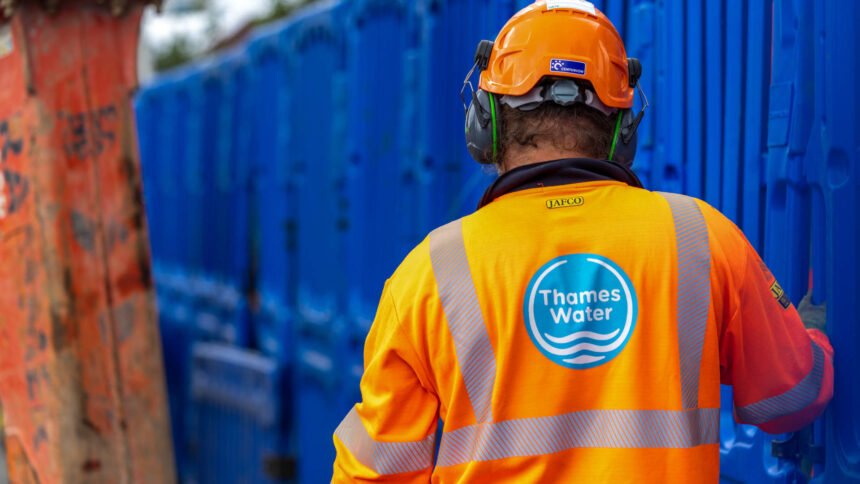
A worker at a Thames Water repair site in London, U.K.
Bloomberg | Bloomberg | Getty Images
This report is from this week’s CNBC’s UK Exchange newsletter. Like what you see? You can subscribe here.
The dispatch
Should Andy Burnham become Britain’s next prime minister, as seems likely, he could quickly find himself in a showdown with some of the world’s biggest — and most feared — investors.
They include Elliott Management and Apollo Global Management, as well as BlackRock, Silver Point Capital and Invesco.
All are creditors of Thames Water which, serving 16 million households and businesses across London and the south east of England, is Britain’s largest water and wastewater utility. It has debts approaching £20 billion ($26.5 billion) and is expected, on its current trajectory, to run out of money this October.
To that end, its main group of creditors — a consortium called London & Valley Water (L&VW) — has been negotiating since June last year with Ofwat, the water industry regulator.
The consortium’s latest proposal, tabled in March this year, would see £9.4 billion of Thames’ debt written down. L&VW would also inject some £3.35 billion worth of equity into the business and, at the same time, provide a new debt facility, worth some £3.25 billion initially, that could ultimately rise to £6.55 billion.
As part of the deal, L&VW has promised that Thames’ largest shareholders would not sell a significant proportion of their equity during the current regulatory period, which runs from 2025 to 2030. It has also promised that Thames would not pay a dividend until April 2035 — or until the company is returned to public markets — so all of its cash could be reinvested.
Part of the proposals would see Ofwat showing greater leniency towards Thames, whose performance has incurred the regulator’s wrath on numerous occasions.
A return to public ownership?
But last month, Emma Reynolds, the environment secretary, wrote to Ofwat expressing concerns over the rescue package. She said she was “not convinced the current proposal is good enough for consumers or the environment.”
That raises the possibility that Thames, which along with nine other regional water authorities in England and Wales was privatized in 1989, could be taken into temporary public ownership via a so-called Special Administration Regime (SAR).
The Treasury is thought to be uneasy about this. With the government already running a deficit equivalent to 4% of U.K. GDP and the national debt currently at around 95% of GDP, the last thing it would want is Thames’ debts sliding onto the national balance sheet and for taxpayers to have to stump up the £19.8 billion Thames is due to invest in its infrastructure during the current regulatory period.
The Treasury is also thought to be worried about the chilling effect putting Thames into an SAR might have on overseas investment in U.K. infrastructure.
Enter Burnham, who wants “greater public control” over energy and water companies.
He told The Guardian last month: “Public ownership is absolutely an option. I would say for Thames Water, that is what should be done.”
On that basis, although Reynolds has given the creditors space to improve their terms, it is hard to see any private sector solution getting past a Burnham government.
Except that, crucially, there is a difference between the SAR and the kind of nationalization Burnham appears to favor.
Under the former, the priority is to continue providing water and wastewater services while minimizing creditor losses and restructuring the company so a new owner can be found. That could include L&VW under the current set-up.
Should Burnham opt for full-blown nationalization instead, it would probably require an act of parliament, while potentially setting him on a collision course with Thames’ creditors.
It will be an interesting early test of his determination to see greater public control of water and energy — and, given the litigious reputation of some of Thames’ creditors, a high-risk one.
— Ian King
Need to know
Watch: U.K. faces big decision on the future of North Sea oil
Britain’s energy debate is back in focus following Keir Starmer’s resignation, with his successor facing a major decision over the future of North Sea oil and gas.
Watch CNBC’s full interview with Scotland’s first minister, John Swinney
CNBC’s Ritika Gupta speaks to John Swinney, Scotland’s first minister, about the U.K.’s change of prime minister, further devolution of powers under a potential Andy Burnham premiership, and the Scottish government’s inaugural bond issuance, known as ‘kilts.’
Red-alert heatwaves are becoming Europe’s new normal. Investors are paying attention
Amid warnings that climate change means scorching temperatures are set to become the norm, some investors are rethinking how to prepare their portfolios for the societal changes anticipated alongside a future of sweltering summers.
— Katrina Bishop
Coming Up
JULY 1: Nationwide House Price Index (June)
JULY 7: Bank of England Financial Policy Committee meeting minutes