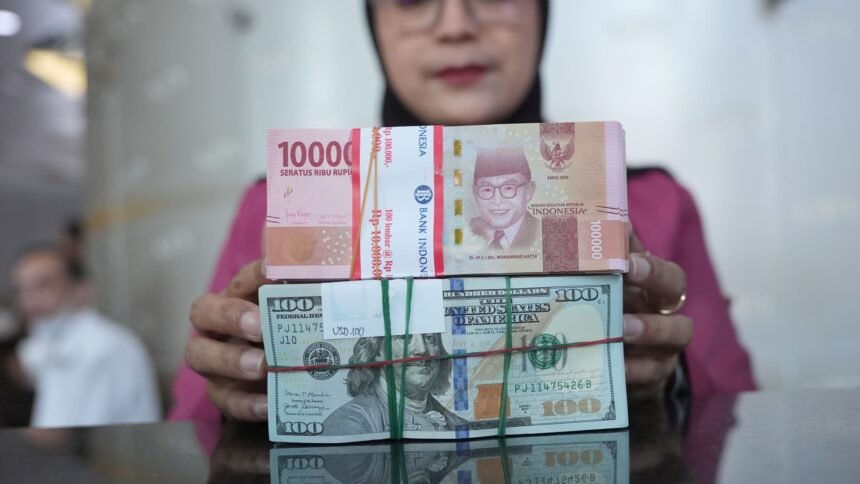
A bundle of Indonesian rupiah and US dollar banknotes arranged at a currency exchange office in Jakarta, Indonesia, on Monday, June 8, 2026. Indonesia’s finance and central bank officials said over the weekend they will boost efforts to stabilize the currency and attract inflows after the nation’s stocks tumbled at the fastest pace worldwide last week. Photographer: Dimas Ardian/Bloomberg via Getty Images
Bloomberg | Bloomberg | Getty Images
Investors will be increasingly wary of Indonesia following a high profile corruption conviction and a warning by index provider MSCI of a potential downgrade of the country’s markets, experts warn.
There’s already evidence: the Jakarta Composite has also lost 7.9% in the last one month and almost 35% year to date.
Concern about President Prabowo Subianto’s fiscal policies, index provider MSCI’s concerns about stock-market governance and now a high-profile corruption case where a former minister was handed a hefty fine and a 10-year prison sentence, are weighing on the country’s assets.
“The Prabowo administration’s populist policies have raised concerns with credit ratings agencies and are viewed unfavorably by offshore investors,” Jayden Vantarakis, head of Asean equity research at Macquarie Capital, wrote in a July 1 note.
A Bank of America survey published in mid-June showed that Indonesia has fallen to fund managers’ least-preferred market in Asia, overtaking India.
Ratings company S&P Global in February warned that rising fiscal pressures, particularly higher debt-servicing costs, had increased downside risks for Indonesia’s sovereign credit profile. Foreign investors have reacted, net selling $4.11 billion of Indonesian stocks in 2026.
Bhima Adhinegara, executive director at the Center of Economic and Law Studies in Indonesia, said on CNBC’s “Squawk Box Asia” that one example of a problematic policy is the so called “single gate” export system launched in May, where exports of palm oil, coal, and ferroalloys are funneled through a designated state-owned enterprise, PT Danantara Sumberdaya Indonesia.
While Jakarta says that this is to reduce revenue leakage and enhance transparency, Adhinegara said that this gives investors the impression that the Indonesian government wants “to take over many of the natural resources and make new layers of bureaucracy very difficult.”
Furthermore, former education minister Nadiem Makarim was sentenced to 10 years in prison after an Indonesian court found finding him guilty in a corruption case involving the country’s education digitalization program.
Makarim, who is also co-founder of ride-hailing and payments giant Gojek, was fined 1 billion Indonesian rupiah ($55,870) — and ordered to pay 809.6 billion rupiah in restitution.
Prosecutors allege that he and other officials steered technical specifications toward Google products, getting the education ministry to procure Chromebooks at inflated prices despite trial results indicating that the laptops were unsuitable for use in remote regions.
The signal to the business community “is very clear. You need to be very, very careful when you’re dealing with the government’s budget, when you’re dealing with the government procurement,” Adhinegara said.
This is making investors in the startup scene think twice if they want to be involved with companies that are close to the government, he added.
The case also comes after index provider MSCI last week extended Indonesia’s market review till November. It warned months ago that the country could be downgraded to “frontier market” status from its current “emerging market” classification. MSCI raised concerns about market accessibility earlier this year and froze the country’s stocks from its indexes in January, citing investibility concerns.
Adhinegara said that it was a “challenging situation,” but pointed out Jakarta is still hesitant to open up information to the market to to make it more transparent.
“If we miss this opportunity to reform the stock market, Indonesia perhaps can be on the consultative or watchlist,” he said, and “the next step after November will be [a] downgrade [to] the frontier market.”